
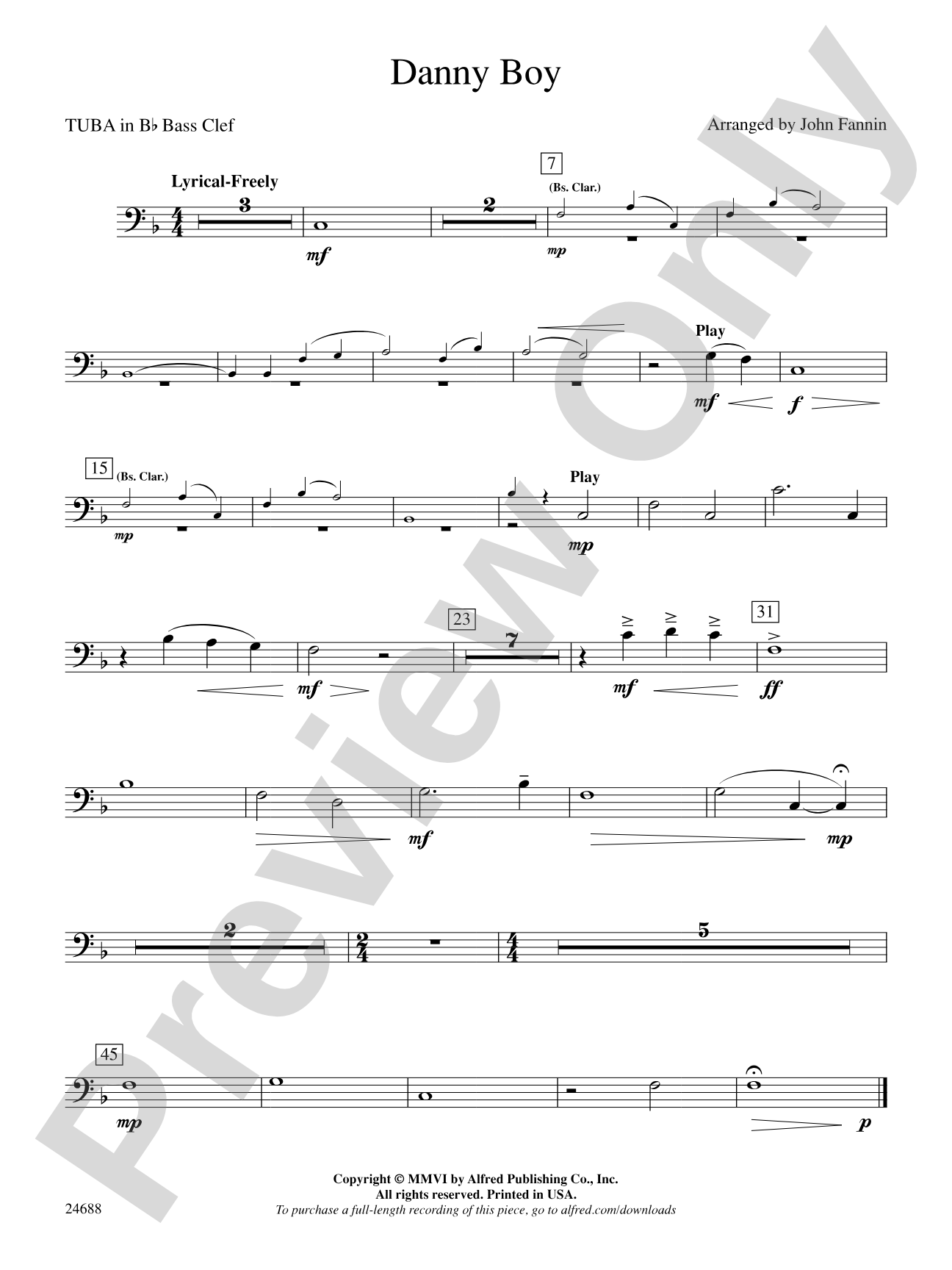

Danny Boy: (wp) B-flat Tuba B.C.
Euphonium, Trombone or Trumpet Solo
By John Fannin
Grade: 2 (Medium Easy)
Item: 00-PC-0000852_wpTBBBC
$3.00
Pickup currently not available
Description
This arrangement of Danny Boy can be played with little rehearsal, regardless of the experience level of the ensemble. Soloists are encouraged to alter the solo part to meet their artistic skill level. Conductors and soloists should take many liberties and add rubato and tenuto throughout the arrangement. This arrangement is scored to accommodate a Euphonium, Trombone or Trumpet player as the soloist.


Don't just read it, hear it, play along with it, and watch your students grow with it. In MakeMusic Cloud, Danny Boy: (wp) B-flat Tuba B.C. comes alive with professional accompaniment, adjustable tempo, and built-in practice tools that turn solo practice into real progress.
Open in the Player
Jump straight in and assign it today.
Start Your Free Trial
Open this title and explore the full library in minutes.
Sample Audio
1
Audio File
--:--
0:00
0:00
Sample Video
No sample videos found.
Additional Details
Series:
Young Symphonic
Publisher:
Alfred Music
Page Count:
140
SKU:
00-PC-0000852_wpTBBBC
More about this title
About the Composer: John Fannin

John Fannin built his career as both a band director and educational leader across multiple states, holding positions at high schools in New Mexico and Arizona before joining Murray State University in 1995. During his tenure at Murray State, he transformed the Racer Marching Band into a nationally competitive ensemble that grew from 85 to 300 members and earned invitations to the Bands of America Grand National Championships in 2006 and 2012. Following his retirement in 2020, Fannin continues to contribute to the field through guest conducting, clinician work, and his own publishing company, Fannin Musical Productions LLC.
His contributions to band music have earned recognition including the 2017 Max Carman Outstanding Teacher Award, the 2010 Murray State University Distinguished Professor honor, and the 2009 KMEA University Teacher of the Year distinction. As a clinician and guest conductor, he has worked with ensembles across the United States and internationally in Brazil, England, and Bangladesh. Fannin's published arrangements with Alfred Music Publishing and other houses reflect his commitment to creating accessible yet musically satisfying concert band literature.
Why we love this
Fannin's arrangement respects the timeless melody while eliminating rehearsal barriers. The flexible solo part invites players to shape the line according to their own musicality, and the Grade 2 scoring ensures your ensemble can deliver a polished, emotional performance without excessive preparation time. This is the kind of piece that reminds students why they play music.
What to expect
This arrangement honors the nostalgic warmth and folk-ballad sincerity of the traditional melody while offering enough musical flexibility to feel fresh in performance. The interplay between soloist and ensemble creates intimate moments of accompaniment that build to fuller, richer textures without ever becoming heavy or overly orchestral. There's room for genuine artistry and personal expression throughout.
Who it's for
Conductors working with intermediate ensembles who want a concert solos with ensemble arrangement that doesn't demand weeks of rehearsal. The Grade 2 level suits middle school and lower division high school bands, but the tunefulness and emotional depth appeal equally to advanced youth ensembles and college groups seeking a shorter, accessible addition to a program. Euphonium, trombone, or trumpet players of varying experience levels can all succeed in the solo role.
How to get the most out of it
- Encourage your soloist to experiment with phrasing and rubato well before the concert. Since the arrangement explicitly invites artistic liberty, rehearsals should include dedicated time for the soloist to try different interpretations without worrying about ensemble precision.
- Shape the ensemble accompaniment with intentional dynamic support around the solo line. Even though the soloist leads, the band should breathe with and respond to their phrasing choices, creating a dialogue rather than a solo-plus-background texture.
- Mark tenuto placements in your conducting score and communicate these to the ensemble in sectionals. Fannin's written markings guide the expressive intent, and consistency from all sections will unify the arrangement's emotional arc.
- If your soloist is new to taking liberties, model a few interpretive ideas during rehearsal and ask them to build on those. Some younger players benefit from hearing two or three recorded examples before they feel confident making their own choices.
How to use it
Program this as a concert feature that fits naturally between more structured ensemble pieces, especially in contexts celebrating American or world music traditions. Its brief rehearsal demand makes it ideal for addition to a program late in the season or as a featured moment in a spring pops concert where lighter preparation schedules allow directors to focus rehearsal time on more complex works.
Skills your students will build
- Ensemble balance and accompaniment texture around a featured soloist
- Rubato and expressive phrasing in unison sections
- Tenuto articulation and its effect on musical character
- Responding dynamically to a soloist's interpretive choices
- Solo confidence and artistic decision-making for the featured player