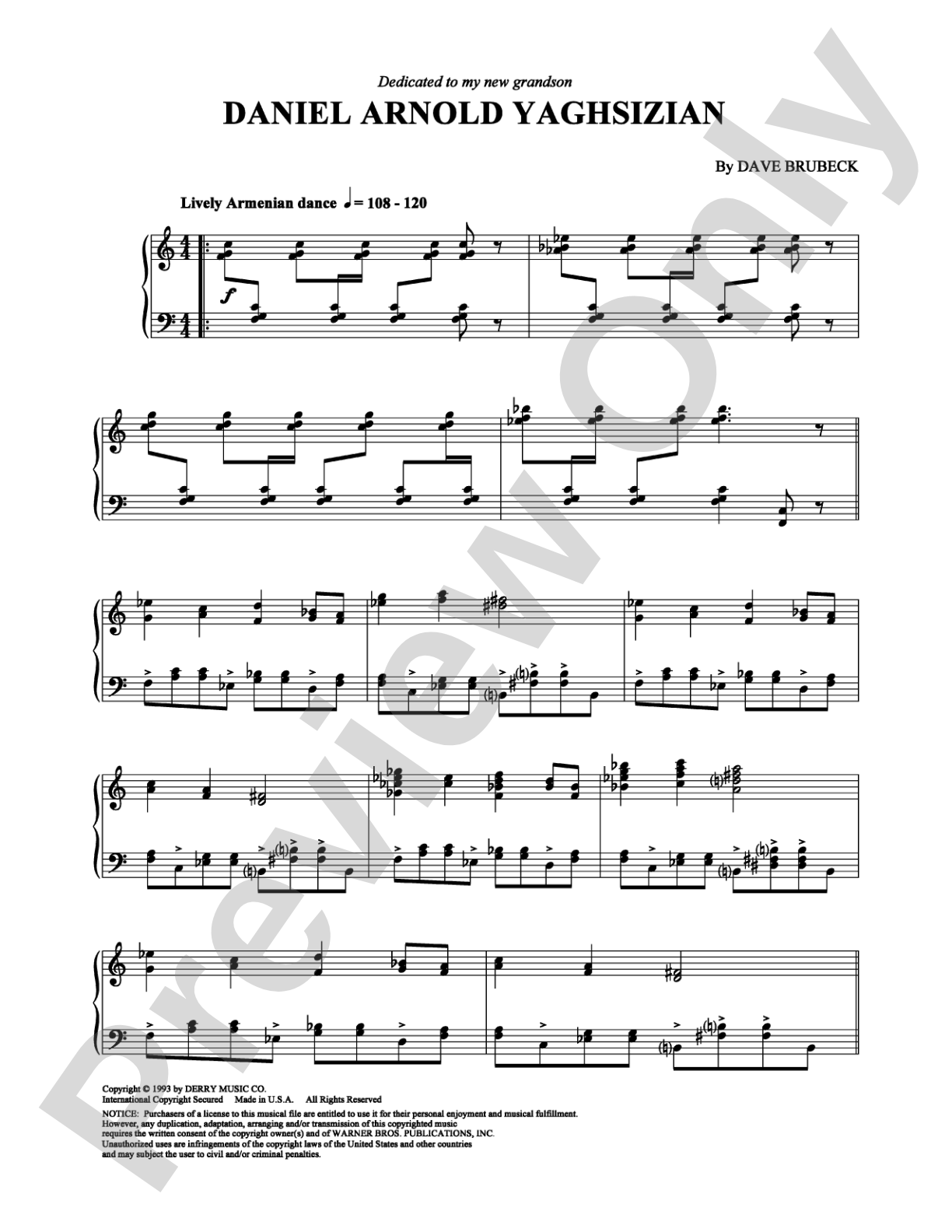
Daniel Arnold Yaghsizian: Piano Digital Sheet Music

Daniel Arnold Yaghsizian: Piano Digital Sheet Music

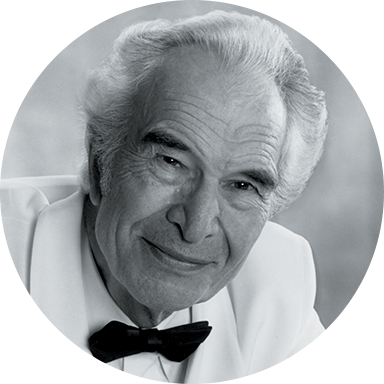
Dave Brubeck

Item: 00-PS-0000773

Digital Download
$3.99
Description

Daniel Arnold Yaghsizian: Piano Digital Sheet Music isn't in MakeMusic Cloud just yet...but it could be. Let us know you'd like to see it, and you'll help shape what comes next. In the meantime, start a free trial and dive into thousands of interactive titles your students can play along with today.

Sample Audio
No sample audio found.
Sample Video
Additional Details
SKU: 00-PS-0000773

More about this title

About the Artist: Dave Brubeck

Dave Brubeck

Dave Brubeck stands as one of jazz's most influential pianists, with a career that spanned decades of both performance and composition. Beyond his reputation as an improviser, he was a prolific composer whose works ranged across choral pieces, orchestral compositions, chamber music, and solo repertoire for piano, violin, and voice. His 1959 album "Time Out" became the first jazz recording to exceed one million copies sold, cementing his place in popular music history. He studied with French composer Darius Milhaud after World War II, an experience that shaped his approach to blending jazz language with classical forms throughout his catalog.

Brubeck's influence extended well beyond the concert hall. He was instrumental in advancing racial integration in American music during the mid-20th century, and his large-scale sacred works such as "To Hope!" and the oratorio "Beloved Son" have been performed and recorded internationally by ensembles including the London Symphony Orchestra. His contributions earned him a Grammy Lifetime Achievement Award, the Presidential Medal of the Arts from President Clinton, and induction into the American Classical Music Hall of Fame in 2003.

Why we love this

This piece represents Brubeck at his most compositionally sophisticated, moving beyond the improvisational settings he's famous for into fully notated piano writing. The score lets pianists experience the depth of his harmonic thinking and structural mastery in an intimate, solo context. Programming a Brubeck composition alongside classical and contemporary repertoire signals to audiences that jazz composing is serious concert music.

What to expect

Sophisticated and purposeful, this composition reflects Brubeck's ability to move seamlessly between the languages of jazz and concert music. The writing feels both intellectually engaged and deeply musical, avoiding the clichés of either tradition.

Who it's for

Pianists seeking substantial solo material that bridges jazz and classical idioms will find this piece rewarding. It appeals to intermediate-advanced players comfortable with jazz harmony and ready to engage with a major composer's notated vision rather than relying on improvisation.

How to get the most out of it

  • Attend closely to the harmonic language. Brubeck's jazz vocabulary often includes polytonal passages and unexpected chromatic movements that require clear voicing rather than rushed tempo.
  • Balance swing inflections with the precision the notation demands. Since this is a fully written composition rather than a lead sheet, the printed score should guide your rhythmic interpretation.
  • Explore the dynamic range available in the piece. Brubeck's orchestral background informed his use of color and dynamics in solo writing.

How to use it

This works well as a solo recital piece that demonstrates the legitimacy of jazz composition at the concert level. It can also serve as a bridge between classical and jazz programming on a mixed-repertoire recital, showing audiences how these traditions inform each other in the hands of a master composer.

Skills your students will build

  • Reading and performing jazz harmony in notated form
  • Voicing complex chord structures with clarity and balance
  • Interpreting swing rhythms and syncopation from a composed score
  • Navigating polytonal passages and chromatic voice leading

You May Also Like