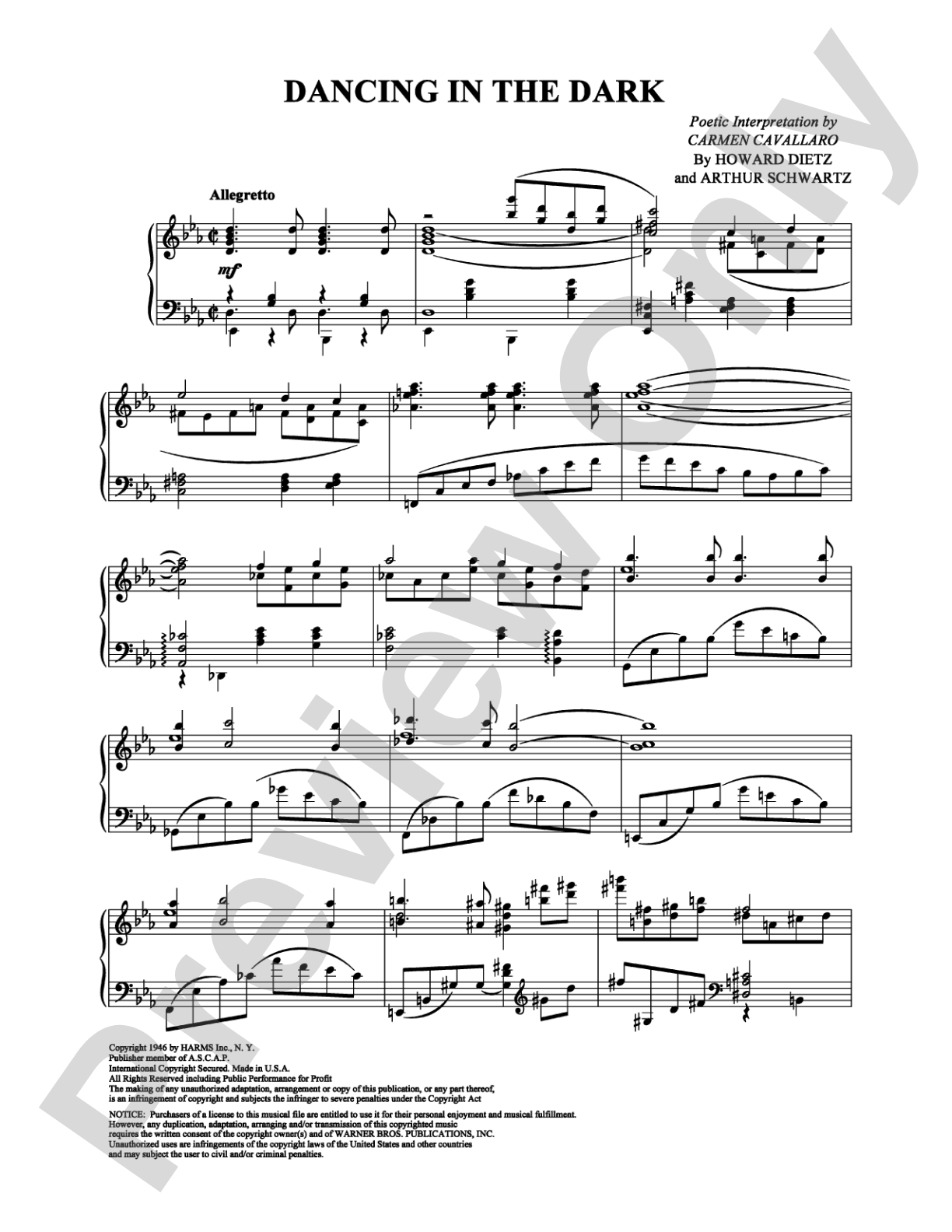
Dancing in the Dark: Piano Digital Sheet Music

Dancing in the Dark: Piano Digital Sheet Music

Arthur Schwartz, Carmen Cavallaro

Item: 00-PS-0001959

Digital Download
$3.99
Description

Dancing in the Dark: Piano Digital Sheet Music isn't in MakeMusic Cloud just yet...but it could be. Let us know you'd like to see it, and you'll help shape what comes next. In the meantime, start a free trial and dive into thousands of interactive titles your students can play along with today.

Sample Audio
No sample audio found.
Sample Video
Additional Details
SKU: 00-PS-0001959

More about this title

About the Artist: Carmen Cavallaro

Carmen Cavallaro (1913-1989) was an American jazz pianist known for his sophisticated touch and lyrical approach to standards. He recorded prolifically from the 1940s through the 1980s, bringing a distinctly romantic sensibility to the Great American Songbook while maintaining genuine jazz vocabulary and harmonic understanding.

Cavallaro's playing emphasized clarity and melodic beauty over flashy technique, making his interpretations accessible to listeners across classical and jazz backgrounds. His work remains a valuable study in how to honor a song's structure while infusing it with personal artistry and jazz voicings.

Why we love this

This is a masterclass in elegant jazz piano phrasing from one of the standard's most refined interpreters. Cavallaro's treatment respects the melody while introducing enough harmonic sophistication to challenge intermediate and advanced pianists who want to move beyond lead-sheet simplicity.

What to expect

Wistful and contemplative, with an underlying warmth that never tips into sentimentality. Cavallaro's touch is intimate—as if the piano is speaking directly to the listener—while the harmonic movement and chord voicings maintain enough jazz color to feel modern and engaged rather than nostalgic.

Who it's for

Intermediate to advanced jazz pianists and standard enthusiasts who want to learn how to balance accessibility with genuine harmonic sophistication. This arrangement works for private studio pianists preparing recital material, jazz students studying authoritative interpretations of classic standards, and experienced players looking to deepen their understanding of swing-era piano aesthetics.

How to get the most out of it

  • Study how Cavallaro voices the chords; his left hand never overplays, giving the right hand melodic line room to breathe and shape the lyric.
  • Pay attention to his rhythmic placement of chords—they land slightly behind the beat in places, creating a relaxed swing feel without explicit syncopation.
  • Use the recorded performance as a reference for touch and dynamics, but don't aim to replicate it note-for-note; personalize the interpretation while maintaining the song's emotional arc.
  • Work on the transition passages between sections to keep the flow conversational rather than mechanical.

How to use it

This fits naturally into a jazz standards recital, either as a solo piece or paired with other Cavallaro arrangements or comparable interpretations. It also works well in a mixed recital showing the evolution of American piano music, bridging classical training and jazz sensibility. Consider programming it in the second half of a recital where audiences have settled in and will appreciate the quieter, more reflective repertoire.

Skills your students will build

  • Comping with rootless voicings and upper extensions
  • Balancing melody and harmonic accompaniment without rhythmic competition
  • Interpreting swing feel and rhythmic placement in a written transcription
  • Shaping long melodic lines with minimal rubato while maintaining groove
  • Voicing jazz standards with harmonic sophistication beyond basic triads

You May Also Like