

Dancing and Springing (Tanzen und Springen): SSA Choral Octavo
(Tanzen und Springen)
Words and music by Hans Leo Hassler / ed. & arr., with English Text, by Patrick M. Liebergen
Item: 00-PO-0000543
$1.75
Minimum order quantity: 20 copies
Pickup currently not available
Related Items
Dancing and Springing: SSA Choral Octavo |
$1.75
|
View |
Description
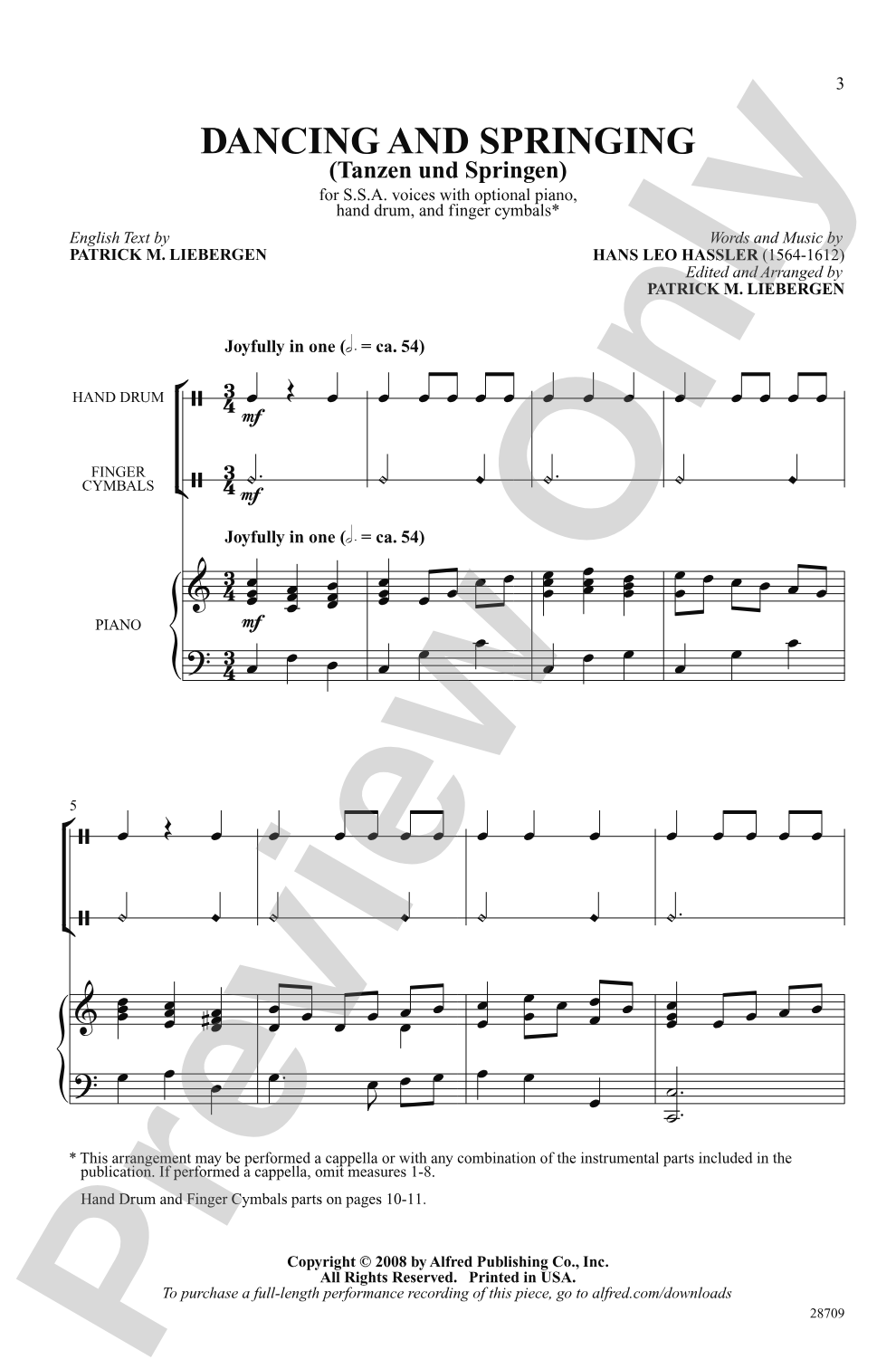
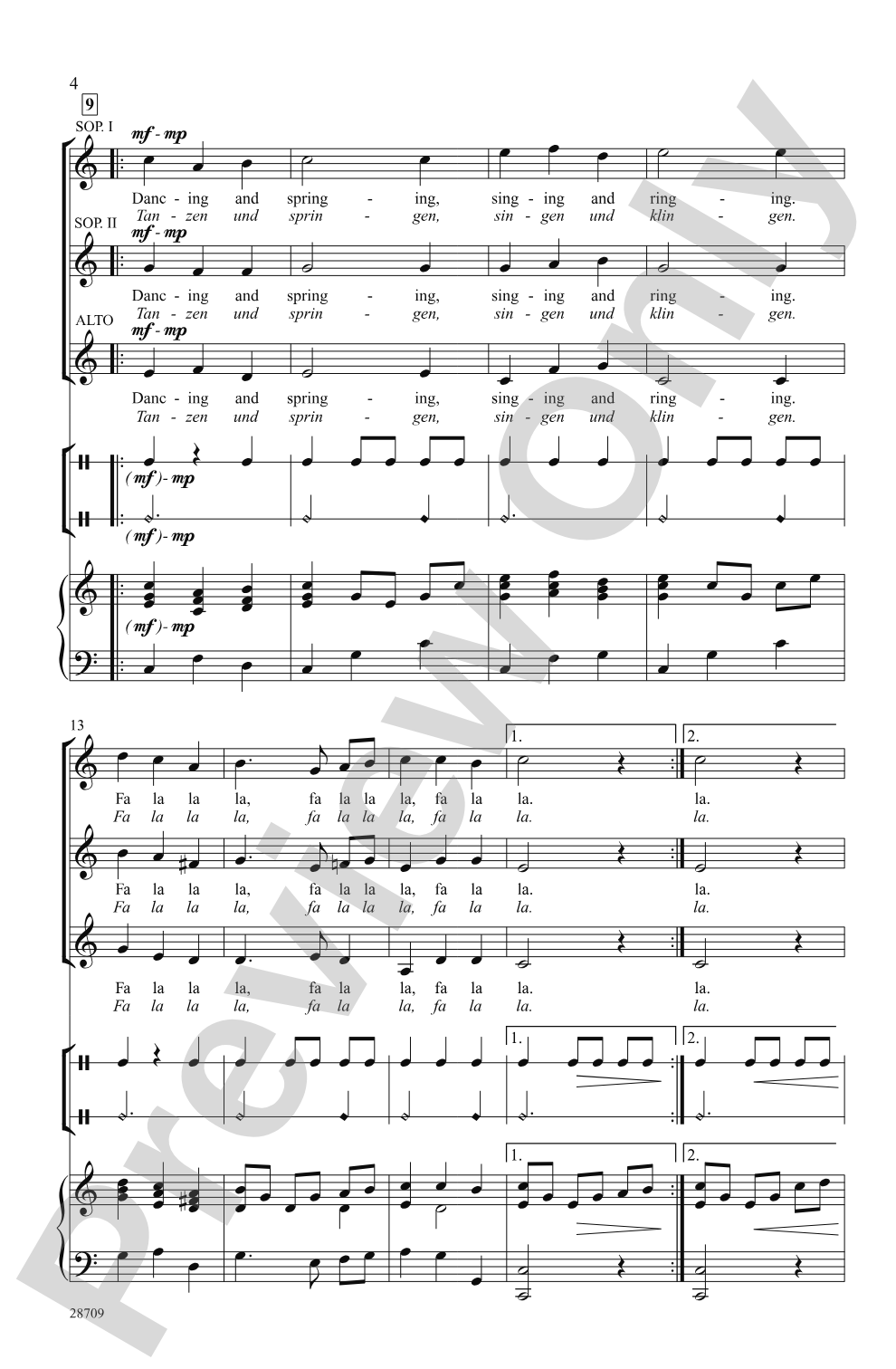
This familiar German madrigal is a solid study of early Baroque singing for SSA choirs. The light 3/4 "in one" feel provides a steady lilt for clear treble sonorities. Sing in English or German (a complete phonetic guide is included) and with or without the piano, hand drum, and finger cymbals.


Dancing and Springing (Tanzen und Springen): SSA Choral Octavo isn't in MakeMusic Cloud just yet...but it could be. Let us know you'd like to see it, and you'll help shape what comes next. In the meantime, start a free trial and dive into thousands of interactive titles your students can play along with today.
Request This Title
Tell us you want it.
Start Your Free Trial
Explore everything that's ready to play right now.
Sample Audio
1
Audio File
--:--
0:00
0:00
Sample Video
No sample videos found.
Additional Details
Series:
Alfred Choral Designs
Publisher:
Alfred Music
Page Count:
12
SKU:
00-PO-0000543
More about this title
About the Composer: Hans Leo Hassler
Hans Leo Hassler (1564-1612) was a German composer and organist who bridged the Renaissance and early Baroque, absorbing Italian musical traditions while maintaining the contrapuntal rigor of Northern Europe. His secular vocal works, including madrigals and dances, became foundational repertoire for choir programs because they combine melodic charm with genuine compositional craft, making them equally rewarding for singers learning counterpoint and audiences enjoying the music.
Hassler's output spanned sacred and secular genres, but his madrigals and dance songs reveal a composer attuned to text expression and the capabilities of the human voice. His influence on later German composers was substantial, and his lighter works remain pedagogically valuable precisely because they refuse to be simple: the part-writing is always purposeful.
Why we love this
This madrigal offers early Baroque voice-leading without the textural density that can overwhelm newer sight-readers. The 3/4 lilt and treble-focused sonorities create an immediate sense of lightness that students can actually hear themselves achieving, which builds confidence fast. The flexibility to perform with or without percussion and in either language means you can tailor it to your rehearsal focus, whether that's pronunciation, unaccompanied singing, or adding color.
What to expect
Buoyant and charming, with a sprightly rhythmic character that never feels heavy or introspective. The three-part writing creates transparent, singing sonorities that feel intimate even in a concert setting; there's a sense of ensemble joy without artifice.
Who it's for
SSA choirs ready to engage with early Baroque counterpoint in an approachable, repertoire-driven way. This works well for high school ensembles, college treble choirs, and adult community choruses that want a piece with real musical substance but immediate performance payoff.
How to get the most out of it
- Let the 3/4 meter sit "in one" rather than conducting or feeling each beat separately; this preserves the dance-like spring the title promises and prevents the piece from dragging.
- Balance the three parts so the top line sings through clearly without the altos and sopranos II underneath disappearing; the contrapuntal writing relies on hearing independent melodic lines.
- If adding hand drum and finger cymbals, keep them light and rhythmically playful; they should enhance the sense of movement, not drive or over-punctuate it.
- Rehearse the phonetic German first if performing in that language, but sing through the English version to lock in the text underlay before switching; this prevents last-minute syllable confusion.
How to use it
Pair this with other madrigals or dance songs from the same era to build a thematic concert set exploring secular vocal music across the Renaissance and early Baroque. It also works beautifully as a concert opener or palate-cleanser between weightier pieces, and its modest length (12 pages) makes it efficient to rehearse.
Skills your students will build
- Independent line-singing in three-part counterpoint
- Reading and performing early Baroque vocal style and phrasing
- German diction and phonetic accuracy (complete guide provided)
- Ensemble balance in textures without full SATB support
- Rhythmic precision and forward momentum in compound meter