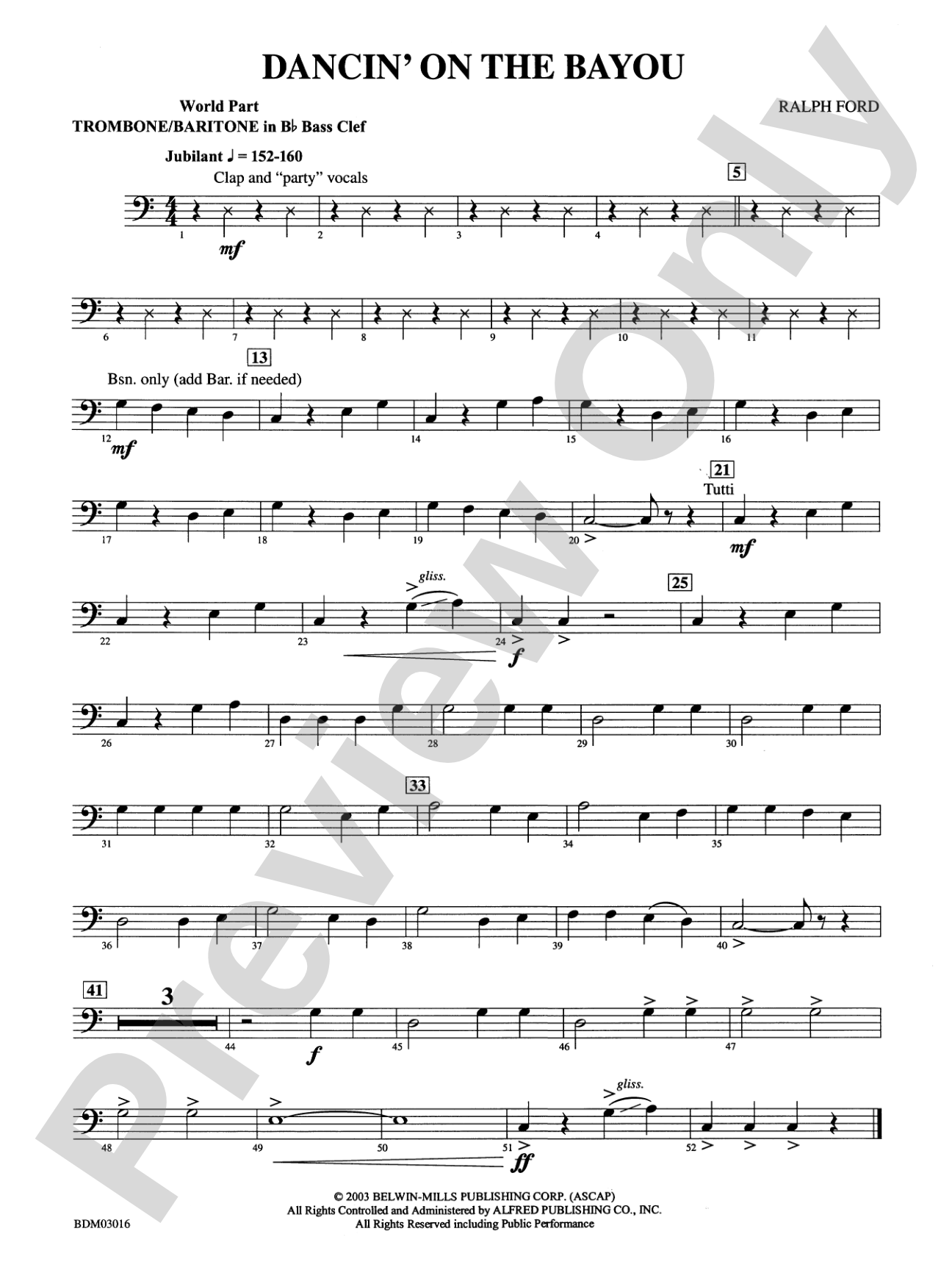
Dancin' on the Bayou: (wp) 1st B-flat Trombone B.C. Sheet Music Preview

Dancin' on the Bayou: (wp) 1st B-flat Trombone B.C.

By Ralph Ford

Grade: 1 (Very Easy)

Item: 00-PC-0015199_wpTN1BC

Digital Download
$3.00
Description
It's real fun, but real music as well. Your percussion section will crave the focus on special effects requiring a washtub, washboards, and jugs (a number of the percussion parts are optional but certainly enhance the entertaining effect). Special guests can also join in the fun! This work provides a wonderful opportunity to introduce cut time and perform authentic Cajun or Zydeco styles. (1:16)

Don't just read it, hear it, play along with it, and watch your students grow with it. In MakeMusic Cloud, Dancin' on the Bayou: (wp) 1st B-flat Trombone B.C. comes alive with professional accompaniment, adjustable tempo, and built-in practice tools that turn solo practice into real progress.

Sample Audio
0:00
0:00
Sample Video
Additional Details
Series: Belwin Beginning Band
Publisher: Alfred Music
Page Count: 146
SKU: 00-PC-0015199_wpTN1BC

More about this title

About the Composer: Ralph Ford

Ralph Ford

Ralph Ford combines classical training with decades of professional work across concert music, media, and broadcast. Since earning his Master of Science degree in 1988, he has taught orchestration, arranging, theory, and applied brass at the university level while building an international catalog of over 250 published titles for orchestra, concert band, jazz ensemble, and marching band.

As an exclusive composer and arranger for Belwin, Ford has created music performed by university, military, professional, community, and school ensembles worldwide. His career spans live radio broadcasts, television production, commercial jingles, and video composition, giving him deep experience translating musical ideas across styles and contexts. He earned regional and international awards for his work in media and animation.

Why we love this

Ford writes Grade 1 band music that genuinely respects young musicians' capabilities while entertaining audiences. The emphasis on optional percussion effects and special guest parts transforms what could be a simple opener into an ensemble-building experience where students feel invested in the full orchestration, not excluded from it.

What to expect

The sound is infectious and warm, built on the rhythmic bounce of Cajun and Zydeco traditions. Washboards and jugs give it texture that feels handmade and rooted, while the melodies stay open enough for young players to breathe but shaped enough to feel like real music, not a novelty piece.

Who it's for

Beginning concert bands in Grades 1-2 looking for a work that combines accessibility with character and cultural awareness. Directors seeking a fun opener that still teaches genuine musical concepts will find the cut time introduction and Cajun idiom provide real pedagogical payoff without sacrificing entertainment value.

How to get the most out of it

  • Assign the washtub, washboard, and jug parts strategically to percussionists who can commit to the rhythmic precision these effects demand; the authentic texture depends on their timing as much as any melodic section.
  • Rehearse the cut time signature separately before introducing it within the full arrangement; young players benefit from understanding how it changes the feel of familiar rhythmic patterns.
  • Consider who your special guest performers might be (students from another ensemble, faculty, parents with basic musicianship) and give them clear, cue-heavy notation so they integrate confidently rather than distract.

How to use it

Open a concert where you want to set an upbeat, welcoming tone while signaling that your band explores musical styles beyond the European canon. At 1:16, it fits perfectly as a first-half opener before moving into something more formal, or pair it with other American roots music to frame a thematic program.

Skills your students will build

  • Reading and performing cut time
  • Rhythmic precision in ensemble settings with non-standard percussion colors
  • Understanding and executing Cajun and Zydeco idioms
  • Listening across full ensemble texture while maintaining individual part integrity
  • Integrating optional and alternative instrumentation into cohesive performance

You May Also Like