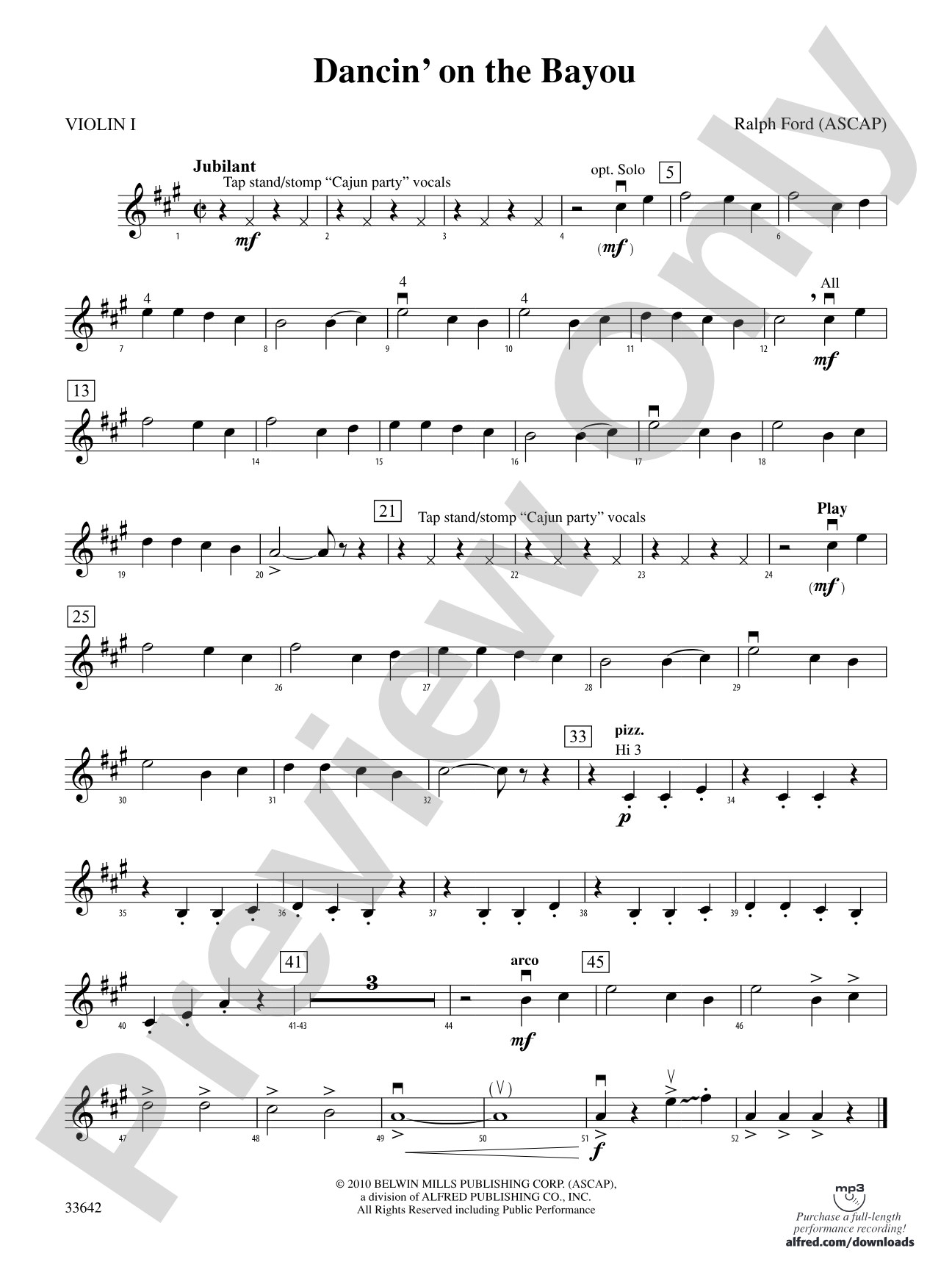
Dancin' on the Bayou: 1st Violin Sheet Music Preview

Dancin' on the Bayou: 1st Violin

By Ralph Ford

Grade: 2

Item: 00-PC-0014436_VN1

Digital Download
$5.99
Description
Deep from the heart of Louisiana bayou country where the food is hot and the music hotter, the Cajun spirit is captured here in this exciting piece for your first concert. Accompanied by fun "found sound" instruments such as washboard, washtub, and bottles, this one is a sure hit and offers an opportunity for study of a unique musical style.

Don't just read it, hear it, play along with it, and watch your students grow with it. In MakeMusic Cloud, Dancin' on the Bayou: 1st Violin comes alive with professional accompaniment, adjustable tempo, and built-in practice tools that turn solo practice into real progress.

Sample Audio
0:00
0:00
Sample Video
Additional Details
Series: Belwin Beginning String Orchestra
Publisher: Alfred Music
Page Count: 86
SKU: 00-PC-0014436_VN1

More about this title

About the Composer: Ralph Ford

Ralph Ford

Ralph Ford brings three decades of professional experience across composition, arrangement, conducting, and music education. Since the mid-1980s, he has held faculty positions teaching orchestration, arranging, theory, and applied instruction while building a prolific catalog of over 250 published works for orchestra, concert band, jazz ensemble, and marching band.

As an exclusive composer and arranger for the Belwin division of Alfred Music, Ford has developed deep expertise in writing for young ensembles across multiple genres. His work extends beyond the concert hall into media production, broadcast, and commercial music, where he has earned recognition for jingles, animation scoring, and news packages for national networks. His music has been premiered and performed by university, military, professional, community, and school ensembles internationally.

Why we love this

Ford captures authentic Louisiana flavor without overwhelming a Grade 2 orchestra. The incorporation of found sound instruments (washboard, washtub, bottles) gives students a tactile connection to Cajun musical tradition while keeping the string writing accessible and rhythmically driving. It's the kind of piece that builds ensemble enthusiasm early in the year while opening ears to folk music beyond standard classical repertoire.

What to expect

Spirited and festive, with a warm, earthy character rooted in Deep South tradition. The piece swings with Cajun rhythmic vitality, mixing folk melody with accessible harmonic colors that feel both authentic and freshly arranged for young strings.

Who it's for

First-year string orchestra students ready to tackle something beyond standard classical etudes. This is ideal for ensembles preparing a first concert that celebrates cultural diversity and musicality alongside technical fundamentals.

How to get the most out of it

  • Establish a steady, infectious groove in the rhythm section before layering the melodic lines; the found sounds are as important to the style as the strings themselves.
  • Encourage the players handling washboard and washtub to listen closely to traditional Cajun recordings so their rhythmic feel serves the idiom, not just percussion texture.
  • Balance the string parts so the melody sings over the accompaniment; Grade 2 scoring can blur if inner voices aren't controlled dynamically.
  • Consider assigning the found sound parts to students who might benefit from a visible, engaging role without high technical demand on their primary instrument.

How to use it

Open your first concert with this piece to set an energetic, approachable tone and demonstrate that string orchestras play living musical traditions, not only classical masters. It pairs well with standard folk or light concert selections and gives your ensemble a memorable encore opportunity.

Skills your students will build

  • Rhythmic accuracy in syncopated, swing-oriented patterns
  • Ensemble balance between melody and accompaniment
  • Cultural awareness of Cajun and folk music traditions
  • Collaborative playing with non-traditional percussion instruments
  • Stylistic interpretation of dance rhythms and folk idioms

You May Also Like