
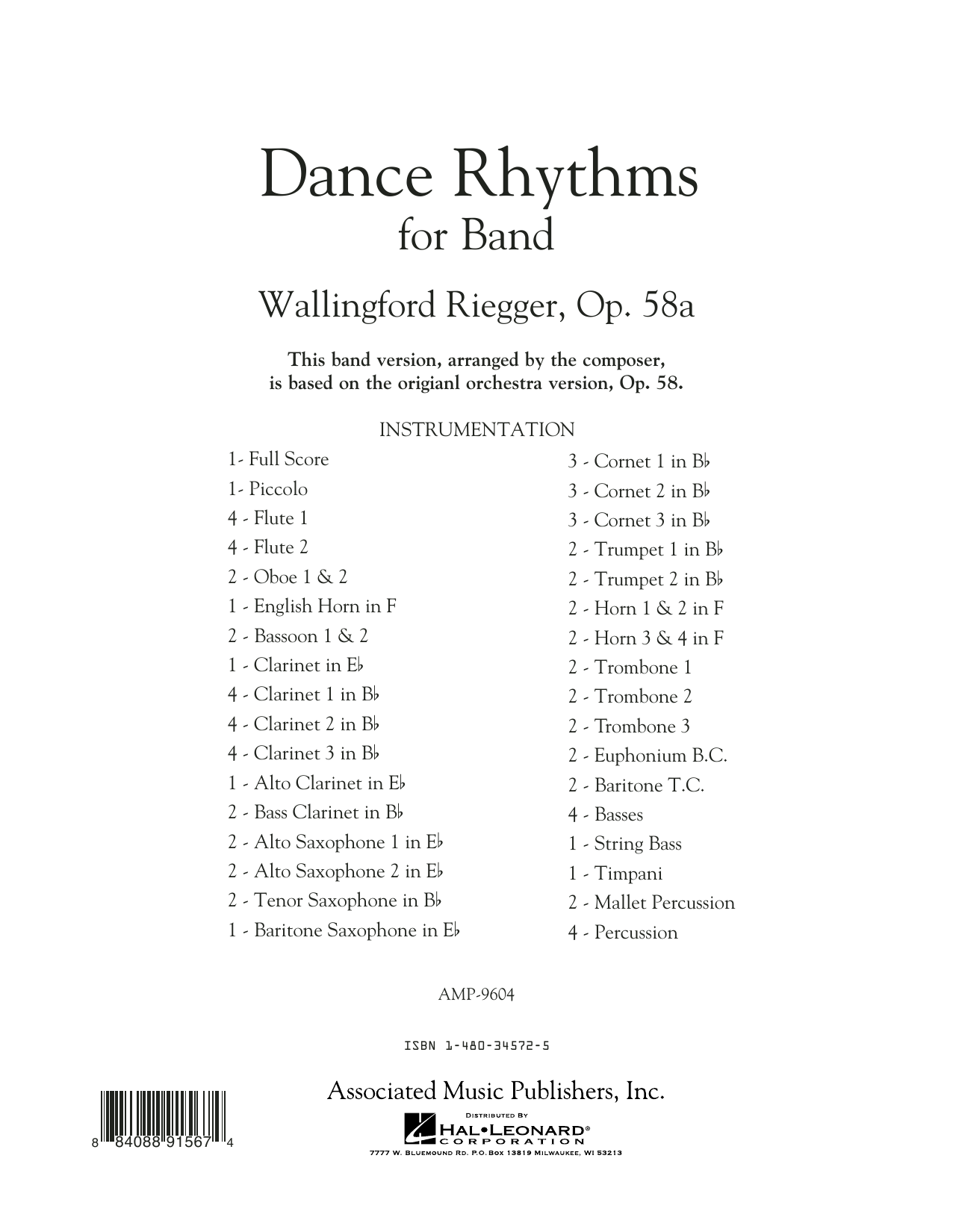

Dance Rhythms for Band, Op. 58: Concert Band Conductor Score & Parts
Grade: 4-5
Item: 35-PK00420740
$85.00
Pickup currently not available
Buy Extra Parts (Digital PDF Download)
Parts Added to Cart!
Description
Acclaimed American composer Wallingford Riegger, wrote Dance Rhythms in 1954 originally for orchestra, but then adapted it himself for band. Noted for its light-hearted mood and energy, it is an impressive study in rhythm and orchestration. This important work for band is available now again.


Dance Rhythms for Band, Op. 58: Concert Band Conductor Score & Parts isn't in MakeMusic Cloud just yet...but it could be. Let us know you'd like to see it, and you'll help shape what comes next. In the meantime, start a free trial and dive into thousands of interactive titles your students can play along with today.
Request This Title
Tell us you want it.
Start Your Free Trial
Explore everything that's ready to play right now.
Sample Audio
No sample audio found.
Sample Video
No sample videos found.
Additional Details
Publisher:
Hal Leonard
SKU:
35-PK00420740
More about this title
About the Creator: Wallingford Riegger
Wallingford Riegger (1885–1961) was a pioneering American composer whose adventurous harmonic language and rhythmic inventiveness helped define twentieth-century American concert music. He worked across multiple genres including ballet, orchestra, and band, earning recognition for his ability to balance modernist techniques with accessibility and clarity.
Riegger's orchestrations were models of craft and efficiency. His decision to adapt Dance Rhythms for band himself speaks to his understanding of how instrumental colors could shift without losing the work's essential character. This piece exemplifies his gift for creating music that challenges performers while remaining deeply musical.
Why we love this
Dance Rhythms stands apart because its rhythmic sophistication never tips into austerity. You get genuine modernist craft applied to music that radiates joy, making it a rare piece that challenges your ensemble technically while keeping morale high. The orchestration reveals something new with each rehearsal, rewarding careful sectional work with genuine sonic payoff.
What to expect
Dance Rhythms crackles with the energy of movement and gesture. Its constantly shifting rhythmic patterns create a sense of forward momentum and playful unpredictability, yet the harmonic language underlying these gestures is harmonically modern and substantial. The overall effect is exuberant without being naive, complex without being cerebral.
Who it's for
This work suits bands ready to engage with rhythmic complexity and sophisticated harmonic language. It rewards ensembles with solid fundamentals and the patience to parse a densely woven score, making it ideal for strong Grade 4-5 programs or as a step forward for advancing groups.
How to get the most out of it
- Isolate the rhythmic layers in early rehearsals by having sections count silently while others play, then swap. This clarifies how independent lines interlock without losing the collective groove.
- Conduct the metric subdivisions clearly in slower passages. Riegger's syncopations will drift if the band isn't anchored to your beat.
- Work dynamics as active shapers of form rather than surface effects. The balance between prominent and supporting voices shifts frequently, and letting these changes breathe keeps the energy propulsive without becoming relentless.
- Balance transparency with brightness in the upper woodwind writing. These lines carry significant thematic material but can obscure lower voices if played too heavily.
How to use it
Program this as a centerpiece of a concert exploring American modernism, or pair it with other Riegger works to showcase his range. It also works beautifully as a finale that sends audiences out on an engaged and energized note, particularly when programmed after more lyrical or introspective pieces.
Skills your students will build
- Reading and executing syncopated rhythms across multiple meter changes
- Balancing independent rhythmic lines within harmonic texture
- Responding to detailed dynamic and articulation changes that reshape orchestral color
- Maintaining ensemble cohesion through passages with competing rhythmic emphasis