
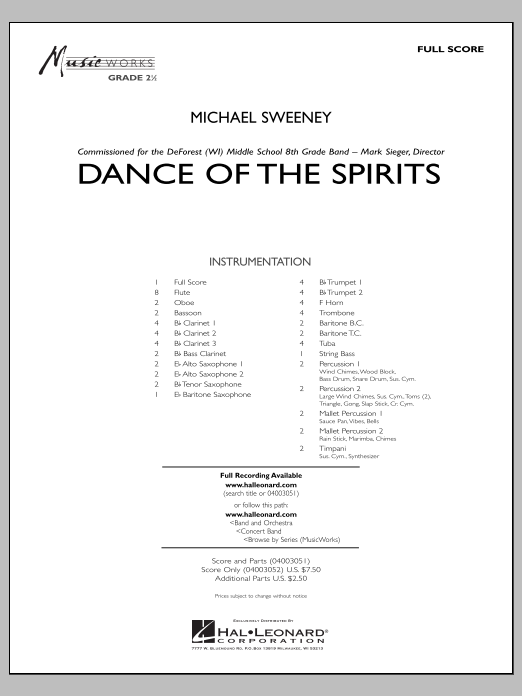

Dance Of The Spirits: Concert Band Conductor Score & Parts
By Michael Sweeney
Grade: 2.5
Item: 35-PK00179174
$65.00
Pickup currently not available
Buy Extra Parts (Digital PDF Download)
Parts Added to Cart!
Description
The Native American Cree tribe refer to the aurora borealis (or "northern lights") as the "dance of the spirits." Using a variety of unusual sounds and effects, quickly changing textures and surprises, Michael Sweeney has created a musical impression of this phenomenon's stunning beauty and unpredictable nature. An exciting and unique addition to the young band repertoire, this will be enjoyable to rehearse and perform. Dur: c. 5:30


Dance Of The Spirits: Concert Band Conductor Score & Parts isn't in MakeMusic Cloud just yet...but it could be. Let us know you'd like to see it, and you'll help shape what comes next. In the meantime, start a free trial and dive into thousands of interactive titles your students can play along with today.
Request This Title
Tell us you want it.
Start Your Free Trial
Explore everything that's ready to play right now.
Sample Audio
No sample audio found.
Sample Video
No sample videos found.
Additional Details
Publisher:
Hal Leonard
SKU:
35-PK00179174
More about this title
About the Composer: Michael Sweeney
Michael Sweeney has spent decades composing for young ensembles with an ear for what actually engages student musicians. His gift lies in writing music that sounds sophisticated without overwhelming developing players, allowing bands to feel genuinely accomplished in rehearsal and performance.
Sweeney understands the pedagogical value of unusual instrumental effects and unconventional textures. Rather than treating them as gimmicks, he integrates them purposefully into the musical fabric, giving students real reasons to expand their technical and expressive vocabulary.
Why we love this
The appeal here runs deeper than novelty. Sweeney uses the northern lights concept as a genuine musical framework, not a thin excuse for random sound effects. Students encounter real compositional choices that build dramatic tension and release, and the changing textures keep ensemble focus sharp throughout rehearsals. This is the kind of piece that reminds young musicians why they chose band.
What to expect
Luminous and restless at once. The music shimmers and shifts like light across snow, with moments of crystalline clarity followed by passages of gentle mystery. Beneath the sonic exploration sits genuine motion and purpose rather than aimless timbral wandering.
Who it's for
Solid Grade 2.5 bands ready to stretch beyond conventional repertoire without losing musicality. This works well for ensembles that have secure fundamentals and enough focus to maintain clarity when texture becomes layered and complex.
How to get the most out of it
- Track the rapid textural shifts in your rehearsal score and mark them clearly. Your ensemble needs to anticipate these transitions rather than react to them, so highlight measure numbers where the sound world changes.
- Experiment with the unusual effects during sectionals first. Letting woodwinds find comfortable flutter tongue technique or brass discover their multiphonic sounds in smaller settings builds confidence before full ensemble run-throughs.
- Balance the dialogue between sections carefully as textures layer and recede. The piece's unpredictability depends on dynamic contrast that reveals individual color rather than washing everything together.
- Record yourself early in the rehearsal process. Listening back reveals whether your interpretation of the "dance" actually reads as movement to an outside ear, or if it lands as static experimentation.
How to use it
Feature this in a concert devoted to music inspired by natural phenomena, where it can sit alongside pieces with equally vivid imagery. Its five and a half minute length makes it a substantial but not demanding centerpiece that gives your audience something they don't often hear from young bands.
Skills your students will build
- Extended instrumental techniques (flutter tonguing, multiphonics, unconventional articulations)
- Listening for and responding to rapidly changing ensemble textures
- Maintaining rhythmic precision when harmonic or timbral landmarks shift
- Balancing individual color within sectional sound
- Connecting technical effects to musical intention rather than pure novelty