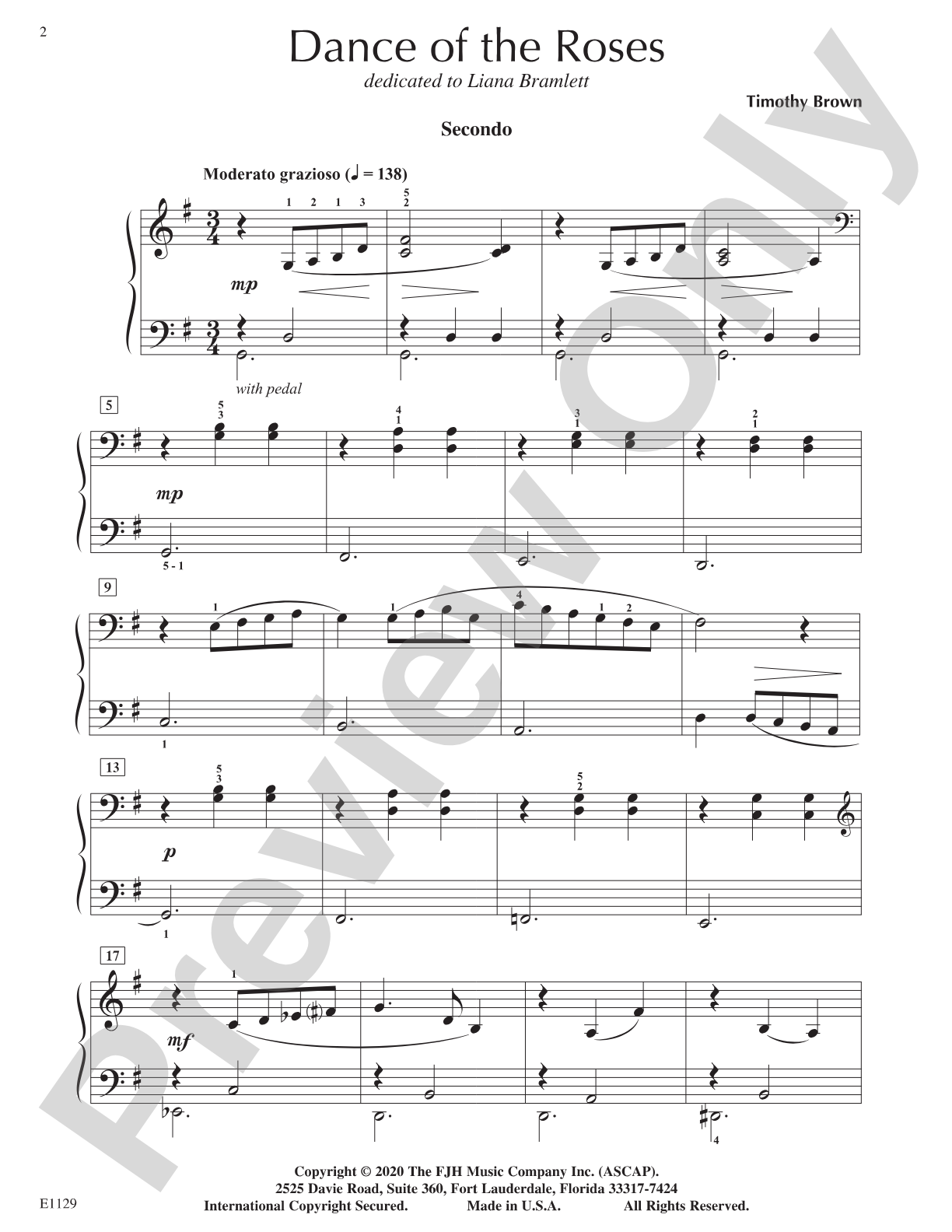
Dance of the Roses Sheet Music Preview

Dance of the Roses: Piano

By Timothy Brown

Item: 98-DE1129

Digital Download
$3.50
Description
This romantic waltz in G major uses equal interplay between the two players. The tender, delicate melody exploits dynamic contrasts throughout and can be a great piece for recitals.

Dance of the Roses: Piano isn't in MakeMusic Cloud just yet...but it could be. Let us know you'd like to see it, and you'll help shape what comes next. In the meantime, start a free trial and dive into thousands of interactive titles your students can play along with today.

Sample Audio
No sample audio found.
Sample Video
Additional Details
Series: The FJH Piano Ensemble Series
Publisher: The FJH Music Company, Inc.
SKU: 98-DE1129

More about this title

Why we love this

The balanced writing between primo and secondo parts means neither player sits idle or feels relegated to accompaniment duty. Brown's use of dynamic contrast within a lyrical waltz framework gives intermediate duettists room to shape phrases expressively without requiring virtuosic technique.

What to expect

A graceful waltz with the poise of a formal dance, yet intimate enough for a small gathering. The G major tonality and tender melody create an atmosphere of restrained elegance, where careful listening between partners becomes as important as technical execution.

Who it's for

Intermediate pianists ready to explore ensemble playing without the complexity of larger group coordination. This works beautifully for recital programs where you want to showcase partnership and musical maturity.

How to get the most out of it

  • Balance the melodic line between hands so that the primary theme emerges clearly even when both players carry thematic material. A light touch on the accompaniment figures lets the waltz breathe.
  • Establish the characteristic three-beat lilt early in rehearsal so both players feel the same rhythmic pocket. Precision here makes the tender passages land with more impact.
  • Lean into the dynamic shifts. Mark them in pencil during prep so neither player misses a swell or drop; these contrasts are the piece's emotional backbone.

How to use it

Pair this with a contrasting contemporary work or a classical-era sonata on a recital to demonstrate range. It also fits naturally into a spring or gala concert where you want to highlight your most musicianly students without overwhelming them technically.

Skills your students will build

  • Coordinating rubato and tempo flexibility between two independent parts
  • Shaping dynamic arcs within a lyrical melodic framework
  • Balancing harmonic and melodic responsibilities in ensemble writing
  • Sustaining legato phrasing across hand position shifts

You May Also Like