
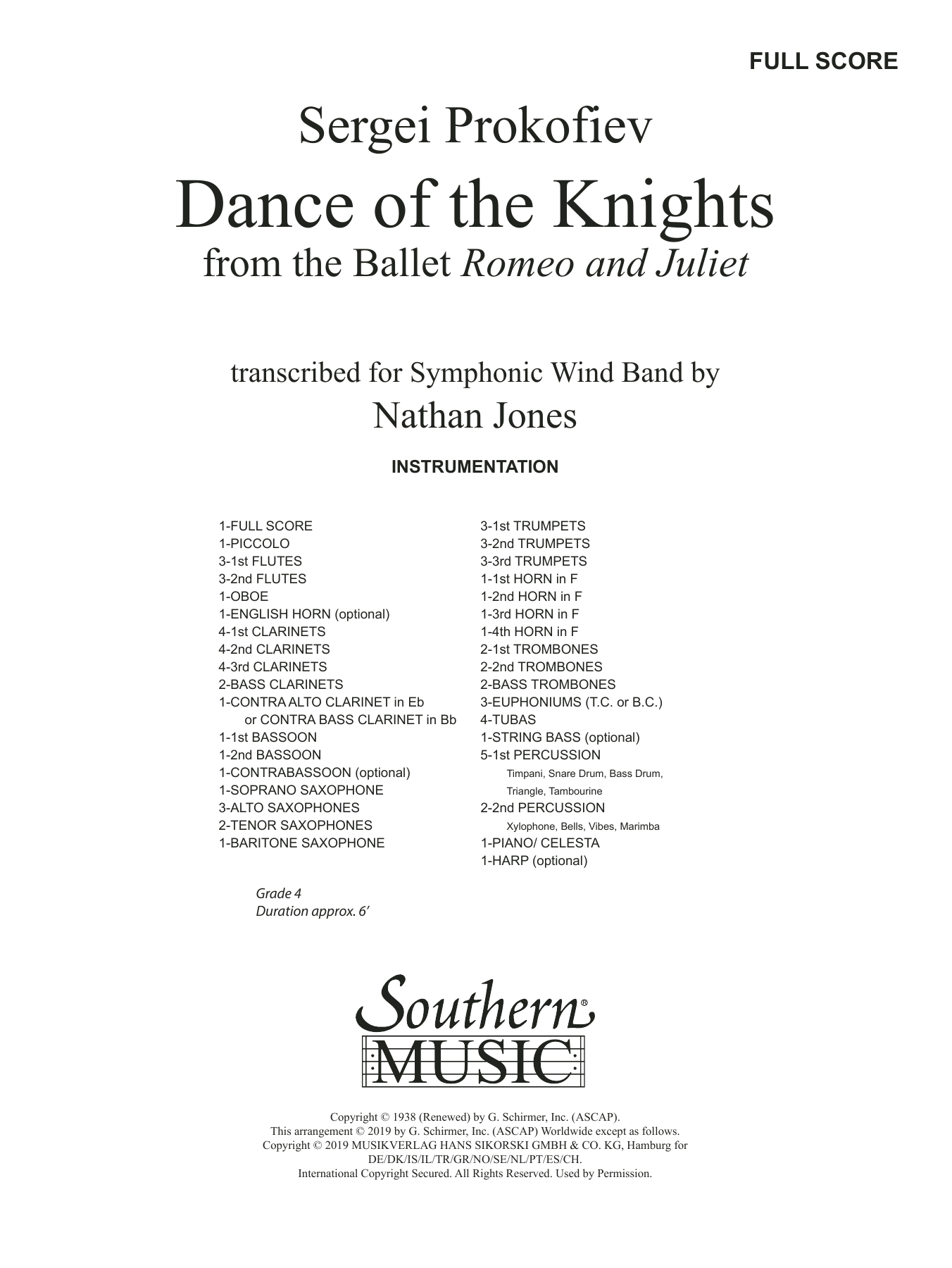

Dance of the Knights (from Romeo and Juliet): Concert Band Conductor Score & Parts
By Sergei Prokofiev / Arranged by Nathan Jones
Grade: 4
Item: 35-PK01467382
$95.00
Pickup currently not available
Buy Extra Parts (Digital PDF Download)
Parts Added to Cart!
Description
This publication marks the first-ever symphonic wind band edition of the Dance of the Knights, from Scene 2 Capulets Ball of Prokofievs ballet Romeo and Juliet. [The ballet] led to one of the most beloved dance works in the repertory and a series of famous orchestral suitesbut the celebrated legacy of Romeo and Juliet belies its tortured history: It left Prokofiev broken and emerged from a period that left many of his colleagues dead. (New York Times). Nathan Jones scoring for symphonic wind band faithfully captures the magic of the original orchestration of this famous work, which has been heard in numerous films and TV shows, including The Simpsons, War Machine, Good Morning Britain and Gotham, among many others. This piece is an ideal opener or closer for intermediate to advanced band.


Dance of the Knights (from Romeo and Juliet): Concert Band Conductor Score & Parts isn't in MakeMusic Cloud just yet...but it could be. Let us know you'd like to see it, and you'll help shape what comes next. In the meantime, start a free trial and dive into thousands of interactive titles your students can play along with today.
Request This Title
Tell us you want it.
Start Your Free Trial
Explore everything that's ready to play right now.
Sample Audio
No sample audio found.
Sample Video
No sample videos found.
Additional Details
Publisher:
Hal Leonard
SKU:
35-PK01467382
More about this title
About the Composer: Sergei Prokofiev
Sergei Prokofiev (1891-1953) was a Russian composer whose fearless harmonic language and rhythmic vitality reshaped twentieth-century classical music. His ballet scores, particularly Romeo and Juliet, showcase his gift for theatrical storytelling through instrumental color and memorable thematic material. For music educators, Prokofiev represents a bridge between tradition and modernism: his works are immediately engaging yet demand serious musicianship from performers.
Romeo and Juliet stands as one of Prokofiev's supreme achievements. Commissioned in 1935 but not premiered until 1940, the ballet transcends its narrative source to become a concert staple. The Dance of the Knights, with its driving rhythmic momentum and bold melodic gestures, has become iconic in its own right, appearing across film, television, and popular culture.
Why we love this
Nathan Jones's band arrangement preserves every ounce of Prokofiev's theatrical swagger while solving a real problem: wind directors finally have a faithful, performable version of this famous movement. The scoring respects the original orchestration's architecture, so your students experience authentic orchestration concepts rather than a simplified knockoff. Its prominence in film and media means your audience will recognize it instantly, making it a crowd-pleaser with genuine musical substance.
What to expect
Relentless forward drive meets orchestral sophistication. The repeated rhythmic figures create hypnotic propulsion, while Prokofiev's angular harmonies prevent the piece from ever feeling predictable or tame. It's theatrical without being precious; powerful without requiring enormous technical facility.
Who it's for
Intermediate to advanced concert bands seeking a work that combines immediate audience recognition with legitimate musical challenge. Your students will build ensemble focus and stamina through a piece that demands rhythmic precision and controlled intensity throughout.
How to get the most out of it
- Shape the main theme with relentless forward motion through the forte passages; Prokofiev's orchestration built momentum through repetition and accumulation, not rubato.
- Balance the percussion layer carefully. The timpani and bass drum drive the piece, but they should lock with the low brass rather than overshadow the melodic material in the upper voices.
- Conduct in two at tempo to maintain clarity across the ensemble. This prevents the natural tendency to slow down in the busier sections and keeps the rhythmic pulse honest.
- Mark the dynamic contrasts in your parts with precision. Prokofiev's scoring relies on sudden drops and surges to maintain drama; vague dynamics will flatten the piece's impact.
How to use it
Open a concert with this to seize attention immediately, or close one with its dramatic momentum. The piece also works well in a program exploring twentieth-century ballet scores or Prokofiev's theatrical legacy. Its film and television presence makes it particularly effective as the cornerstone of a movie music or popular culture themed concert.
Skills your students will build
- Rhythmic precision in repeated metric figures across ensemble sections
- Balancing melody and accompaniment in complex textures
- Ensemble control at sustained forte dynamics
- Responding to conductor direction through rapid dynamic shifts
- Maintaining consistent articulation across fast moving lines