

Dance of Fire: Piano
By Bruce W. Tippette
Level: Intermediate
Item: 00-PS-0012873
$3.99
Pickup currently not available
Related Items
Dance of Fire: Piano Sheet |
$3.50
|
View |
Description
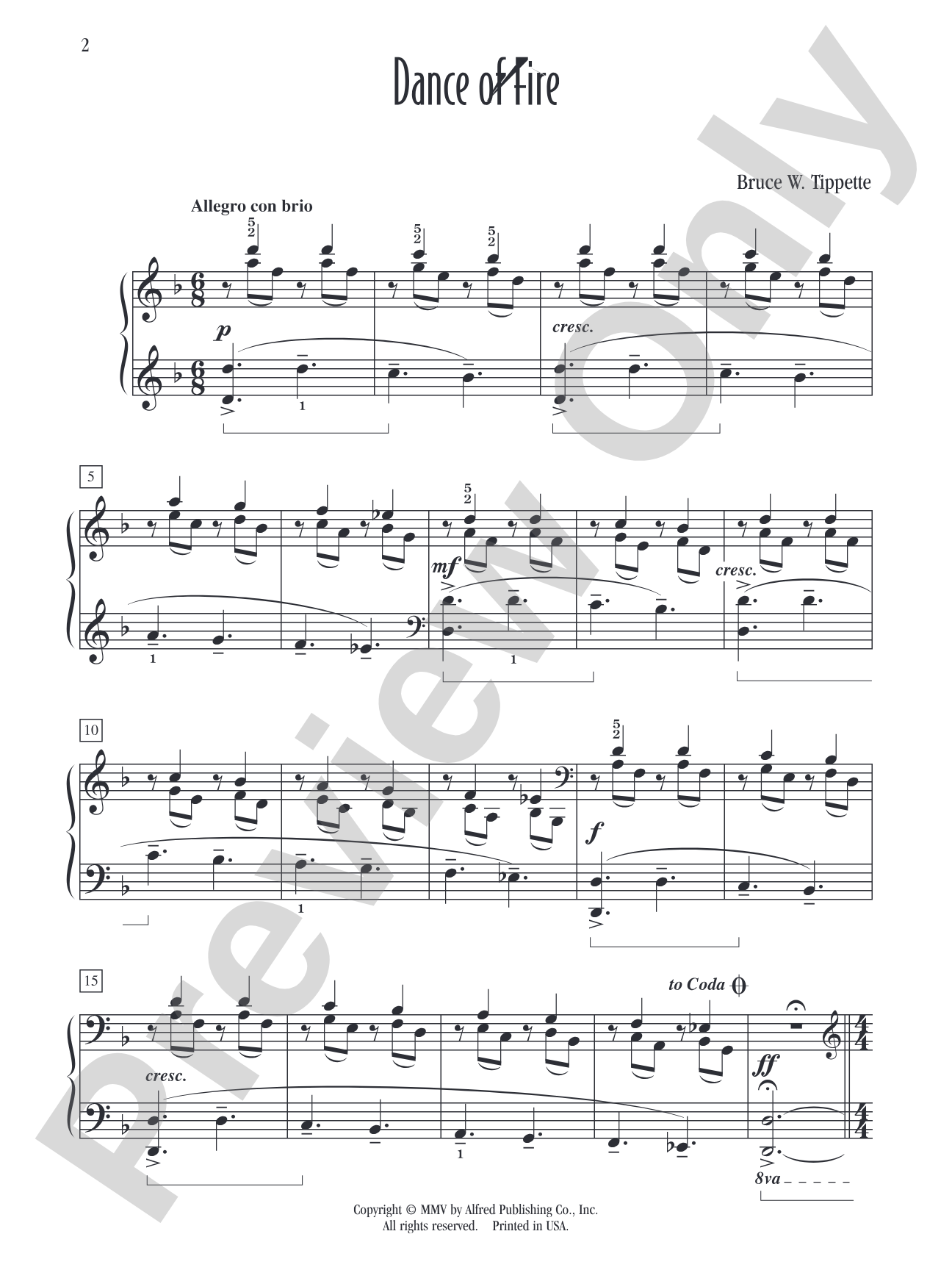
This solo was the 2005 winner of the Lynn Freeman Olson Composition Award. Written in 6/8 meter and the key of D minor, the piece is in A-B-A form. The A section has the melody in the left hand with a broken-chord accompaniment in the right hand. The B section is slower and chorale-like. The return of the A section is followed by a short coda.


Dance of Fire: Piano isn't in MakeMusic Cloud just yet...but it could be. Let us know you'd like to see it, and you'll help shape what comes next. In the meantime, start a free trial and dive into thousands of interactive titles your students can play along with today.
Request This Title
Tell us you want it.
Start Your Free Trial
Explore everything that's ready to play right now.
Sample Audio
1
Audio File
--:--
0:00
0:00
Sample Video
No sample videos found.
Additional Details
Series:
Alfred's Premier Piano Solos
Publisher:
Alfred Music
Page Count:
4
SKU:
00-PS-0012873
More about this title
About the Composer: Bruce W. Tippette

Bruce W. Tippette is a composer and educator whose work spans concert music, film, choreography, and collaborative multimedia projects. He earned his Master of Music in composition from the University of North Carolina School of the Arts and undergraduate degrees in composition, theory, and music education from Appalachian State University. His compositions have been performed internationally, and he maintains an active commission practice for both choral and instrumental ensembles.
Tippette's accolades include the 2012 Mary Starling Composition Competition for his orchestral work Unconquered, multiple commissions through a Cirque du Soleil collaboration with UNCSA (2012-2014), and the Lynn Freeman Olson Composition Award for Dance of Fire. He teaches music composition, theory, piano, and voice at the Community Music School of UNCSA, serves as Youth Music and Handbell Director at Augsburg Lutheran Church in Winston-Salem, North Carolina, and works as a collaborative pianist and rehearsal accompanist.
Why we love this
Dance of Fire earned its recognition as an award winner because it balances technical interest with genuine musicality. The A-B-A structure gives students a satisfying arc to shape, while the contrast between the energetic outer sections and the introspective chorale provides an opportunity to develop control and expressive depth on a single instrument.
What to expect
Dance of Fire ignites with passionate energy in its outer sections, the left-hand melody dancing above the shimmering right-hand figurations. The middle section steps back into shadow and reflection, like a moment of quiet intensity before the fire returns.
Who it's for
Intermediate pianists who are ready to work with more sophisticated structures and expressive demands. This piece suits students comfortable with 6/8 meter and two-hand independence who want to explore how melody and accompaniment roles can switch between hands.
How to get the most out of it
- Bring out the melody in the left hand during the A section; it's easy for pianists to overshadow it with the right-hand accompaniment, but the tune deserves clarity and presence.
- Shape the broken-chord patterns in the right hand with subtle dynamic gradations rather than mechanical evenness, which will give the accompaniment musicality and forward motion.
- Use the tempo contrast between sections deliberately. The slower B section should feel genuinely meditative, not rushed, to make the return to the A section feel vivid.
- Pay attention to the coda's proportions and energy. It's brief, so don't lose momentum; let it feel like a natural completion rather than an afterthought.
How to use it
Pair this with other award-winning intermediate solos for a recital showcasing different compositional voices and structures. It also works as a strong standalone piece for student recitals or competitions, where its award pedigree and structural clarity will impress listeners.
Skills your students will build
- Reading and performing in 6/8 meter with fluency
- Managing contrasting roles between hands (melody in left, accompaniment in right)
- Shaping broken-chord patterns with musicality rather than mechanical evenness
- Creating and sustaining tempo relationships between sections
- Interpreting A-B-A form and understanding how recapitulation can deepen through performance choices