
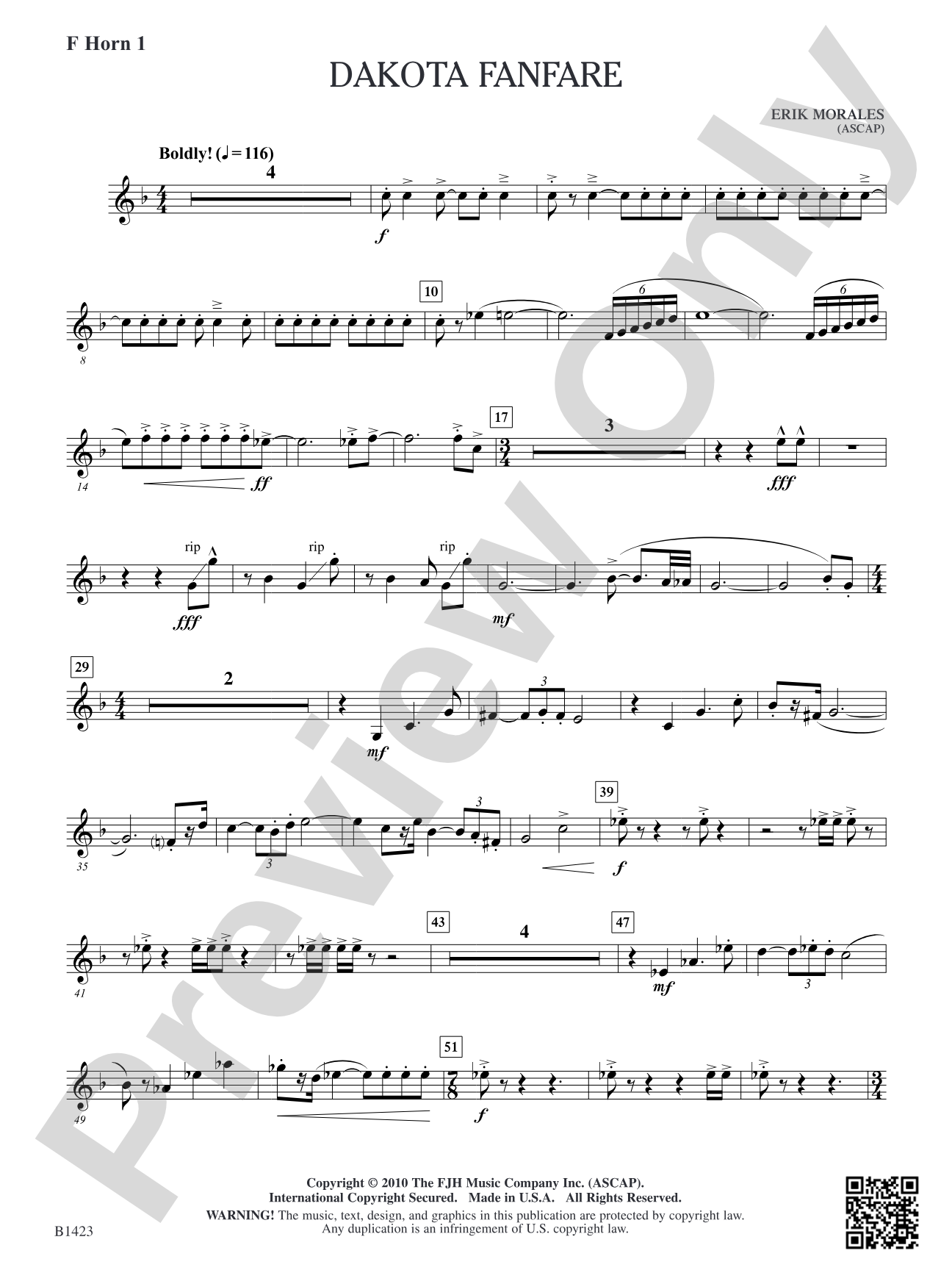

Dakota Fanfare: F Horn 1
By Erik Morales
Grade: 5
Item: 98-PC-DB1423_H1
$7.00
Pickup currently not available
Description
Explode into a flurry of sound with this riveting work based on a driving rhythmic pulse. Incredible trumpet flourishes open the work (and are surprisingly easy to play as they alternate strictly between first and open fingerings!) before the woodwinds take over to state the infectious main theme. After a whirlwind of meter changes and ensemble hits, the music returns to the opening material before a dramatic and intense accelerando, bringing the fanfare to a fiery conclusion. Stunning!


Dakota Fanfare: F Horn 1 isn't in MakeMusic Cloud just yet...but it could be. Let us know you'd like to see it, and you'll help shape what comes next. In the meantime, start a free trial and dive into thousands of interactive titles your students can play along with today.
Request This Title
Tell us you want it.
Start Your Free Trial
Explore everything that's ready to play right now.
Sample Audio
1
Audio File
--:--
0:00
0:00
Sample Video
No sample videos found.
Additional Details
Series:
FJH Symphonic Band
Publisher:
The FJH Music Company, Inc.
SKU:
98-PC-DB1423_H1
More about this title
About the Composer: Erik Morales

Erik Morales was born in New York City in 1966 and began composing during his high school years in south Florida, initially arranging music for his band director's marching ensemble in 1985. He earned his bachelor's degree from the University of Louisiana, Lafayette (1989) and studied composition at Florida International University. His catalog now includes over 150 published works spanning wind ensembles, orchestral settings, jazz, and chamber combinations, all performed internationally.
As a trumpet player, Morales has shaped the modern trumpet repertoire through compositions that balance artistic ambition with pedagogical integrity. His trumpet ensemble works have earned first-place recognition at the 2006 and 2008 National Trumpet Competitions, and his Concerto for Trumpet in C and Piano premiered at the 2009 International Trumpet Guild conference. In 2016, he was inducted into the Louisiana Association for Jazz Education's Hall of Fame. He continues to receive commissions from schools and organizations across the country.
Why we love this
Morales knows how to write for the trumpet section, and it shows immediately in Dakota Fanfare. The opening flourishes exploit the natural break between first valve and open fingerings, giving young players an accessible entry into flashy writing. Beyond the spectacle, the piece builds ensemble cohesion through precise meter changes and strategic hits that require genuine coordination, making it engaging both to teach and to perform.
What to expect
Dakota Fanfare pulses with driving energy from the first note, opening with brilliant trumpet calls that establish an immediate sense of urgency and celebration. The piece races through shifting meters and ensemble colors, never settling into predictability, before accelerating toward a finale that feels both earned and exhilarating.
Who it's for
This is a Grade 5 concert band piece designed for advanced middle school or high school ensembles seeking substantial repertoire with technical demands that reward careful preparation. Bands preparing for festival or contest programming will find a work that showcases both bright brass writing and compositional craft without requiring specialized instrumentation.
How to get the most out of it
- Balance the opening trumpet figure carefully; the alternating first-valve and open notes should feel clean and crisp rather than sloppy. Slight separation between sections of the figure maintains clarity.
- Lock the woodwind entrance with the rhythm section. The transition from trumpet to the main theme needs precision, so rehearse that moment repeatedly until the handoff feels seamless.
- Shape the accelerando toward the conclusion with attention to both tempo and dynamics. The intensity should build gradually; avoid jumping to the final tempo too early.
- Pay close attention to the meter changes throughout. Mark them visibly on the parts and consider rehearsing passages in isolation before layering them back into the full ensemble.
How to use it
Program this as a commanding opening to a concert where you want to establish ensemble confidence and audience attention immediately. It pairs well with slower, more lyrical pieces later in the program, providing contrast in tempo and texture while showcasing your trumpet section's abilities.
Skills your students will build
- Clarity and accuracy in alternating fingering patterns (open and first-valve passages)
- Reading and executing multiple meter changes (3/4, 4/4, and mixed meters)
- Ensemble precision through rhythmic synchronization and sectional balance
- Dynamic shaping and phrasing within a fast-moving, energetic context
- Collaboration between brass and woodwind sections during thematic handoffs