
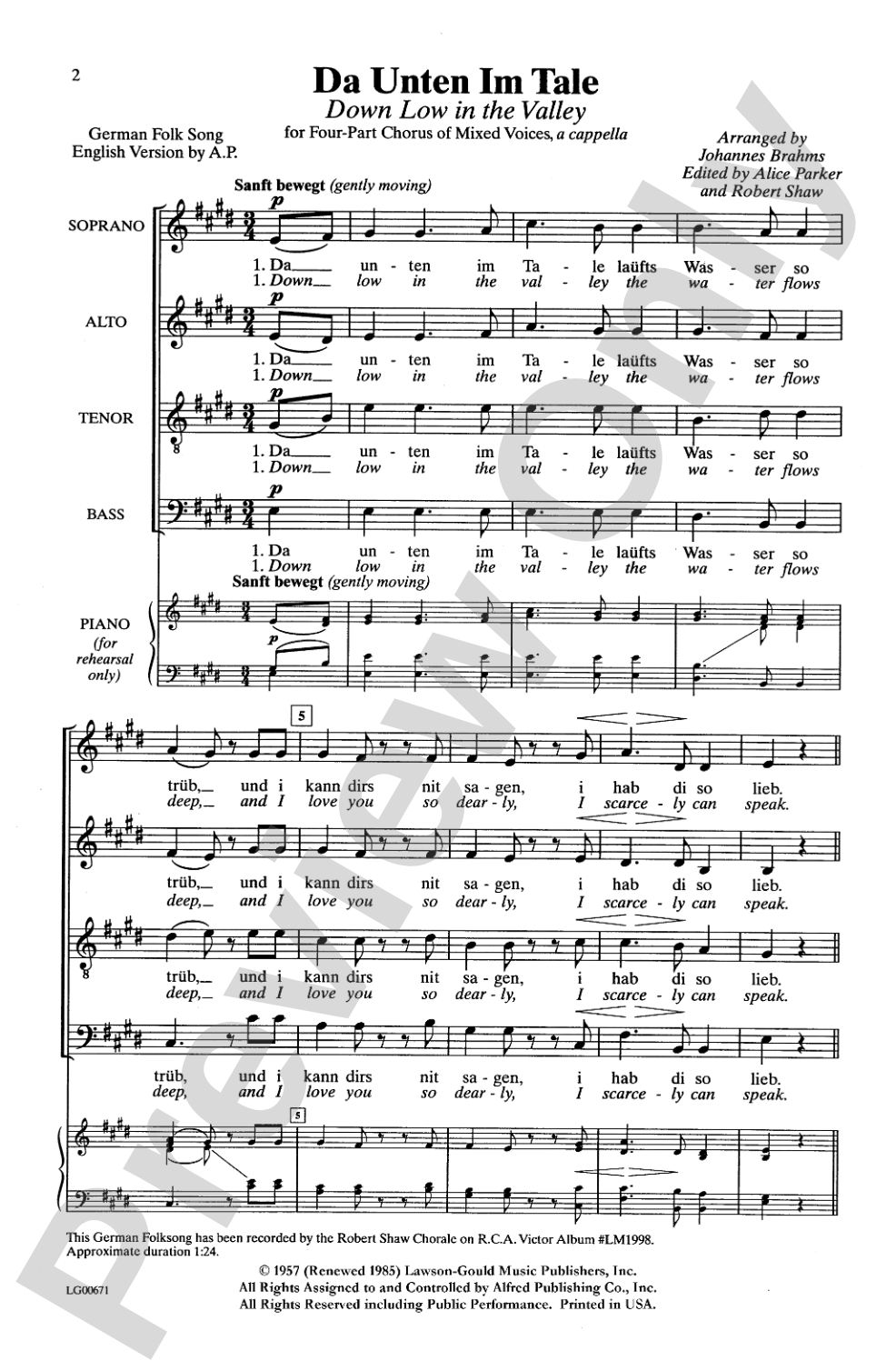
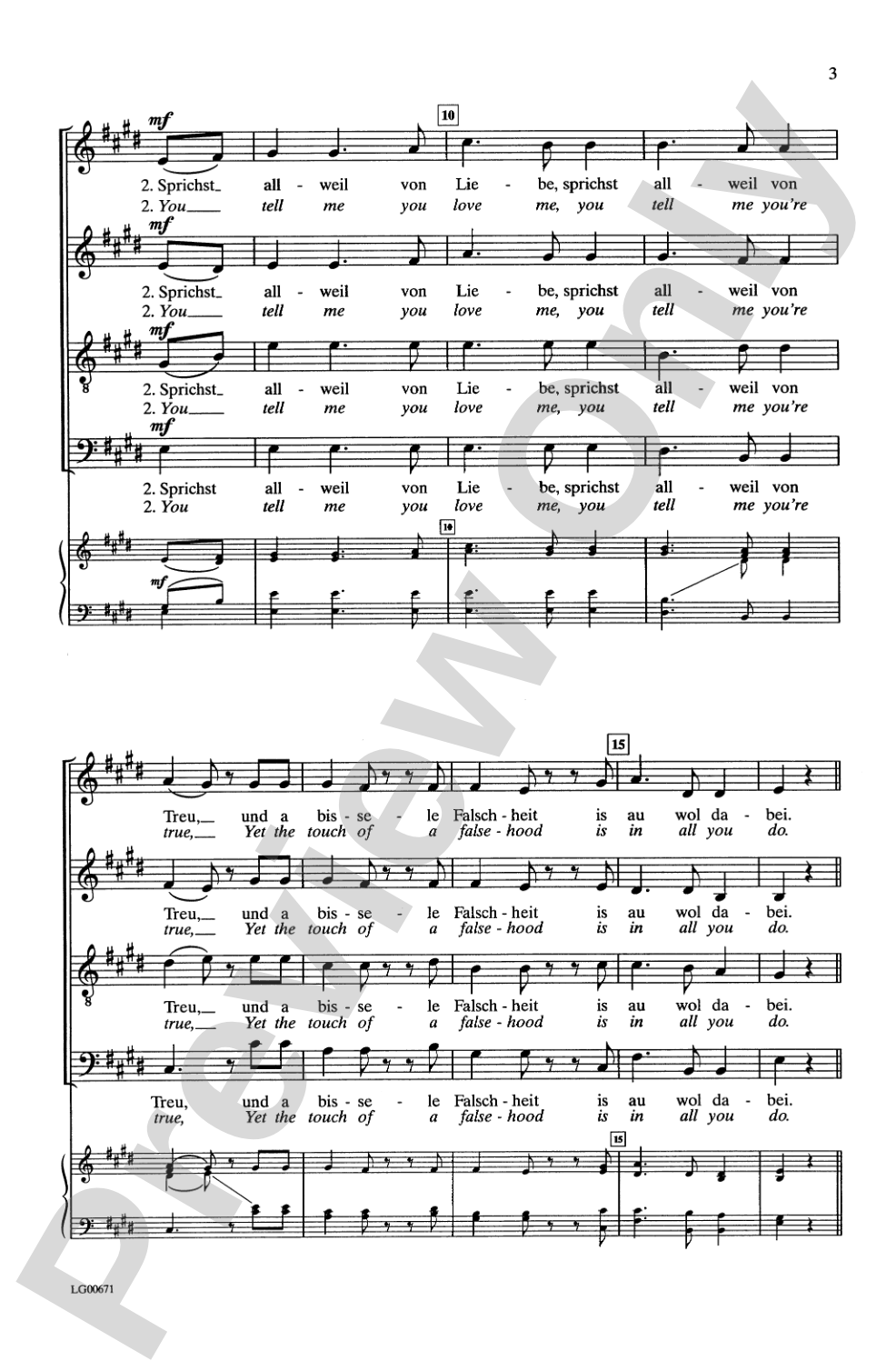

Da Unten Im Tale / In Stiller Nacht (Down Low in the Valley / The Still of Night): SATB, a cappella Choral Octavo
(Down Low in the Valley / The Still of Night)
German Folk Songs / arr. Johannes Brahms / ed. Alice Parker and Robert Shaw
Item: 00-PO-0004935
$2.25
Minimum order quantity: 20 copies
Pickup currently not available
Related Items
Da Unten Im Tale / In Stiller Nacht: SATB, a cappella Choral Octavo |
$2.25
|
View |
Description


Da Unten Im Tale / In Stiller Nacht (Down Low in the Valley / The Still of Night): SATB, a cappella Choral Octavo isn't in MakeMusic Cloud just yet...but it could be. Let us know you'd like to see it, and you'll help shape what comes next. In the meantime, start a free trial and dive into thousands of interactive titles your students can play along with today.
Request This Title
Tell us you want it.
Start Your Free Trial
Explore everything that's ready to play right now.
Sample Audio
No sample audio found.
Sample Video
No sample videos found.
Additional Details
Series:
Alfred Archive Edition: Lawson-Gould Music Publishers
Publisher:
Alfred Music
Page Count:
8
SKU:
00-PO-0004935
More about this title
About the Arranger: Johannes Brahms
Johannes Brahms (1833–1897) was a German composer and conductor whose deep engagement with folk traditions shaped his compositional voice throughout his career. Beyond his symphonies and concertos, Brahms devoted significant energy to arranging and collecting folk songs, viewing them as repositories of musical wisdom and emotional authenticity. His arrangements of German folk material reveal his gift for honoring a song's essential character while enriching its harmonic and textural possibilities.
Brahms's approach to folk arrangement was scholarly and reverent. He studied regional musical traditions, collaborated with folk song collectors, and published several collections of arrangements. These works were not exercises in modernist recomposition but acts of preservation and celebration, demonstrating that folk material could sustain the most sophisticated musical minds. For choral directors and singers, his arrangements remain exemplary models of how to serve a traditional melody while deepening its expressive reach.
Why we love this
Brahms's harmonic language transforms these paired folk melodies into something luminous without overshadowing them. The a cappella setting requires genuine blend and control from your singers, making this both a showcase for ensemble maturity and a rewarding rehearsal challenge that yields immediate, audible results.
What to expect
Quiet contemplation beneath starlight. The music settles into a hushed, intimate space, with warm harmonic sonorities that feel both simple and profound. There's a sense of timelessness here, as though the folk melody is being sung in a room where everyone has gathered simply to listen and remember.
Who it's for
This arrangement serves choral ensembles with solid intonation and blend skills but doesn't demand virtuosity. It works well for concert or festival settings where you want to program something of genuine substance that audiences immediately recognize as beautiful and accessible.
How to get the most out of it
- Shape the opening phrase with gentle forward motion in the soprano, allowing the lower voices to establish a solid harmonic foundation before the melody gains prominence.
- Balance the alto and tenor lines carefully during passages where they move in counterpoint; these inner voices carry essential harmonic color and deserve clarity without sacrificing blend.
- Attend to the text's emotional arc across both melodies. The gentle, introspective character demands a warm, well-supported tone throughout, with vibrato controlled to maintain ensemble unity.
- Bring voices into the piece gradually during early rehearsals, layering parts once the soprano melody is secure; this approach helps singers hear both the folk tune and their own harmonic role.
How to use it
Program this on a concert where you're exploring European folk traditions or building a set around themes of nature and reflection. It pairs naturally with other German folk arrangements, Renaissance part-songs, or art songs, creating a sophisticated program that feels cohesive without sacrificing variety. The intimate scale makes it particularly effective as a contrasting moment in a longer concert.
Skills your students will build
- Sustaining pure vowel sounds and maintaining blend in a cappella settings
- Reading and balancing inner voice counterpoint while supporting the soprano melody
- Understanding harmonic function and how arrangement enriches folk material
- Performing with controlled vibrato appropriate to ensemble singing
- Interpreting textual meaning and translating it into musical shape and color