
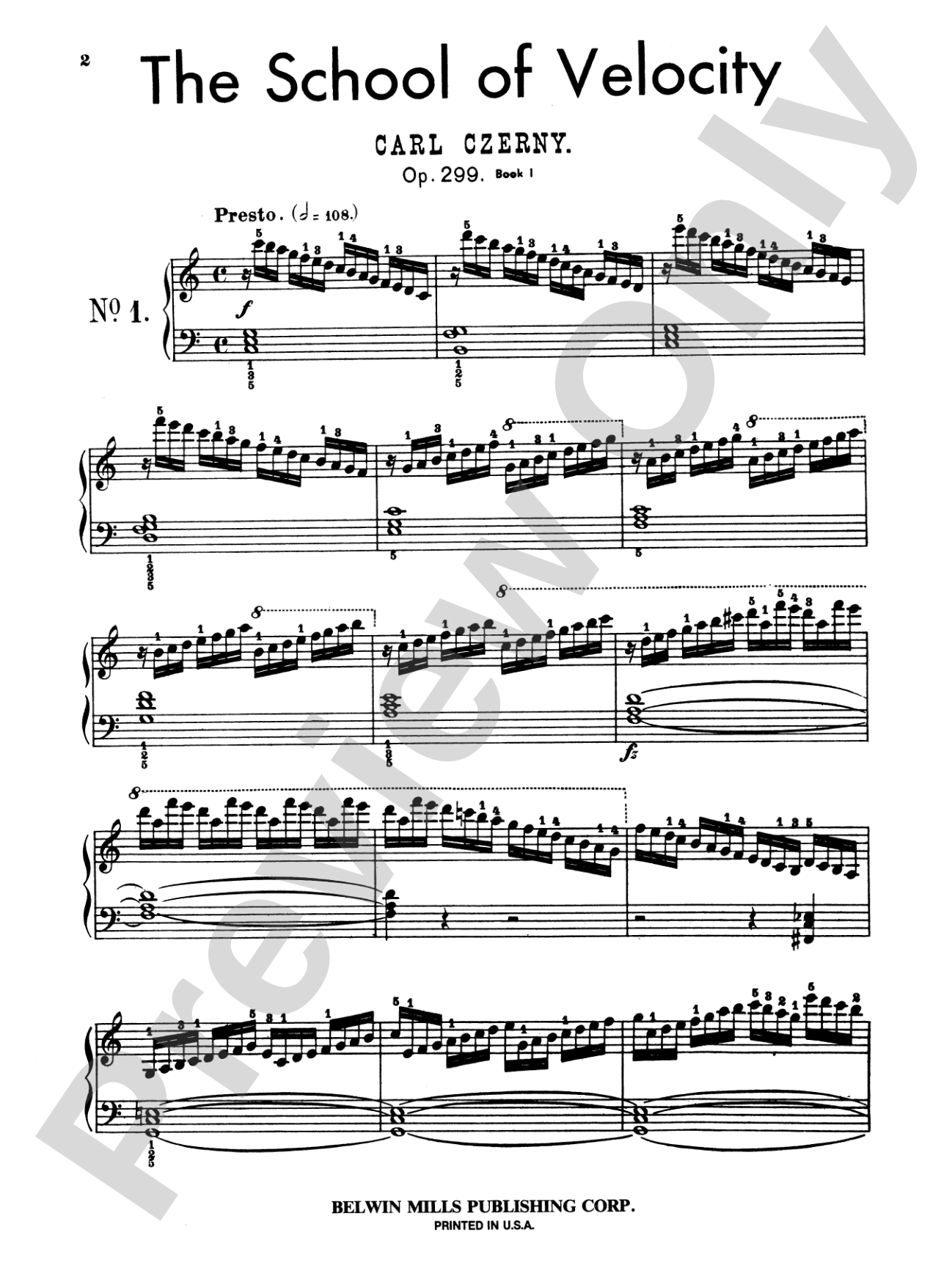

Czerny: School of Velocity, Op. 299 (Complete): Piano Book
By Carl Czerny
Item: 00-PK-0003027

$10.99
Pickup currently not available
Buy Extra Parts (Digital PDF Download)
Parts Added to Cart!
Related Items
School of Velocity, Opus 299 (Complete): Piano Book |
$10.99
|
View |
Description
Carl Czerny (1791--1857) was an Austrian pianist, composer and teacher. Today he is best remembered for his volumes of études for the piano. Czerny's music was greatly influenced by his teachers, Clementi, Hummel, Salieri and Beethoven. This book contains Czerny's Opus 299 (Books 1-4), "The School of Velocity," Exercises 1-40.


Don't just read it, hear it, play along with it, and watch your students grow with it. In MakeMusic Cloud, Czerny: School of Velocity, Op. 299 (Complete): Piano Book comes alive with professional accompaniment, adjustable tempo, and built-in practice tools that turn solo practice into real progress.
Open in the Player
Jump straight in and assign it today.
Start Your Free Trial
Open this title and explore the full library in minutes.
Sample Audio
No sample audio found.
Sample Video
No sample videos found.
Additional Details
Series:
Kalmus Edition
Publisher:
Alfred Music
Page Count:
104
SKU:
00-PK-0003027
More about this title
About the Composer: Carl Czerny
Carl Czerny (1791-1857) was an Austrian pianist, composer, and pedagogue whose influence on piano technique remains foundational to music education today. A student of Beethoven and Hummel, Czerny synthesized the Classical virtuosity of his mentors into a systematic approach to finger work, hand independence, and velocity that transformed how pianists develop technical facility.
Why we love this
Czerny's School of Velocity stands apart because it builds speed with genuine musical purpose rather than mechanical repetition. The complete Op. 299 collection offers enough variety and progressive difficulty to sustain a student's engagement over months, and teachers appreciate that Czerny's writing respects the instrument while demanding real technical growth.
What to expect
Czerny's velocity studies feel purposeful and bright. Each exercise moves with forward momentum and clarity, never feeling empty despite the technical demands. There's a classical restraint and elegance to the writing; the music pushes technique without abandoning musicality.
Who it's for
This collection serves intermediate to advanced pianists (roughly Grades 3-5) who need systematic work on finger independence, clarity at tempo, and the confidence that comes from mastering elegant, well-crafted études. Teachers use it for students transitioning from foundation-building exercises to more musically rewarding technical work.
How to get the most out of it
- Lock in a steady tempo before increasing speed. Czerny's pieces reward rhythmic precision more than virtuosic rushing; establish the groove at a moderate pace and let muscle memory accelerate naturally.
- Shape the melodic line even in passages dominated by figuration. These études are not finger drills; voice the primary material so the piece breathes rather than blurs.
- Pay close attention to hand position and wrist rotation. Velocity work creates tension easily; efficient hand mechanics prevent injury and unlock the fluidity Czerny's writing demands.
- Use the full dynamic range Czerny notates. Contrast between forte and piano passages clarifies texture and prevents the monotony that fast, relentless playing can create.
How to use it
Assign these systematically within a student's practice schedule rather than as recital material. They function best as the technical foundation supporting more ambitious repertoire; a student working through Op. 299 gains the finger facility and rhythmic confidence needed for Romantic-era sonatas and character pieces.
Skills your students will build
- Sixteenth-note and thirty-second-note articulation at steady tempo
- Hand independence and finger facility across multiple registers
- Maintaining clarity and evenness in rapid scalar and arpeggiated passages
- Coordination of both hands in contrasting rhythmic patterns
- Reading and executing accurate dynamic shaping within technical passages
- Building stamina for sustained fast passages without fatigue or loss of control