
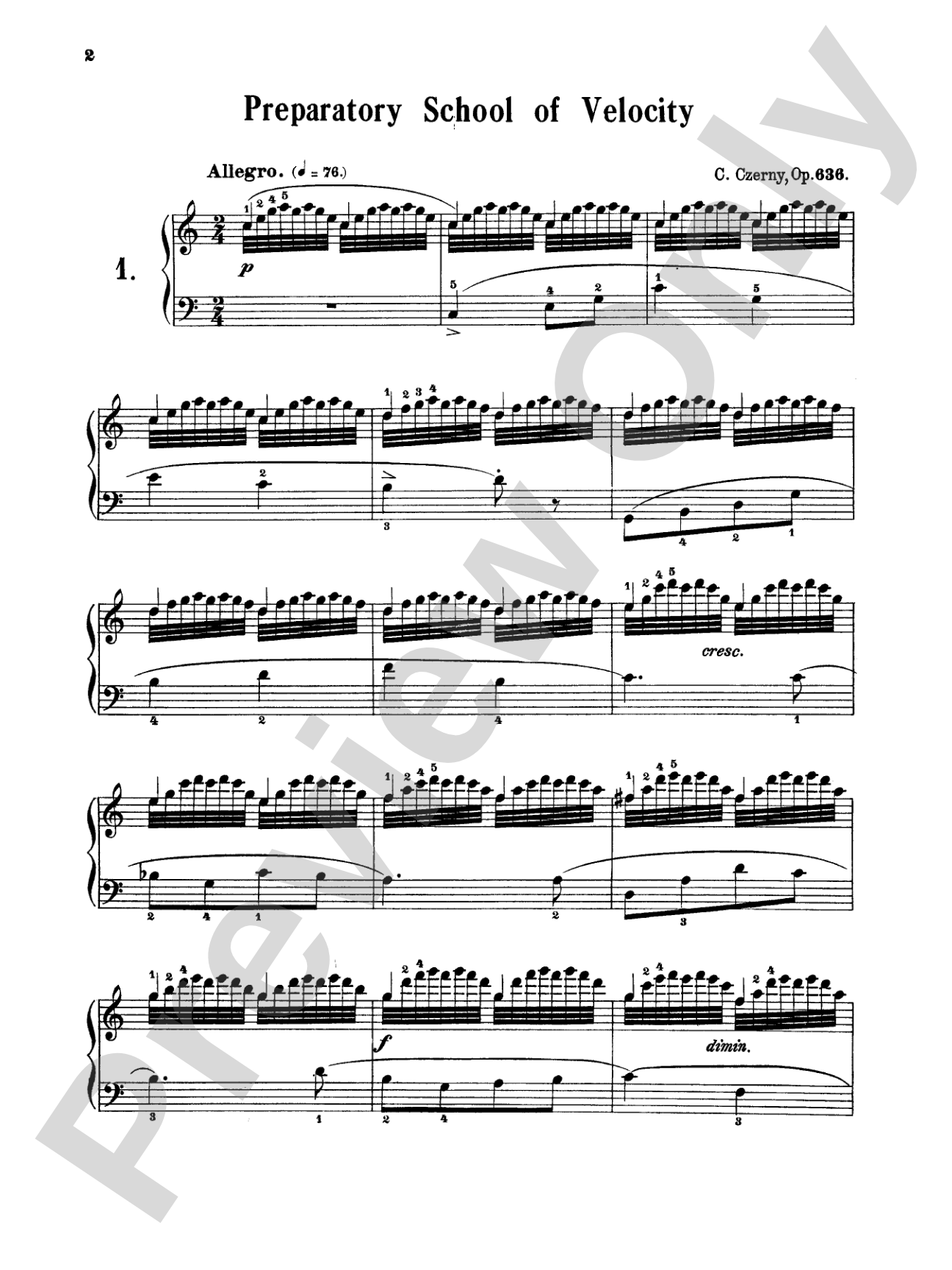
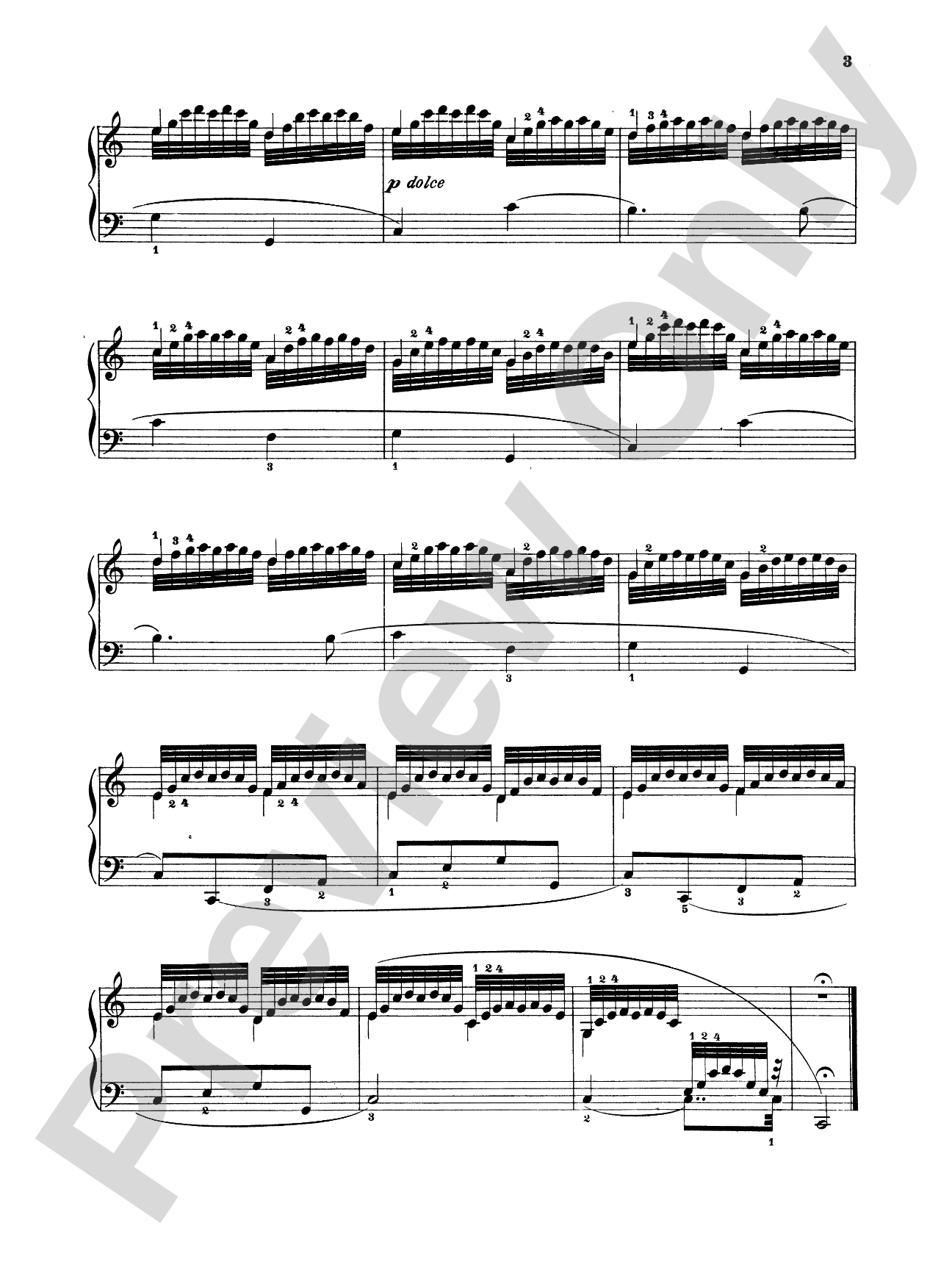

Czerny: Preparatory School of Velocity, Op. 636: Piano Book
By Carl Czerny
Item: 00-PK-0003029

$9.99
Pickup currently not available
Buy Extra Parts (Digital PDF Download)
Parts Added to Cart!
Related Items
Preparatory School of Velocity, Opus 636: Piano Book |
$9.99
|
View |
Description
Carl Czerny (1791--1857) was an Austrian pianist, composer and teacher. Today he is best remembered for his volumes of études for the piano. Czerny's music was greatly influenced by his teachers, Clementi, Hummel, Salieri and Beethoven. This book contains Czerny's Opus 636, "Preparatory School of Velocity," Exercises 1-23.


Don't just read it, hear it, play along with it, and watch your students grow with it. In MakeMusic Cloud, Czerny: Preparatory School of Velocity, Op. 636: Piano Book comes alive with professional accompaniment, adjustable tempo, and built-in practice tools that turn solo practice into real progress.
Open in the Player
Jump straight in and assign it today.
Start Your Free Trial
Open this title and explore the full library in minutes.
Sample Audio
No sample audio found.
Sample Video
No sample videos found.
Additional Details
Series:
Kalmus Edition
Publisher:
Alfred Music
Page Count:
48
SKU:
00-PK-0003029
More about this title
About the Composer: Carl Czerny
Carl Czerny (1791, 1857) studied directly with Beethoven and became one of the most prolific composers of pedagogical music in the nineteenth century. His output spanned thousands of compositions, most designed to solve specific technical problems pianists encountered at various levels of advancement. Rather than treat technique as separate from musicality, Czerny embedded learning into musical contexts, which is why his études remain teaching standards across conservatories worldwide.
Czerny's training under Clementi, Hummel, and Salieri gave him an insider's understanding of what pianists actually needed to play the virtuosic repertoire of his era. He wrote not as a theorist but as a working musician who knew exactly which finger patterns, hand positions, and rhythmic challenges would prepare students for real concert pieces. His legacy rests less on popularity than on pedagogical intelligence.
Why we love this
Czerny's Opus 636 sits at a crucial developmental moment: students have moved beyond elementary technique but need systematic preparation for the velocity demands of Romantic repertoire. These 23 exercises build fingerwork patterns that become muscle memory, freeing students to focus on interpretation and expression in more substantial works. The progression is pedagogically sound, moving through related technical challenges without feeling arbitrary.
What to expect
Czerny's voice here is pragmatic and musical at once. These are not dry, mechanical patterns; they move through the piano with clarity and often surprising grace. The exercises flow logically from one to the next, building confidence as fingering patterns expand and hand positions shift.
Who it's for
Intermediate pianists working toward Romantic-era repertoire who need targeted technical preparation without the musical demands of full-length etudes or character pieces. Teachers value this collection for students transitioning from late-elementary to early-intermediate levels who are ready for disciplined velocity work but benefit from short, focused exercises.
How to get the most out of it
- Establish a steady tempo before increasing speed. Czerny exercises demand accuracy at moderate tempos first; velocity follows naturally once the pattern is secure in the hands.
- Practice hands separately when learning a new exercise, then bring them together only once each hand reads comfortably alone.
- Maintain consistent finger height and evenness throughout running passages. Relaxation matters as much as precision; tension in the hand undermines the velocity gains these exercises develop.
- Use a metronome starting at a conservative tempo, then increment by small increments (5–10 BPM) across multiple practice sessions rather than rushing to performance speed.
How to use it
Assign these systematically as part of a student's weekly practice routine rather than as performance pieces. A teacher might anchor a studio recital around one or two of the more musical exercises as pedagogical demonstrations of progress, showing families how technical work translates to fluency and ease.
Skills your students will build
- Scalar passages in sixteenth-note patterns across multiple octaves
- Consistent hand position and finger independence during rapid passagework
- Rhythmic precision and evenness in running figures
- Left-hand accompaniment patterns paired with right-hand velocity lines
- Reading and executing repeated figures with increasing accuracy and speed