
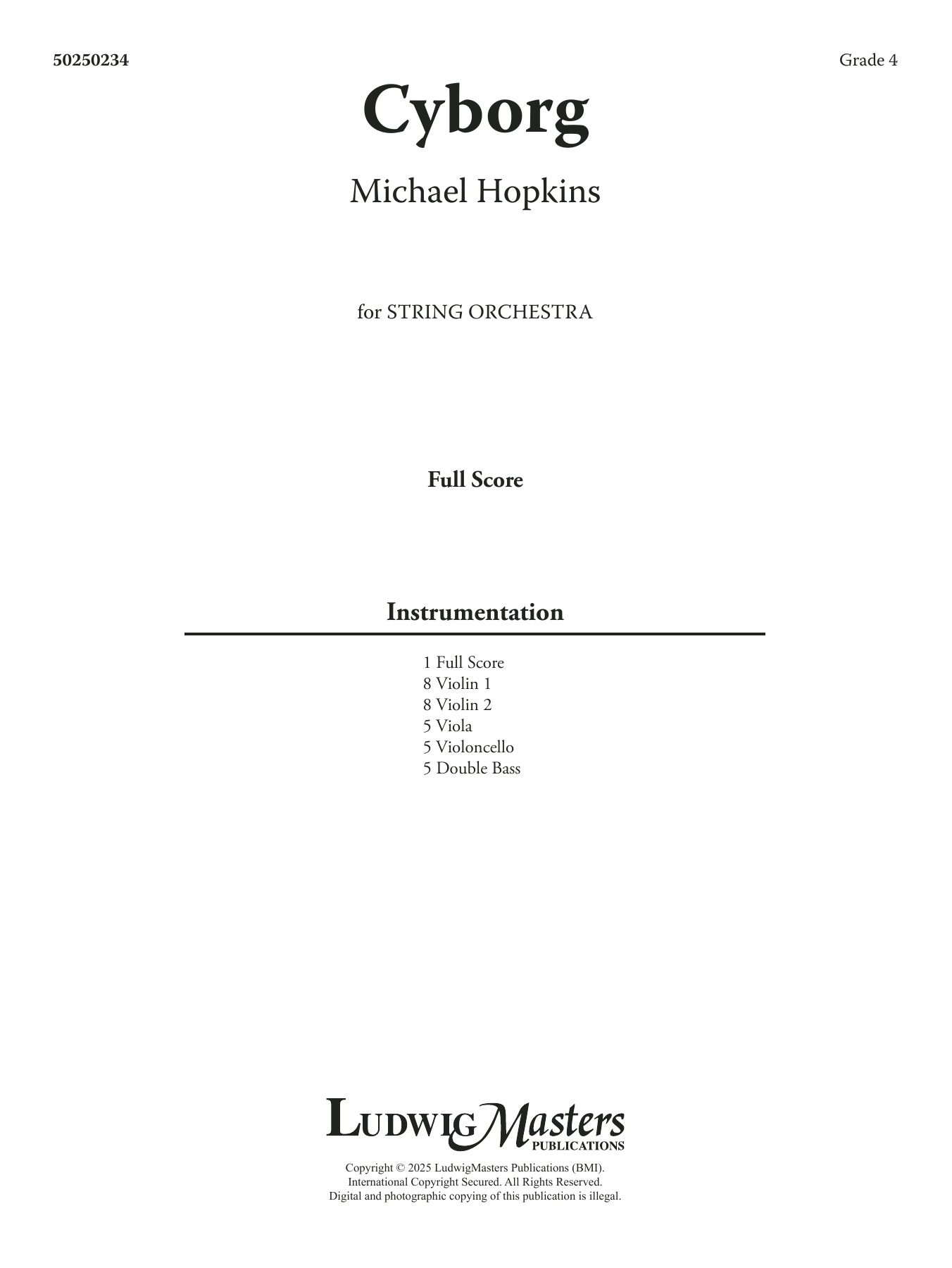

Cyborg: String Orchestra Conductor Score & Parts
By Michael Hopkins
Grade: 4
Item: 35-PK01699901
$65.00
Pickup currently not available
Buy Extra Parts (Digital PDF Download)
| Product | Price | Quantity |
|---|---|---|
| Cyborg - Full Score | $10.00 | |
| Cyborg - Violin 1 | $2.50 | |
| Cyborg - Violin 2 | $2.50 | |
| Cyborg - Viola | $2.50 | |
| Cyborg - Cello | $2.50 | |
| Cyborg - Bass | $2.50 |
Parts Added to Cart!
Description
Cyborg is an upbeat, high energy blues-rock piece for intermediate orchestra. This is a great piece for working on left hand chromatic fingering, syncopated rhythms, and crisp articulations. Written in a modified 12-bar blues form, the music features all sections of the orchestra on thematic material. You and your students will have fun performing this exciting work for intermediate orchestra.


Cyborg: String Orchestra Conductor Score & Parts isn't in MakeMusic Cloud just yet...but it could be. Let us know you'd like to see it, and you'll help shape what comes next. In the meantime, start a free trial and dive into thousands of interactive titles your students can play along with today.
Request This Title
Tell us you want it.
Start Your Free Trial
Explore everything that's ready to play right now.
Sample Audio
No sample audio found.
Sample Video
No sample videos found.
Additional Details
Publisher:
Hal Leonard
SKU:
35-PK01699901
More about this title
About the Composer: Michael Hopkins

Michael Hopkins leads the music education program at the University of Michigan, where he specializes in string pedagogy, orchestra methods, and music technology. His career spans decades of conducting university orchestras and directing student ensembles at the middle and high school levels across Colorado, Michigan, and Vermont. He founded the Burlington Chamber Orchestra and has guest conducted at over 100 festivals and clinics nationwide.
Hopkins has established himself as a voice in music education research, publishing in peer-reviewed journals including the Journal of Research in Music Education and American String Teacher. His textbook, The Art of String Teaching, serves as a standard reference for orchestral pedagogy. With over 70 published compositions and arrangements for orchestra to his credit, he writes with both the classroom conductor and the developing musician in mind.
Why we love this
Hopkins captures what makes intermediate orchestras tick: genuine fun alongside real technical challenge. The blues-rock idiom gives students permission to groove and lean into the rhythm without sacrificing the fingerwork and articulation work that matters at this level. It's the kind of piece that gets your ensemble genuinely excited about rehearsal.
What to expect
Cyborg kicks with forward momentum and swagger. The blues-rock foundation gives the piece a streetwise confidence, while the orchestral treatment keeps it sophisticated; you'll hear all sections trading the main ideas, which builds ensemble texture and keeps everyone invested in the arrangement. It's the kind of piece that feels cool to play.
Who it's for
String orchestras at the intermediate to early advanced level who thrive on contemporary idioms and want to deepen their rhythmic precision. It works equally well for students who respond to energy and groove as a learning tool, and for programs that value performing music written by educators who understand how strings develop.
How to get the most out of it
- Establish the groove first, even before drilling rhythmic accuracy. Have students tap the main beat in their laps while you conduct the syncopations; this anchors everyone to the underlying pulse before they worry about landing on the offbeats.
- Map out the chromatic passages in the left hand before adding bow movement. Isolate measures with technical density and have players practice the fingering up to tempo without bows, then gradually integrate smooth bow changes.
- Lock down section articulations separately. String players often want to soften the attack during syncopated figures; mark which notes need snap and which can breathe, then rehearse one section at a time against a click track.
How to use it
Program it as the anchor of a contemporary or pops concert, where it can shine without competing for attention. It also serves beautifully as a spring concert opener that establishes energy and shows community audiences what your intermediate group can do with modern idioms. The technical demands make it a strong choice for festival or contest repertoire when you want pieces that challenge rhythm section and soloists equally.
Skills your students will build
- Chromatic left-hand fingering with accurate intonation
- Syncopated rhythms (sixteenth-note subdivisions against main beat)
- Crisp articulation under dynamic control
- 12-bar blues form recognition and structure
- Ensemble listening for sectional independence and rhythmic lock