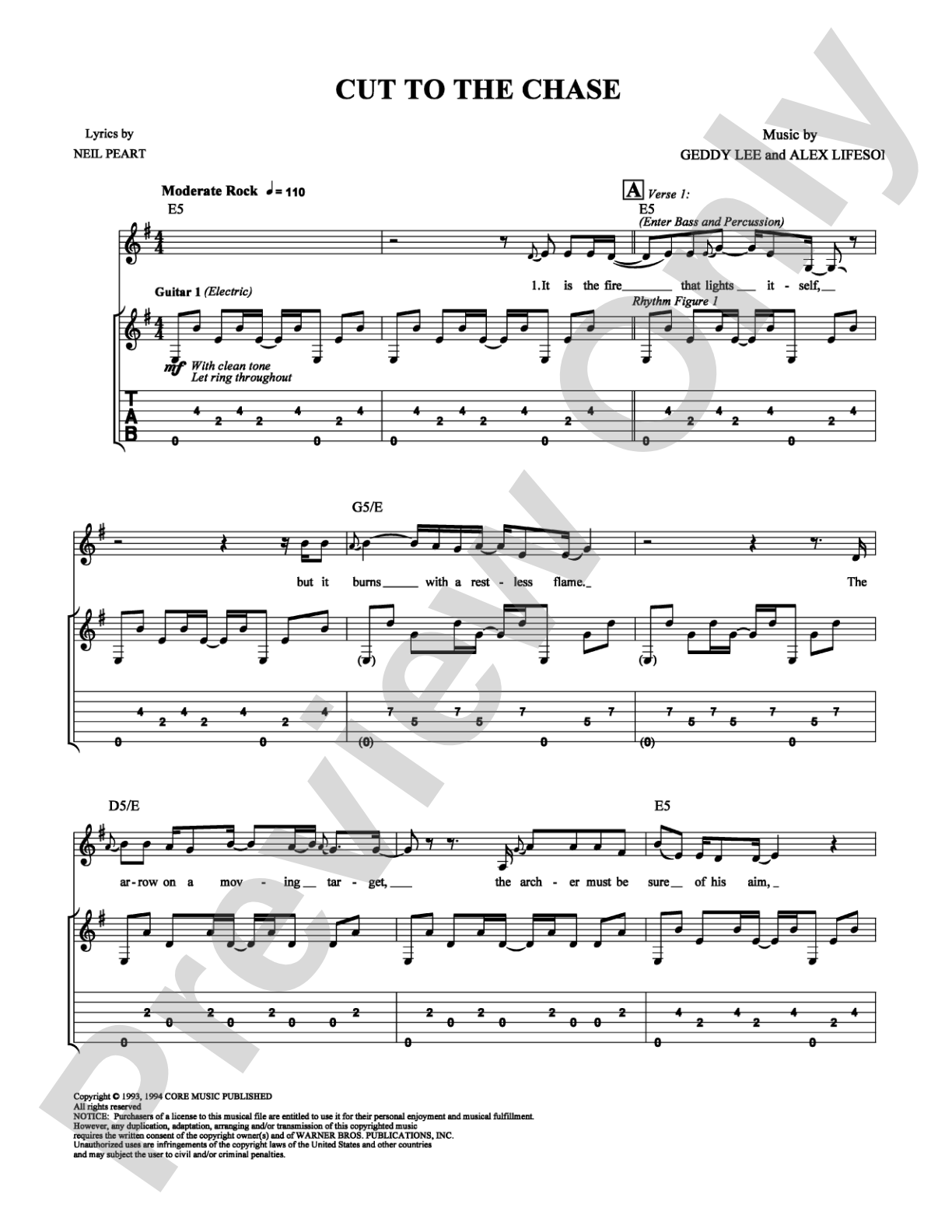
Cut to the Chase: Guitar TAB Digital Sheet Music

Cut to the Chase: Guitar TAB Digital Sheet Music

Rush, Geddy Lee, Alex Lifeson

Item: 00-PS-0003077

Digital Download
$2.99
Description

Cut to the Chase: Guitar TAB Digital Sheet Music isn't in MakeMusic Cloud just yet...but it could be. Let us know you'd like to see it, and you'll help shape what comes next. In the meantime, start a free trial and dive into thousands of interactive titles your students can play along with today.

Sample Audio
No sample audio found.
Sample Video
Additional Details
SKU: 00-PS-0003077

More about this title

About the Artist: Rush

Rush stands as one of rock's most technically demanding and philosophically ambitious bands. Formed in Toronto in 1968, the trio of Geddy Lee (vocals and keyboards), Alex Lifeson (guitar), and Neil Peart (drums and lyrics) built a catalog defined by complex time signatures, virtuosic instrumental passages, and lyrics rooted in science fiction, philosophy, and individual freedom. Their influence on progressive rock and metal education is substantial; generations of musicians have used Rush compositions to develop precision, endurance, and the confidence to play against unconventional harmonic and rhythmic structures.

Peart's drumming and compositional vision drove much of Rush's evolution across five decades. Lifeson's guitar work ranges from angular, syncopated rhythm parts to extended solos that demand both technical fluency and musical maturity. For guitar students, Rush's catalog serves as a bridge between accessible rock fundamentals and the demands of professional-level musicianship.

Why we love this

Rush's catalog challenges guitarists to think beyond standard rock patterns and develop the rhythmic independence that separates competent players from engaged musicians. This TAB digital download gives students direct access to one of rock's most technically uncompromising bands without requiring transcription skills or years of ear training to decode their work. Programming Rush in a guitar curriculum signals that you expect serious musicianship.

What to expect

Cut to the Chase captures Rush at their most propulsive. The piece moves with urgency and precision, built on guitar lines that lock and unlock against the rhythm section with mechanical clarity. Playing it demands both mechanical accuracy and musical phrasing; nail the mechanics first, then find where the song actually breathes.

Who it's for

Intermediate to advanced guitarists who want to engage with Rush's catalog but lack access to reliable transcriptions. Students preparing for jazz or contemporary ensemble auditions will find Rush's metric complexity and harmonic language invaluable for developing rhythmic security. Teachers building a progressive rock unit will use this to set a high technical bar.

How to get the most out of it

  • Lock into the click. Rush's rhythmic architecture often sits slightly behind or ahead of a conventional beat; practice with a metronome set to subdivisions smaller than the main pulse to internalize where the phrase actually lands.
  • Separate hand independence from speed. Work the passage slowly enough that your fretting hand and picking hand are solving two different problems; speed emerges only when each hand understands its own role.
  • Study the context around your part. Rush songs rarely isolate the guitar; understanding where drums and bass sit relative to your line transforms a collection of notes into a cohesive arrangement.

How to use it

Assign this as a focused study piece for guitarists working on metric modulation or syncopated rhythmic independence. It works well as an elective repertoire choice for students who gravitate toward progressive rock and want to develop the maturity that style demands. Use it in a mixed-instrument ensemble context to teach how a guitar line functions within a dense, busy arrangement.

Skills your students will build

  • Reading and executing syncopated rhythmic figures against a steady pulse
  • Picking precision and consistency under tempo
  • Understanding harmonic rhythm in complex song structures
  • Hand independence between fretting and picking across wider intervals
  • Listening to and locking with a rhythm section in unconventional meters

You May Also Like