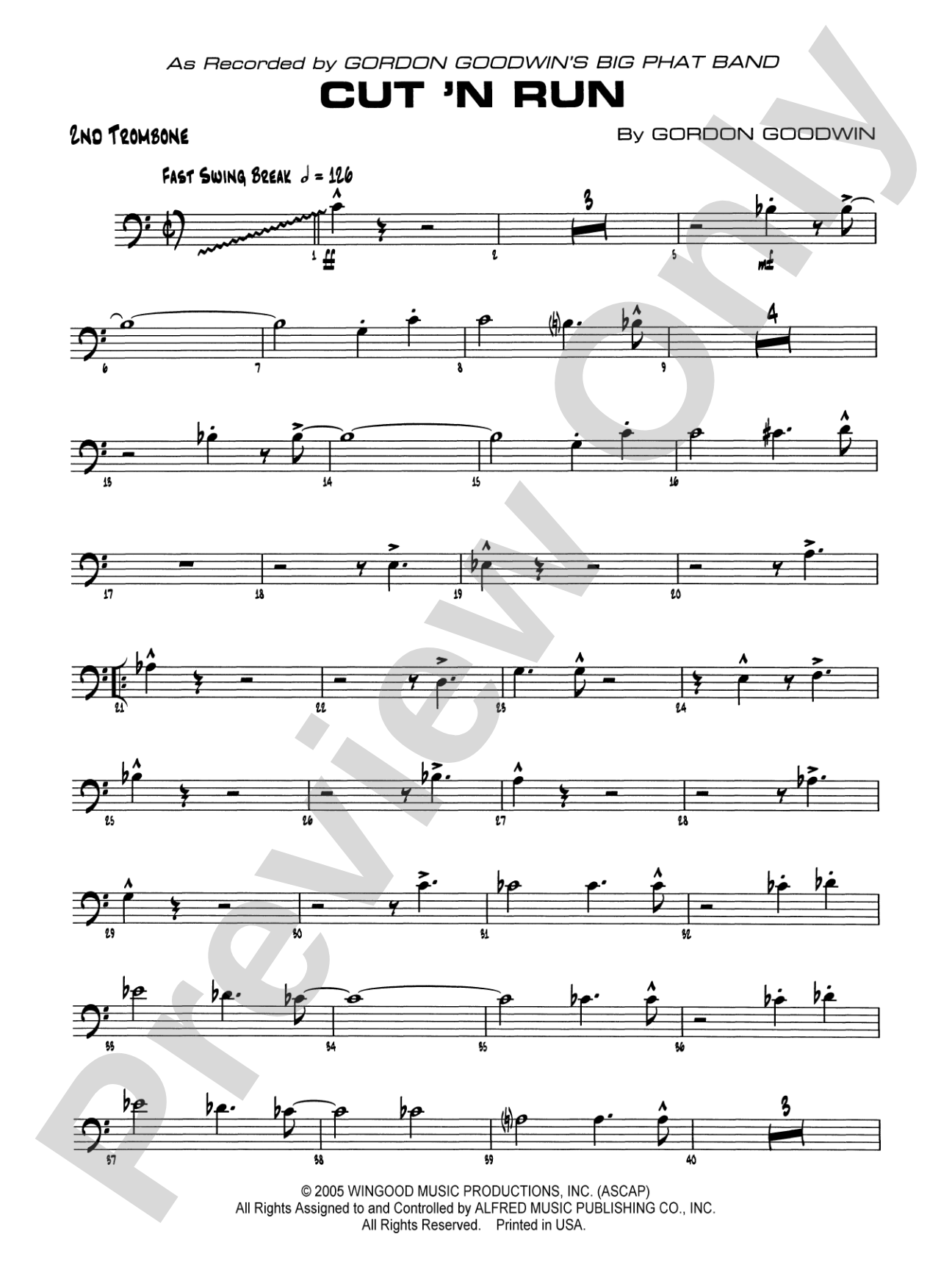
Cut 'n Run: 2nd Trombone Sheet Music Preview

Cut 'n Run: 2nd Trombone

By Gordon Goodwin

Grade: 5 (Advanced / Difficult)

Item: 00-PC-0014733_TN2

Digital Download
$3.00
Description
This swinger is like a high-wire act requiring speed, agility and the horsepower. Brilliant composer/arranger Gordon Goodwin penned this rapid tempo chart for his Big Phat Band and is recorded on his newest CD, The Phat Pack on Silverline Records. High energy throughout with optional solos for alto, tenor, trumpet and bones. Standard instrumentation. Hot! (excerpt 2:16) This title is available in MakeMusic Cloud.

Don't just read it, hear it, play along with it, and watch your students grow with it. In MakeMusic Cloud, Cut 'n Run: 2nd Trombone comes alive with professional accompaniment, adjustable tempo, and built-in practice tools that turn solo practice into real progress.

Sample Audio
0:00
0:00
Sample Video
Additional Details
Series: Gordon Goodwin Series
Publisher: Alfred Music
Page Count: 74
SKU: 00-PC-0014733_TN2

More about this title

About the Composer: Gordon Goodwin

Gordon Goodwin

Gordon Goodwin began composing at five years old, writing complete arrangements rather than fragments, and had already completed his first big band chart by age thirteen. His dual mastery of composition and orchestration has earned him three Emmy Awards and multiple Grammy nominations, with his scoring credits spanning films including Bad Boys II, Con Air, Remember the Titans, and Star Trek: Nemesis, alongside work with artists from Quincy Jones to Christina Agüera.

Since founding Gordon Goodwin's Big Phat Band in 2000, he has established himself as one of Los Angeles's most dynamic big band leaders. The ensemble's recordings have set industry benchmarks, with their debut making history as the first commercially available DVD audio release and their follow-up album XXL garnering three Grammy nominations for Best Large Jazz Ensemble Album and Best Instrumental Composition.

Why we love this

Goodwin's arrangements for his own Big Phat Band carry the confidence of someone who leads the ensemble night after night, so every rhythmic gesture and solo moment feels genuinely playable rather than theoretically impressive. At Grade 5, this chart demands technical facility and ensemble precision without sacrificing the infectious swagger that makes his writing instantly recognizable in the jazz world.

What to expect

From the opening measure, this chart radiates controlled intensity. Propulsive and athletic, it demands precision and energy in equal measure, with the optional solos providing moments of individual spotlight within a relentlessly driving ensemble texture.

Who it's for

Advanced jazz ensembles and college jazz bands with solid fundamentals across all sections and at least one capable soloist in each optional part (alto, tenor, trumpet, trombone). Directors comfortable programming demanding contemporary big band literature will find this chart both musically rewarding and immediately engaging for audiences.

How to get the most out of it

  • Lock the rhythm section into a unified groove before drilling the horn lines; the forward momentum of this swinger depends entirely on unshakeable pocket playing from drums, bass, and piano.
  • Map out the optional solo sections well in advance so soloists know exactly where they sit and can prepare accordingly; communicate clearly whether you want each solo taken or cut based on rehearsal time and player readiness.
  • Push the tempo gradually during sectional rehearsals before bringing it up to performance speed; players unfamiliar with Goodwin's angular melodic phrasing need time to absorb the rhythmic profiles without racing.

How to use it

Open a concert with this piece to set a high-energy tone, or use it as the centerpiece of a set dedicated to modern big band composition. Its recorded availability (on The Phat Pack) makes it an excellent choice for students who want to hear their exact arrangement performed at the highest level.

Skills your students will build

  • Reading rapid scalar passages and angular melodic figures
  • Ensemble precision at demanding tempos
  • Jazz articulation and swing phrasing at speed
  • Solo preparation and improvisation opportunities (alto, tenor, trumpet, trombone)
  • Listening to section partners in a complex harmonic environment

You May Also Like