
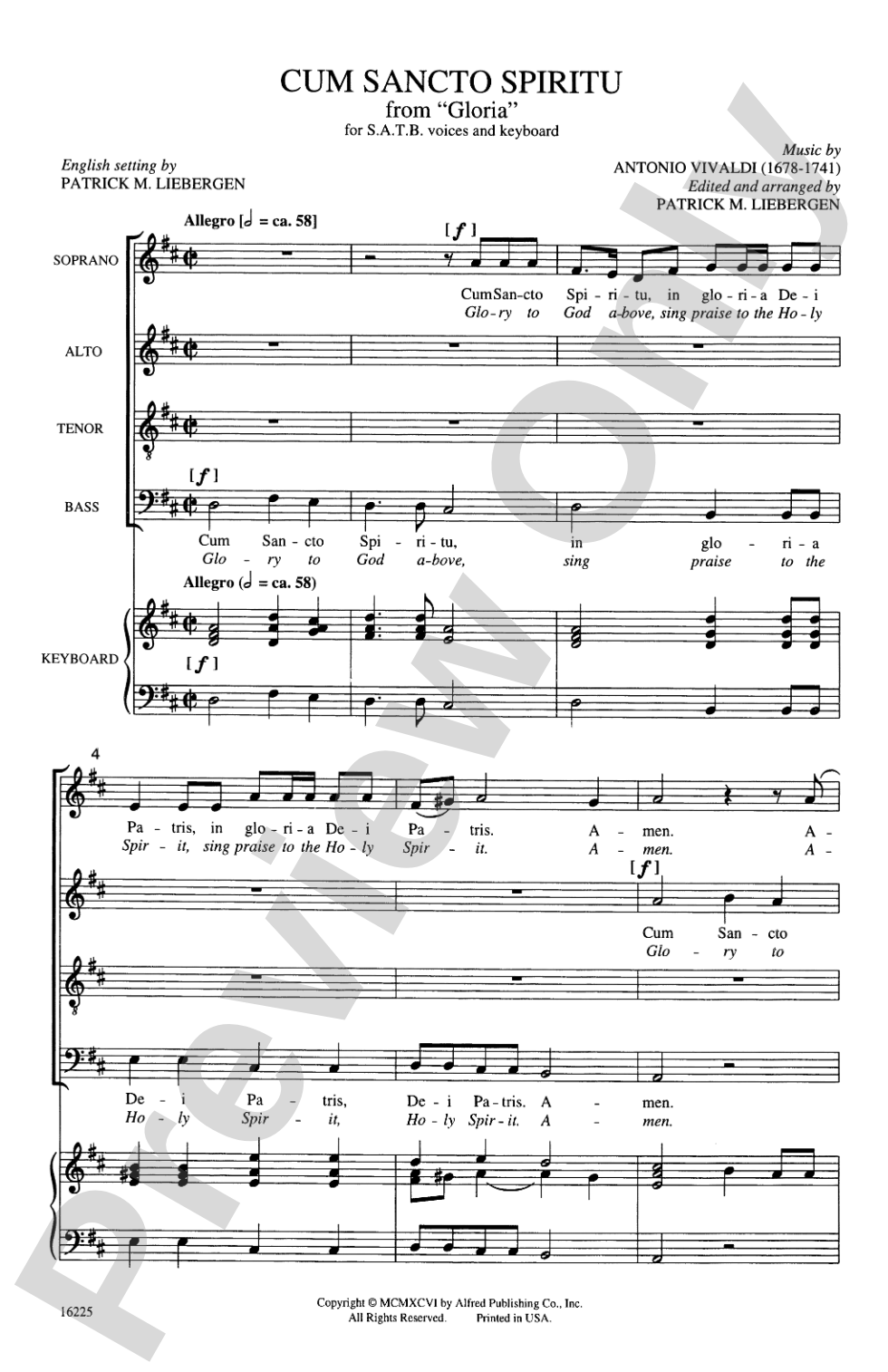
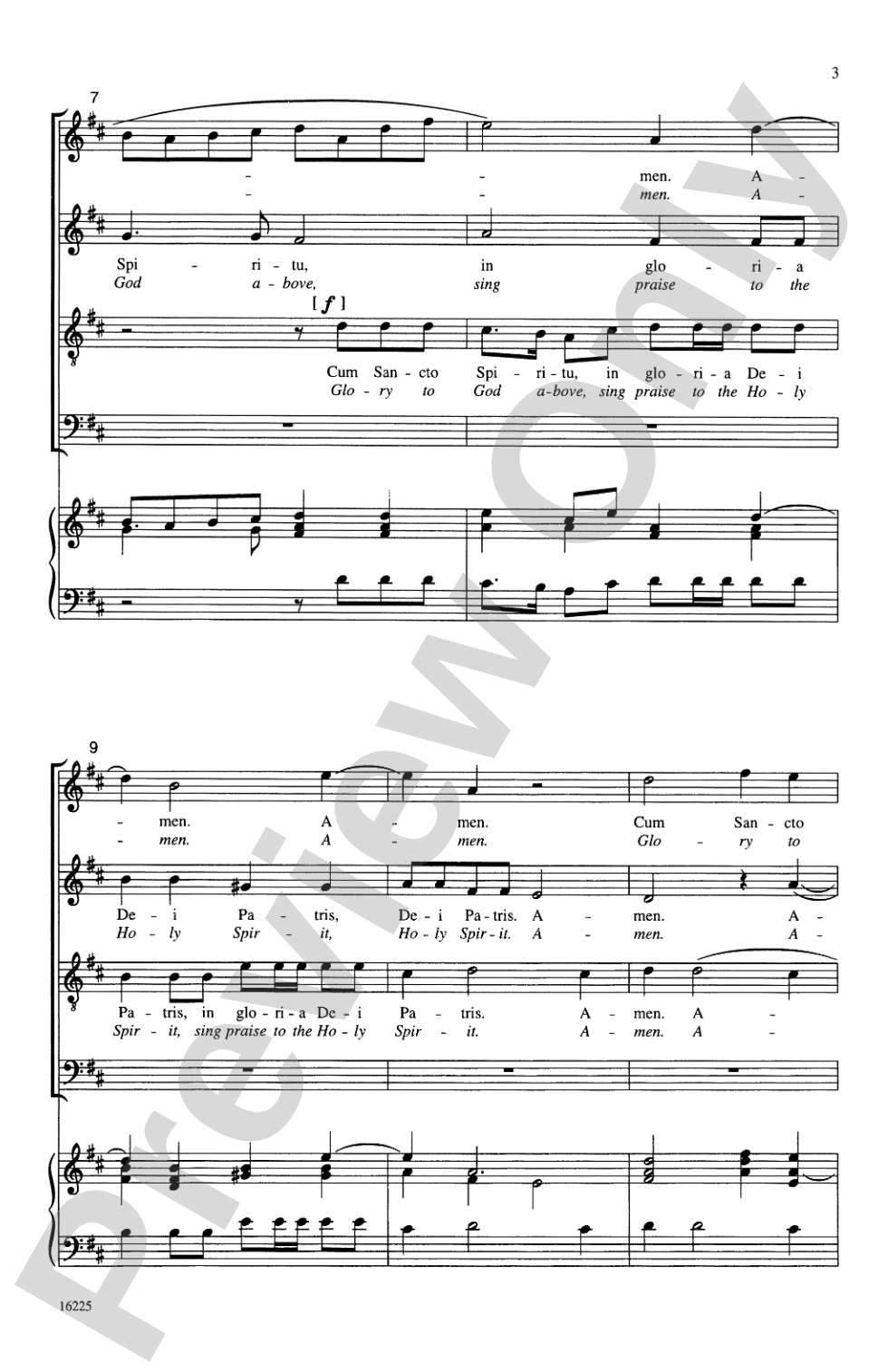
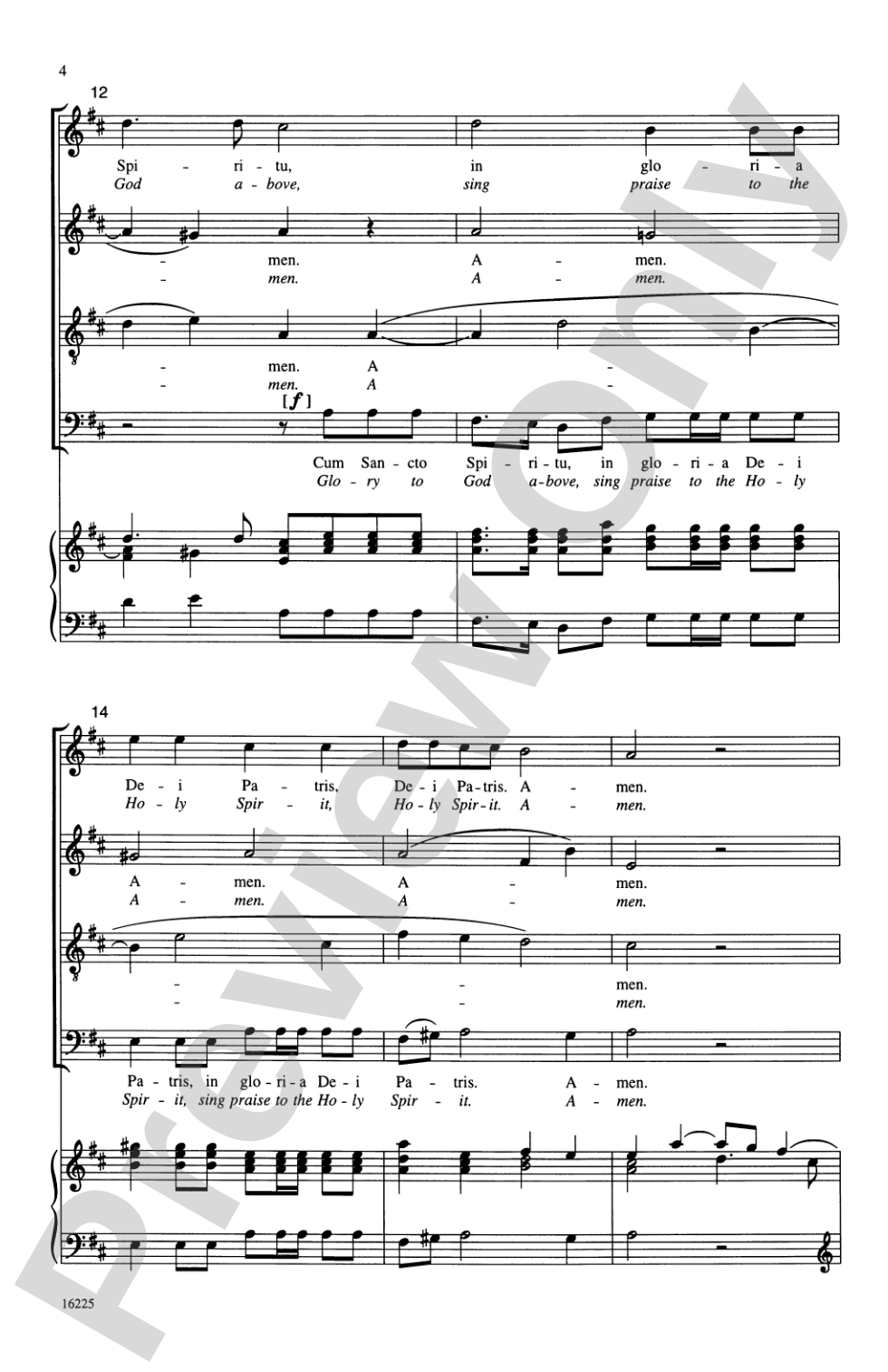

Cum Sancto Spiritu (from Gloria): SATB Choral Octavo
Music by Antonio Vivaldi / arr. Patrick M. Liebergen
Item: 00-PO-0002085
$2.95
Minimum order quantity: 20 copies
Pickup currently not available
Related Items
Cum Sancto Spiritu (from Gloria): SATB Choral Octavo |
$2.95
|
View |
Description
GLORIA is a setting of the hymn of praise from the traditional Latin Mass. The work is divided into twelve seperate movements, which include eight choruses, one aria for soprano, two arias for alto and a duet for two sopranos. The final movement is a setting of the words Cum Sancto Spiritu, in gloria Dei Patris. Amen. (with the Holy Spirit, the glory of God the Father. Amen.). This exuberant conclusion is a fuge which Vivaldi adapted from the final section of a GLORIA composed in 1708 by Giovanni Maria Ruggeri. Ruggeri was a colleague of Vivaldi in Venice. Vivaldi expanded Ruggeri's work into a joyous finale in praise of the Holy Spirit.


Cum Sancto Spiritu (from Gloria): SATB Choral Octavo isn't in MakeMusic Cloud just yet...but it could be. Let us know you'd like to see it, and you'll help shape what comes next. In the meantime, start a free trial and dive into thousands of interactive titles your students can play along with today.
Request This Title
Tell us you want it.
Start Your Free Trial
Explore everything that's ready to play right now.
Sample Audio
No sample audio found.
Sample Video
No sample videos found.
Additional Details
Series:
Alfred Archive Edition: Alfred Choral Designs
Publisher:
Alfred Music
Page Count:
16
SKU:
00-PO-0002085
More about this title
About the Composer: Antonio Vivaldi
Antonio Vivaldi (1678-1741) was a Venetian priest, virtuoso violinist, and prolific composer whose works defined the Baroque concerto and shaped sacred music across Europe. His facility with melody, rhythmic drive, and orchestral color made him one of the most performed composers of his era and beyond. In the early 18th century, Vivaldi composed multiple settings of the Gloria, a canticle of praise from the Latin Mass, each showcasing his gift for combining soloists, chorus, and orchestra into movements that range from intimate to jubilant.
For choral directors, Vivaldi's Gloria movements remain among the most rewarding sacred works to rehearse. His writing for choir balances accessibility with brilliance: the lines sit well in the voice, the harmonies are clear and tonal, and the architectural sense of drama builds naturally from section to section. This final movement, Cum Sancto Spiritu, exemplifies why Vivaldi's choral works endure in schools, churches, and concert halls.
Why we love this
Patrick Liebergen's arrangement captures the infectious energy of Vivaldi's fugal finale without sacrificing the sophisticated harmonic writing that makes this movement a masterwork. The SATB voicing sits comfortably across adult and mature high school choirs, giving singers genuine four-part counterpoint to navigate. Programming this as a contest or festival piece stakes a claim on quality Baroque repertoire that audiences recognize and musicians respect.
What to expect
Exuberant and luminous. The fugal writing propels the text forward with relentless joy, voices cascading and interweaving in praise. There's a sense of celebration that feels both intellectual (the craft is evident) and immediate (the energy is unmistakable), ending in an affirmation so confident it feels inevitable.
Who it's for
Advanced high school and college choirs with solid sight-reading skills and experience in Baroque repertoire. Singers should be comfortable with independent vocal lines and the textural clarity that counterpoint demands.
How to get the most out of it
- Establish a steady, energetic tempo early in rehearsals and hold it through the fugal sections; the momentum is essential to the text's exuberance and prevents the counterpoint from feeling sluggish.
- Balance the fugal entries so each voice part announces its subject clearly before blending; mark the exact measures where each section enters and drill these cues until singers hear them instinctively.
- Shape the final Amen cadence with a slight broadening and unified vowel production to land the affirmation with weight and clarity.
How to use it
Reserve this for a contest or festival context where it can stand alone or anchor a Baroque sacred concert. It works equally well as a festival finale or the centerpiece of a program built around Latin Mass movements. The 16-page octavo allows for substantial preparation and makes a strong impression in adjudicated settings.
Skills your students will build
- Reading and performing fugal entries with accurate pitch and rhythmic alignment
- Balancing independent melodic lines while maintaining harmonic cohesion
- Sustaining energy and precision through rapid text setting and repeated fugal figures
- Singing Latin text with clear diction at a brisk tempo