
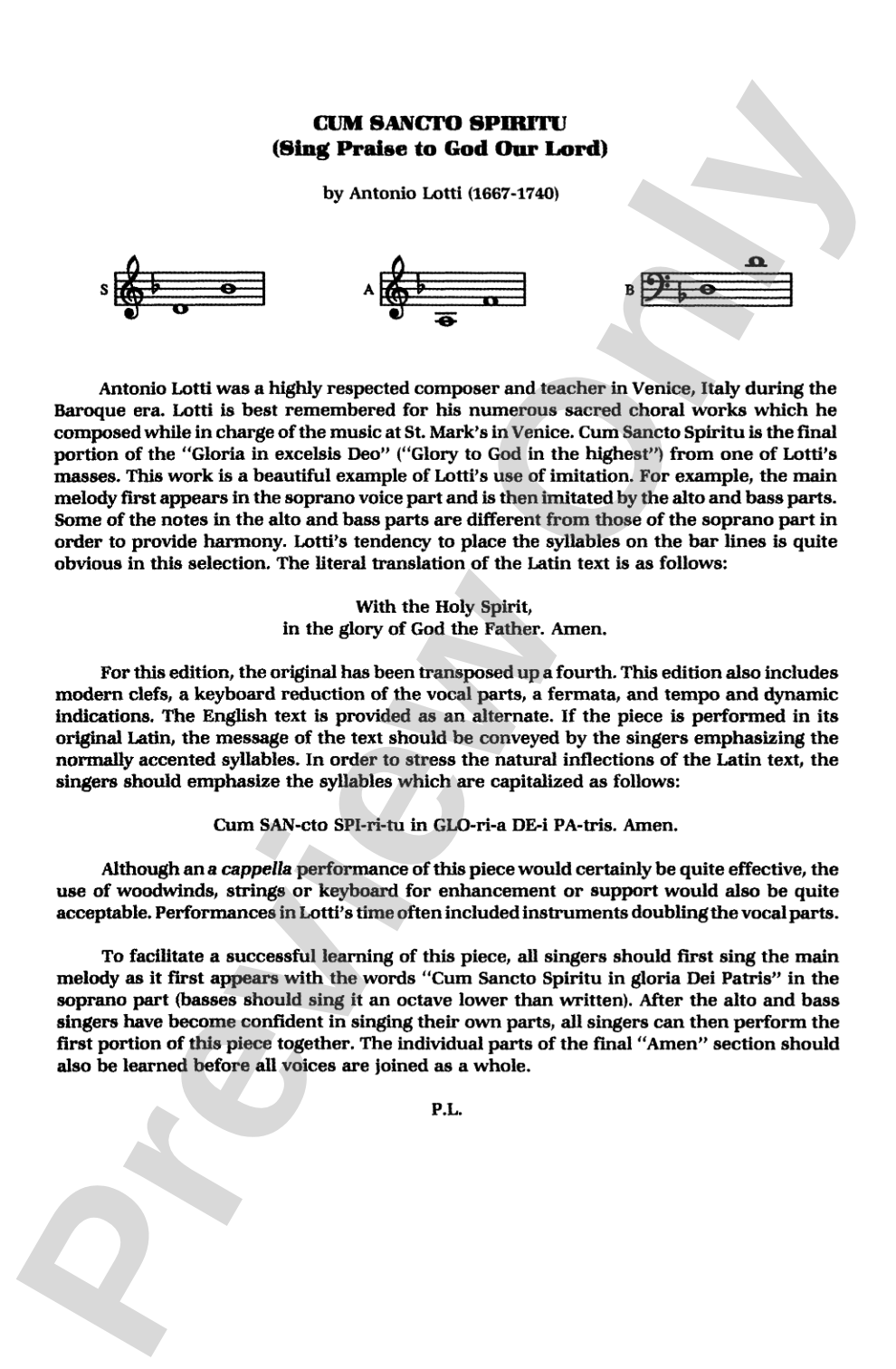

Cum Sancto Spiritu: SAB, a cappella Choral Octavo
By Antonio Lotti / ed. Patrick M. Liebergen
Level: Moderate
Item: 00-PO-0003062
$2.25
Minimum order quantity: 20 copies
Pickup currently not available
Related Items
Cum Sancto Spiritu: SAB, a cappella Choral Octavo |
$2.25
|
View |
Description
This anthem is the final portion of a 'Gloria' taken from one of Lotti's masses, and is a lovely example of his use of imitation. It's scored a cappella, but instruments could easily and effectively double the vocal parts, as was often the tradition. Includes an alternate English text. For Pentecost or general use. This title is available in MakeMusic Cloud.


Cum Sancto Spiritu: SAB, a cappella Choral Octavo isn't in MakeMusic Cloud just yet...but it could be. Let us know you'd like to see it, and you'll help shape what comes next. In the meantime, start a free trial and dive into thousands of interactive titles your students can play along with today.
Request This Title
Tell us you want it.
Start Your Free Trial
Explore everything that's ready to play right now.
Sample Audio
No sample audio found.
Sample Video
No sample videos found.
Additional Details
Series:
Alfred Archive Edition: Studio PR Catalog
Publisher:
Alfred Music
Page Count:
8
SKU:
00-PO-0003062
More about this title
About the Composer: Antonio Lotti
Antonio Lotti (1666-1740) was a Venetian composer and maestro di cappella whose sacred works represent the height of late Baroque vocal writing. He spent much of his career at St. Mark's Basilica in Venice, where he mastered the polychoral traditions of the region and developed a distinctive style marked by clear counterpoint and expressive harmonic language. His masses and motets remain essential to the choral repertoire, valued for their architectural clarity and emotional depth.
Lotti's compositional approach influenced generations of sacred music writers. He was equally skilled at writing for large ensembles and intimate vocal combinations, and his work bridges the transition from the Renaissance polyphonic tradition to the more galant sensibility of the eighteenth century. His masses are among his most significant contributions to music, combining structural sophistication with genuine spiritual character.
Why we love this
This excerpt showcases Lotti's gift for imitative writing without ever feeling academic or dry. The text repetition and overlapping entrances create natural musical momentum that feels both learned and singable, making it an excellent teaching tool for voices still developing their independence. Programming it as a Pentecost selection or general sacred offering gives your choir access to Baroque sophistication at a manageable level.
What to expect
Luminous and forward-moving, with a sense of clarity and purpose that comes from Lotti's precise counterpoint. The imitative texture creates an almost conversational quality, as if each voice is answering or reinforcing what came before, building toward moments of homophonic strength that feel earned and resonant.
Who it's for
This work suits choirs with solid intonation and basic independence in three-part singing. Singers need to track their own line through overlapping entrances without constant conductor support, making it ideal for intermediate high school or college choirs and accomplished community ensembles.
How to get the most out of it
- Bring out the individual voice lines during imitative passages by having singers listen horizontally within their own part first, then practice hearing how their line interlocks with others. This builds awareness of counterpoint without requiring extra rehearsal time.
- The alternate English text offers flexibility for liturgical or secular concert settings; decide your text early so singers can commit to diction and phrasing in one language without confusion.
- If doubling with instruments, assign them strategically to one or two voices per section rather than full scoring. This honors both the a cappella tradition and the historical practice Lotti himself would have expected.
- Shape phrases by the text rather than by harmonic changes alone. Lotti's imitative design sometimes obscures the underlying harmonic rhythm, so singers need to hear the poetry driving the line.
How to use it
Reserve this for spring concerts focused on sacred or early music repertoire, where it can anchor a Baroque section or stand alone as a Pentecost observance. Its modest length and moderate difficulty make it a natural companion to other Renaissance or Baroque choral works, and the option of English text allows programming flexibility across liturgical and concert contexts.
Skills your students will build
- Tracking independent voice lines within imitative texture
- Maintaining intonation while sustaining focus on individual part
- Shaping phrases according to textual and poetic meaning rather than harmonic landmarks
- Balancing clarity with blend in three-part counterpoint