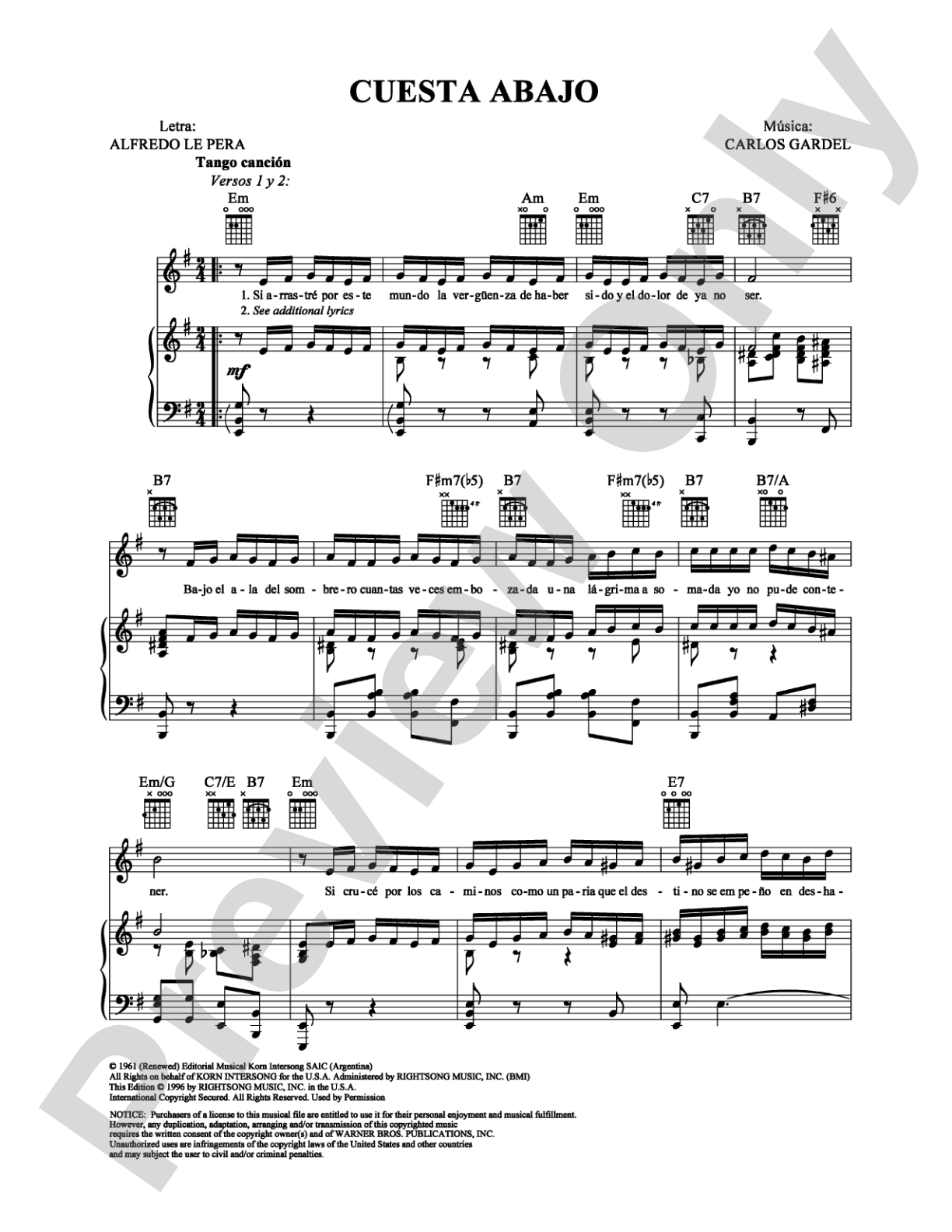
Cuesta Abajo: Piano/Vocal/Chords Digital Sheet Music

Cuesta Abajo: Piano/Vocal/Chords Digital Sheet Music

Carlos Gardel

Item: 00-PS-0003358

Digital Download
$3.99
Description

Cuesta Abajo: Piano/Vocal/Chords Digital Sheet Music isn't in MakeMusic Cloud just yet...but it could be. Let us know you'd like to see it, and you'll help shape what comes next. In the meantime, start a free trial and dive into thousands of interactive titles your students can play along with today.

Sample Audio
No sample audio found.
Sample Video
Additional Details
SKU: 00-PS-0003358

More about this title

Why we love this

Cuesta Abajo brings authentic tango idiom into a singer's hands with clear chord changes that invite both jazz-inflected interpretation and traditional styling. The piano/vocal/chord format makes it equally useful for solo recital, teaching repertoire, or chamber collaboration with accompanists who read from chord symbols.

What to expect

There's a bittersweet quality in the title itself, 'cuesta abajo' suggests downhill movement, loss, resignation. The music sits somewhere between melancholy and resilience, with the tango's characteristic syncopation giving it forward motion even as the harmonic language pulls inward.

Who it's for

Vocalists preparing tango repertoire for recital or study, pianists looking to develop fluency with Latin chord changes and accompaniment styles, and teaching studios seeking accessible yet musically sophisticated material that bridges classical training and vernacular song.

How to get the most out of it

  • Lean into the rubato tradition of tango; the chord symbols give you freedom to shape the melody's phrasing beyond strict time, then settle back into the groove.
  • Balance the lyrical vocal line against sparse, intentional piano comping rather than filling every beat; restraint deepens the emotional weight.
  • Use the chord symbols to explore different accompaniment textures (stride patterns, jazz voicings, traditional tango rhythms) depending on your accompanying musician's strengths.

How to use it

Feature this in a recital exploring Latin American song traditions, pair it with art songs in other languages to showcase cultural breadth, or use it in a mixed program that moves between classical and popular idioms.

Skills your students will build

  • Reading and interpreting chord symbols in a tango context
  • Managing rubato and flexibility within a fixed harmonic structure
  • Shaping a Latin melody with appropriate phrasing and emotional inflection
  • Collaborating with an accompanist using chord notation rather than a fully notated score

You May Also Like