Cubauza! Sheet Music Preview

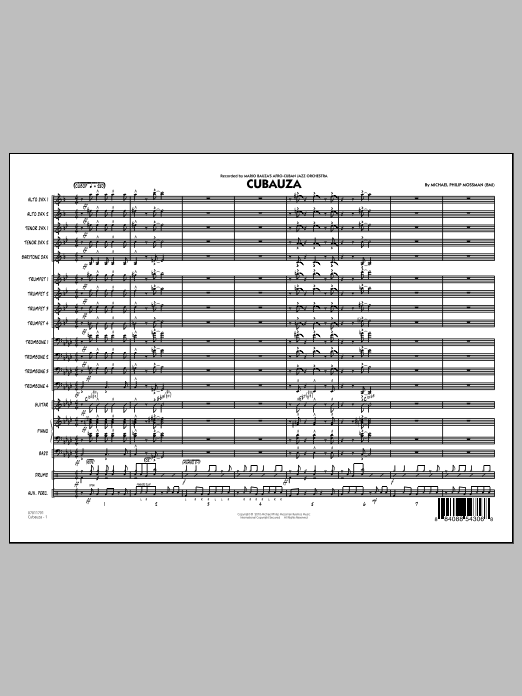
Cubauza!: Jazz Ensemble Conductor Score & Parts

By Michael Philip Mossman / As performed by Mario Bauza

Grade: 5

Item: 35-PK00202188

Digital Download
$60.00

One moment…

Description
This exciting Afro-Cuban composition is the opening cut from the 1993 album "944 Columbus," the final recording by Mario Bauza, one of the most influential figures in the development of Latin Jazz. The title comes from combining the words "Cuban" and "Bauza" and features a bebop influence interpreted by the Afro-Cuban rhythm section. This newly edited and engraved edition is a "must have" for mature bands. (Recorded by Mario Bauza)

Cubauza!: Jazz Ensemble Conductor Score & Parts isn't in MakeMusic Cloud just yet...but it could be. Let us know you'd like to see it, and you'll help shape what comes next. In the meantime, start a free trial and dive into thousands of interactive titles your students can play along with today.

Sample Audio
No sample audio found.
Sample Video
Additional Details
Publisher: Hal Leonard
SKU: 35-PK00202188

More about this title

About the Composer: Michael Philip Mossman

Michael Philip Mossman is a trumpeter, composer, and arranger whose work bridges the worlds of bebop and Latin jazz with fluency and sophistication. His arrangements and original compositions have become essential repertoire for jazz ensembles seeking authentic interpretations of Afro-Cuban music, particularly through his collaborations with Latin jazz pioneers and his own prolific output as a bandleader and session musician.

Why we love this

Mossman captures the infectious energy of Mario Bauza's legacy while writing clearly enough for advanced high school and college ensembles to execute. The bebop sensibility layered over a tight Afro-Cuban foundation gives students access to serious jazz history while staying engaging and fun to play.

What to expect

Propulsive and warm at once. The Afro-Cuban rhythm section creates an irresistible groove while the horn writing dances with bebop sophistication, making the piece feel both rooted in tradition and energetically alive.

Who it's for

Jazz ensembles at the high school and college level with strong section reading and comfort with bebop harmony will thrive with this chart. Directors looking to program authentic Afro-Cuban jazz rather than simplified Latin funk will find this a cornerstone piece.

How to get the most out of it

  • Lock the clave pattern early in rehearsals. Have the rhythm section play it unaccompanied for a full chorus so that every horn player hears the harmonic implications of that specific clave relationship.
  • Balance the front line carefully during the head. The composition works best when soloists can be heard clearly against the ensemble foundation without the horns overwhelming the momentum.
  • Push the tempo gradually into the solos rather than staying metronomic. Bauza's recordings breathe, and your ensemble will sound more authentic if you allow that natural swing to develop.
  • Give the rhythm section room to dialogue with the soloist. This isn't a locked-down chart; it's a conversation between the drums, bass, piano, and the improviser.

How to use it

Open a concert with this to establish sophistication and cultural depth from the first downbeat. It also works beautifully as the anchor in a set focused on Latin jazz repertoire or as a vehicle to explore how bebop and Cuban music shaped each other.

Skills your students will build

  • Reading and interpreting Afro-Cuban clave patterns in relation to bebop harmony
  • Accompanying and supporting soloists with dynamic listening and ensemble flexibility
  • Balancing articulation and tone across trumpet, trombone, and saxophone sections in a Latin jazz context
  • Understanding the historical development of jazz through direct engagement with a seminal Bauza composition

You May Also Like