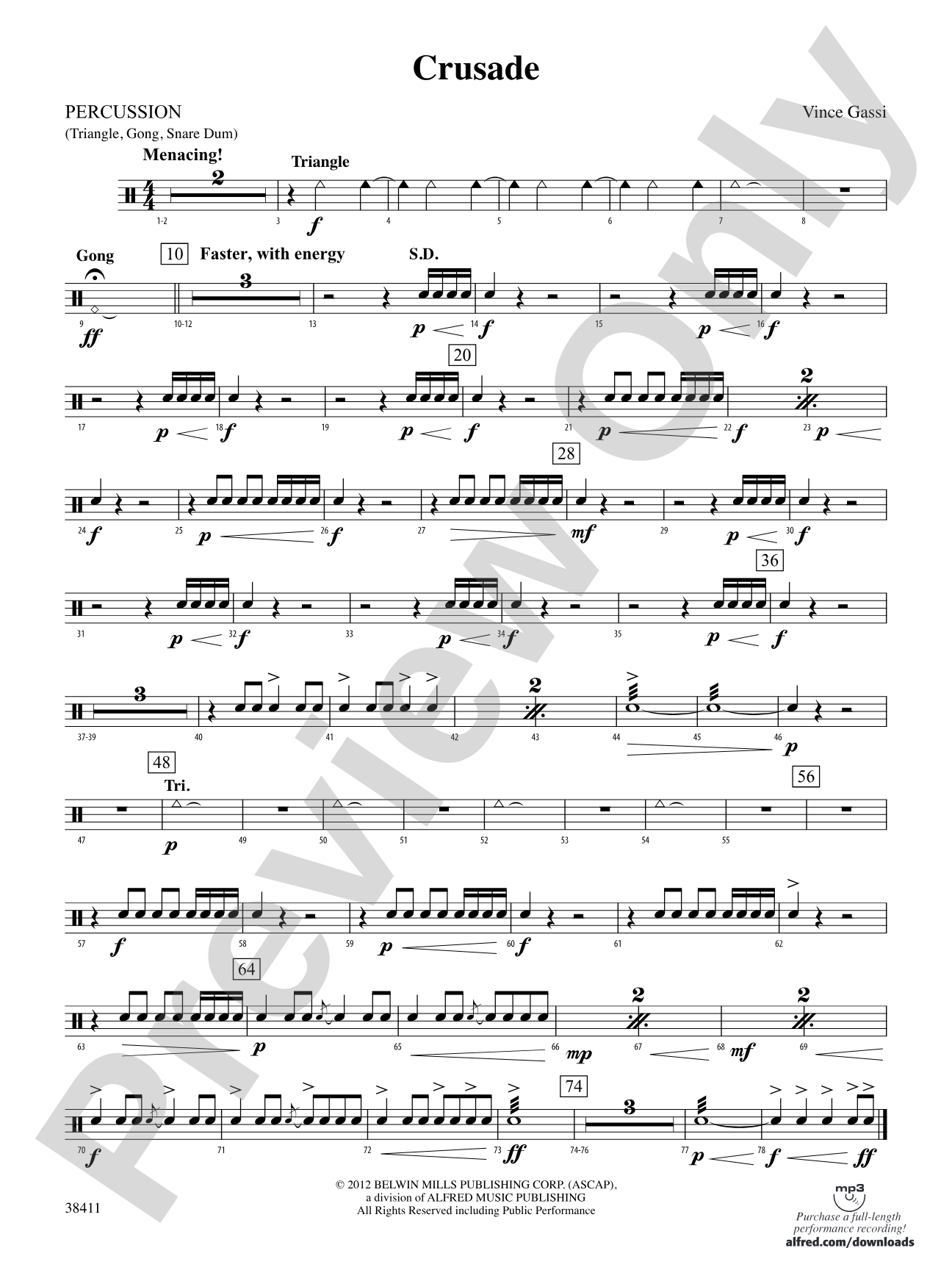
Crusade: 1st Percussion Sheet Music Preview

Crusade: 1st Percussion

By Vince Gassi

Grade: 2.5

Item: 00-PC-0015478_PC1

Digital Download
$5.99
Description
This exciting original work opens with an ominous theme. It continues to build throughout, culminating in a powerful, climactic ending. Set in Dorian Mode, this piece overflows with vibrant and dramatic energy, conjuring images of strength, majesty, and passion.

Don't just read it, hear it, play along with it, and watch your students grow with it. In MakeMusic Cloud, Crusade: 1st Percussion comes alive with professional accompaniment, adjustable tempo, and built-in practice tools that turn solo practice into real progress.

Sample Audio
0:00
0:00
Sample Video
Additional Details
Series: Belwin Beginning String Orchestra
Publisher: Alfred Music
Page Count: 80
SKU: 00-PC-0015478_PC1

More about this title

About the Composer: Vince Gassi

Vince Gassi

Vince Gassi has established himself as a prolific composer with more than 100 published works since joining Alfred Music in 2006. His output spans multiple ensemble types and educational levels, and his pieces regularly appear on concert and festival programs across North America, Europe, and Japan. He holds a Bachelor of Music from the University of Western Ontario and pursued advanced studies in composition and arranging at the Dick Grove School of Music in Los Angeles, completing a Ph.D. at York University in Toronto.

Gassi spent twenty-five years teaching instrumental music at elementary and secondary levels, an experience that deeply informs his compositional voice. He maintains an active schedule as a guest conductor, adjudicator, and clinician, and he leads workshops on student engagement, creative arranging, and digital workflows for music directors. His works frequently appear at the Midwest Clinic and have earned recognition for balancing genuine musical substance with accessibility for developing ensembles.

Why we love this

Gassi writes for young string orchestras with a keen ear for what holds student attention and builds confidence. The Dorian mode and dramatic arc give this piece real musical personality without requiring virtuosic playing, making it equally rewarding for contest adjudicators and young musicians discovering orchestral writing beyond diatonic conventions.

What to expect

Crusade opens with an unsettling, brooding quality that draws listeners in immediately. As the piece unfolds, tension builds steadily through layered orchestration and rising dynamics, culminating in a powerful swell that channels strength and passion without requiring heavy technical virtuosity.

Who it's for

This score and parts set suits grade 2.5 string orchestras ready for repertoire with genuine dramatic content and modal harmony. Directors preparing for contests or concert performances will find a piece that allows intermediate students to sound advanced without excessive technical demands.

How to get the most out of it

  • Establish the ominous opening theme with focused, sustained bow control across the ensemble. Precision in dynamics and intonation here sets the tone for the entire piece.
  • Layer the dynamic builds carefully during the acceleration to the climax. Have each section track which instruments are gaining intensity and when, so the swell feels intentional rather than chaotic.
  • Balance the Dorian mode's characteristic sound by listening for the raised sixth degree (if you're in A Dorian, that's F-sharp). It gives the piece its distinctive color, so make sure violas and cellos aren't muddying that interval.
  • Shape the final powerful section with clear articulation from the full ensemble. Clean attacks and releases will maximize the majesty you're building toward.

How to use it

Position this as a centerpiece concert selection where you want to showcase your orchestra's dynamic control and ensemble unity. It also works exceptionally well on festival programs where judges appreciate modal writing and original composition at the Grade 2.5 level.

Skills your students will build

  • Dorian modal harmony and harmonic color
  • Dynamic contrast and crescendo control across multiple sections
  • Ensemble intonation in non-diatonic harmonic contexts
  • Sustained bow technique and tone production
  • Reading multi-line string parts with independent rhythmic figures

You May Also Like