
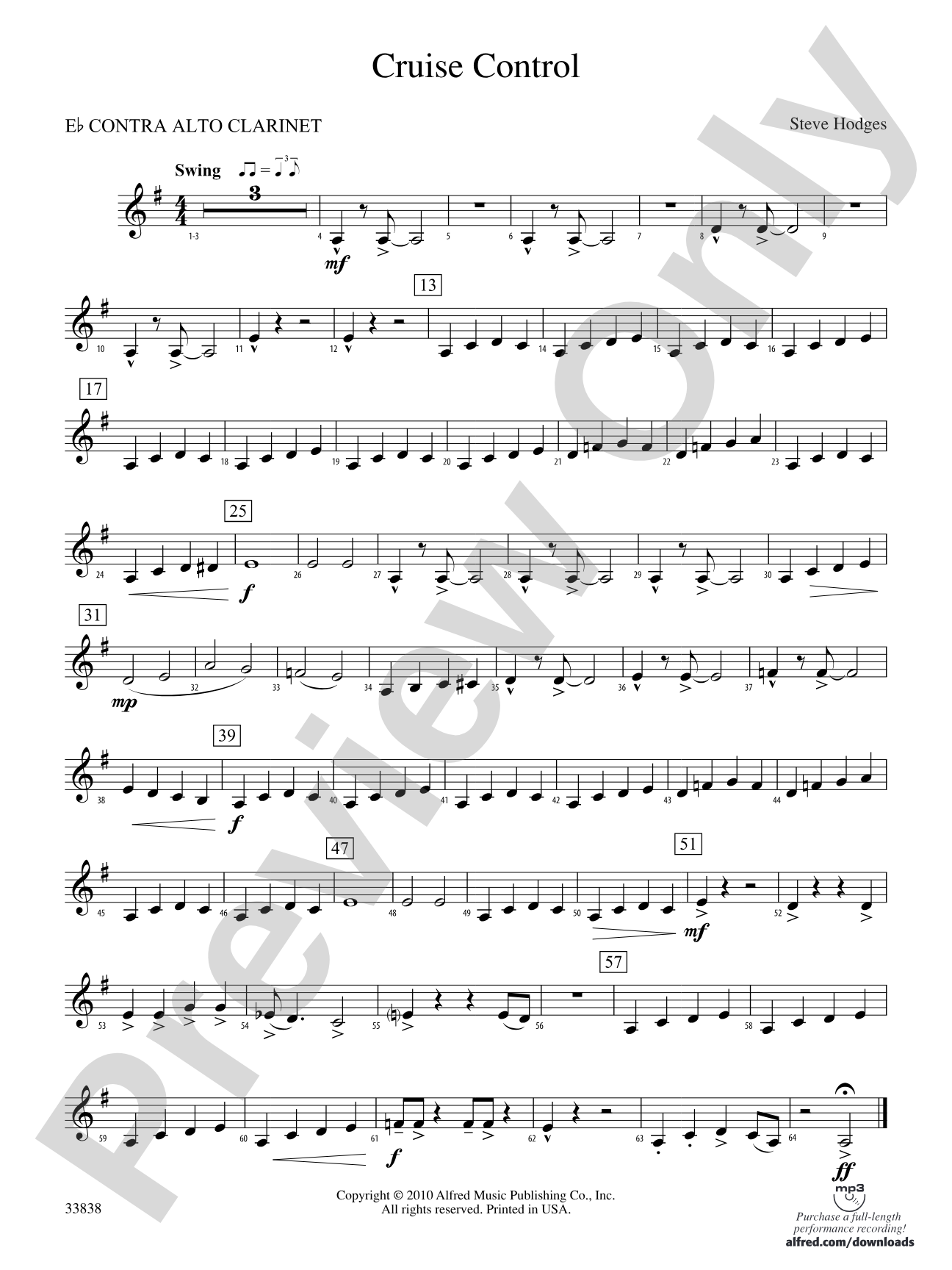

Cruise Control: (wp) E-flat Contrabass Clarinet
By Steve Hodges
Grade: 1 (Very Easy)
Item: 00-PC-0014569_wpECBC
$3.00
Pickup currently not available
Description
A cool swing groove on the ride cymbal opens this jazzy piece for first year band students. With the low brass and woodwinds providing a driving walking bass line, the trumpets, saxes, and upper woodwinds trade the melody effectively throughout the piece. Solid scoring and a strong rhythmic foundation allow the band to really lay back and put themselves into the "cruise control" setting! This is a great learning tool introducing elements of the swing and jazz genres to the young band.


Don't just read it, hear it, play along with it, and watch your students grow with it. In MakeMusic Cloud, Cruise Control: (wp) E-flat Contrabass Clarinet comes alive with professional accompaniment, adjustable tempo, and built-in practice tools that turn solo practice into real progress.
Open in the Player
Jump straight in and assign it today.
Start Your Free Trial
Open this title and explore the full library in minutes.
Sample Audio
1
Audio File
--:--
0:00
0:00
Sample Video
No sample videos found.
Additional Details
Series:
Alfred Debut Series
Publisher:
Alfred Music
Page Count:
114
SKU:
00-PC-0014569_wpECBC
More about this title
About the Composer: Steve Hodges

Steve Hodges brings four decades of public school band directing experience to his compositions. He holds degrees from Western Oregon University (Bachelor of Science) and Central Washington University (Master of Music Education), and has published over 120 concert band works with Alfred Music since 1986, along with choral arrangements through Staff Music and Shawnee Press.
Hodges's music has reached audiences across multiple countries, appearing at festivals, state conventions, and on TBS and ESPN broadcasts. His commissioned works span honor bands and schools throughout Virginia, Iowa, British Columbia, Washington, Oregon, and North Carolina. As an ASCAP member, he continues to compose from his home in The Dalles, Oregon, where he remains active in community music alongside his family.
Why we love this
Hodges writes with genuine understanding of what first-year students can accomplish without requiring them to compromise on style. The swing groove and sectional trading feel authentic to the jazz idiom rather than simplified, which means your band gets to experience real musicianship from day one. The rhythmic clarity and balanced orchestration create immediate success while introducing ear-catching elements that make rehearsals genuinely enjoyable.
What to expect
Cruise Control lands somewhere between a casual, groovy confidence and genuine musicality. The opening ride cymbal sets a relaxed atmosphere immediately, and once the walking bass enters, the piece settles into a pocket that feels both simple and sophisticated. Student musicians experience the satisfaction of playing with style and control rather than struggling through technical demands.
Who it's for
First-year concert band students encountering swing and jazz style for the first time. Directors seeking an accessible yet stylistically authentic introduction to the jazz idiom that doesn't require advanced technical skills. Any program needing a confident opener or early-season piece that builds ensemble awareness of groove and phrasing.
How to get the most out of it
- Lock in the ride cymbal pattern early; this rhythmic anchor allows the walking bass line to settle naturally and gives the band confidence in the groove.
- Bring out the sectional exchanges between trumpet/sax and upper woodwinds without forcing the dynamics. The melody trades work best when each section colors their phrase distinctly.
- Encourage the low brass and woodwinds to feel the walking bass as a conversation rather than a background line. When they commit to the pocket, the entire band relaxes into the swing feel.
- Keep the overall tempo steady and resisting the urge to rush. Young bands often accelerate during ensemble passages, so marking a clear conductor beat helps maintain the laid-back quality the title promises.
How to use it
Open a concert with this piece to establish a lighter, engaging tone while showcasing your ensemble's rhythmic foundation and sectional independence. The accessible difficulty level makes it an ideal piece for mid-rehearsal season when students have the fundamentals in place but haven't yet tackled complex meter or advanced techniques. Its appeal to audiences also works well for community outreach events or pep band contexts where stylistic variety matters.
Skills your students will build
- Swing and jazz phrasing conventions
- Reading and maintaining a steady walking bass line
- Sectional melody trading and listening to other parts
- Ride cymbal accompaniment patterns
- Understanding rhythm section roles (drums, bass, harmony)
- Relaxed articulation and groove-based interpretation