
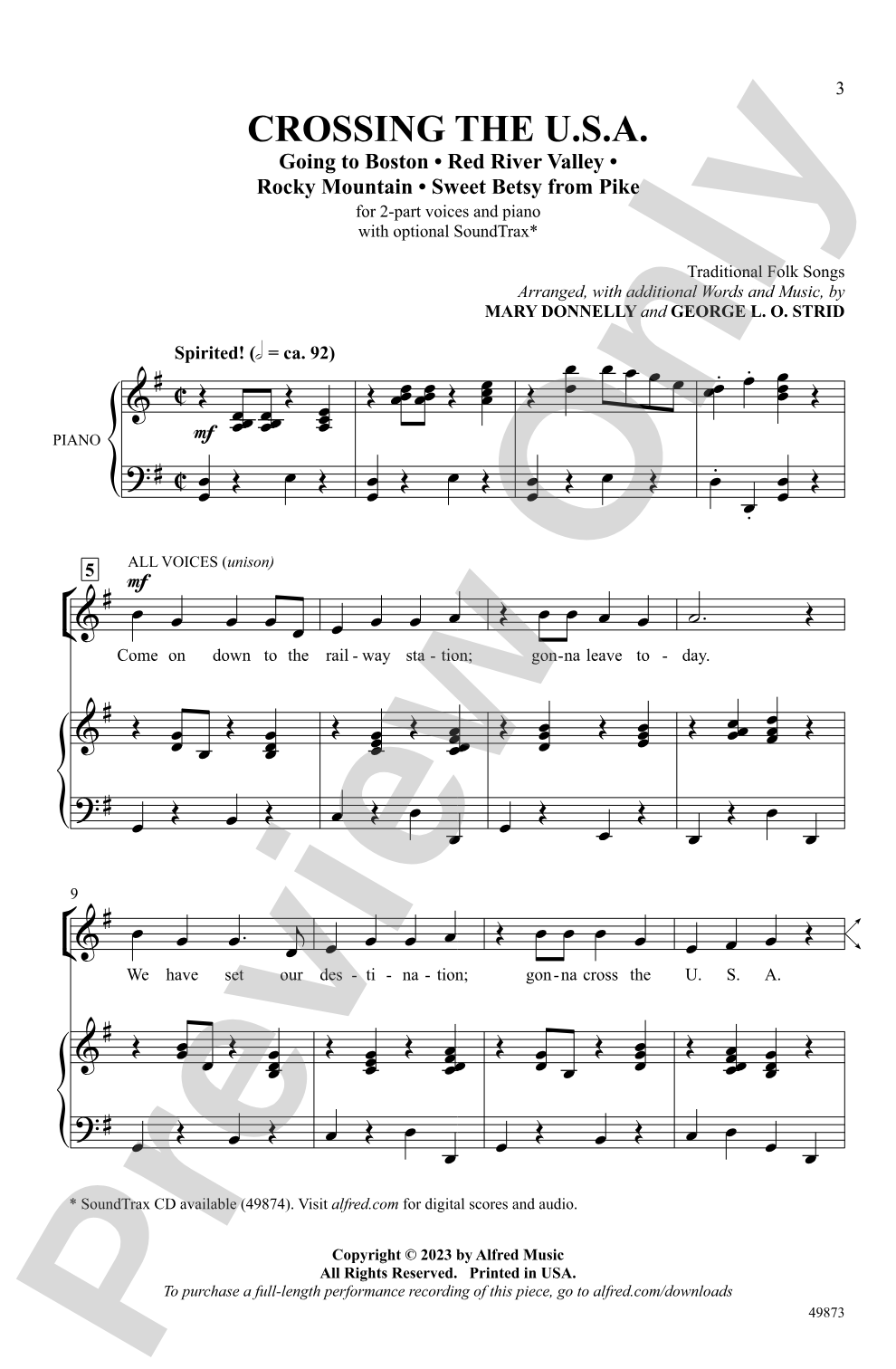
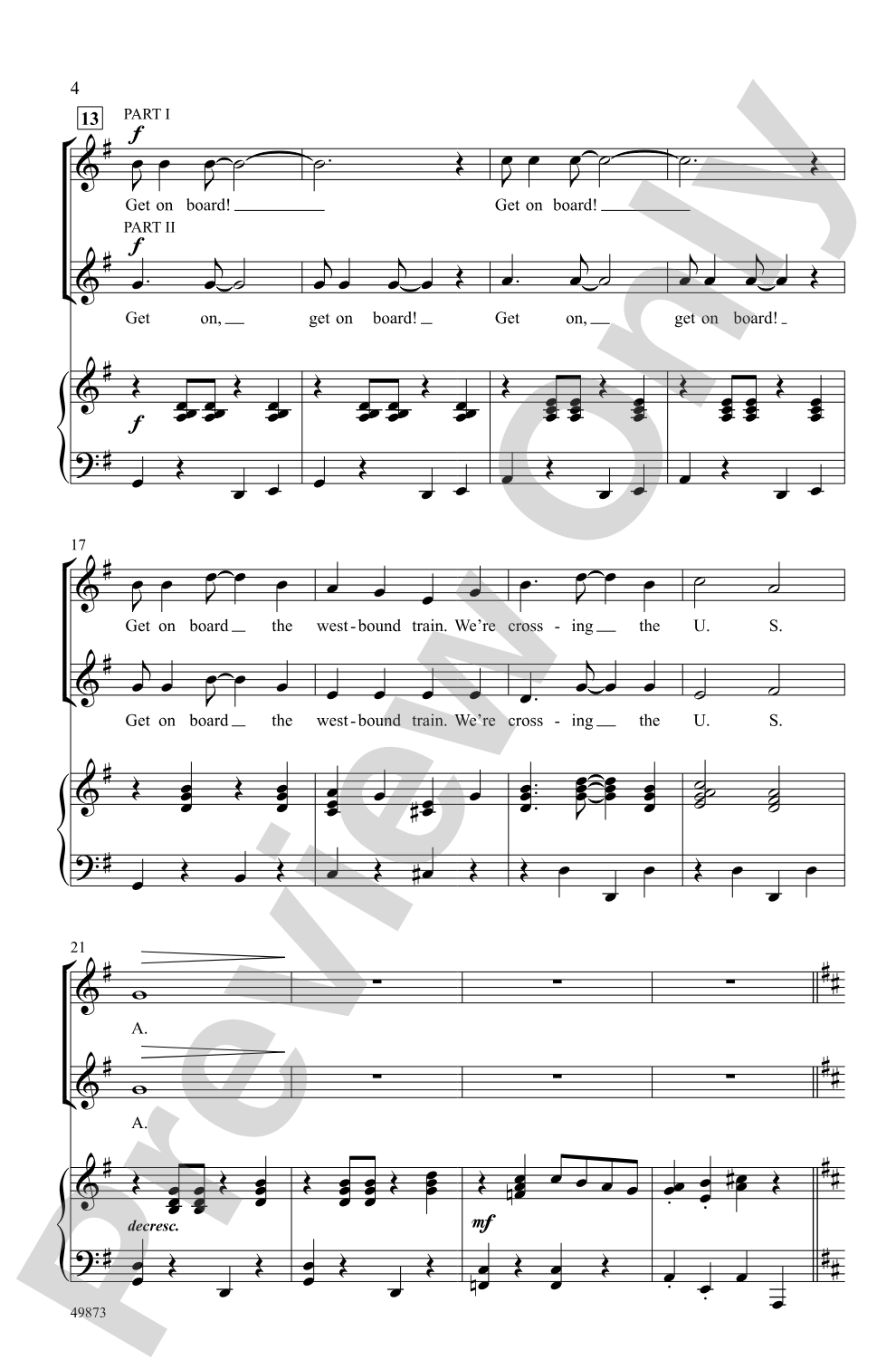

Crossing the U.S.A.: 2-Part Choral Octavo
Going to Boston * Red River Valley * Rocky Mountain * Sweet Betsy from Pike
Traditional Folk Songs / arr., with additional words and music, by Mary Donnelly and George L. O. Strid
Item: 00-PO-0006997
$2.05
Minimum order quantity: 20 copies
Pickup currently not available
Description
All aboard! Don't miss this action-packed, 2.5-minute medley of American folk favorites. Kid-friendly voice parts, a bouncy accompaniment, and an irresistible train ride theme create the ultimate journey from east to west. Don't leave the station without a whistle and some costume conductor hats. Fun!


Crossing the U.S.A.: 2-Part Choral Octavo isn't in MakeMusic Cloud just yet...but it could be. Let us know you'd like to see it, and you'll help shape what comes next. In the meantime, start a free trial and dive into thousands of interactive titles your students can play along with today.
Request This Title
Tell us you want it.
Start Your Free Trial
Explore everything that's ready to play right now.
Sample Audio
1
Audio File
--:--
0:00
0:00
Sample Video
Additional Details
Series:
Alfred Choral Designs
Publisher:
Alfred Music
Page Count:
12
SKU:
00-PO-0006997
More about this title
About the Arranger: Mary Donnelly
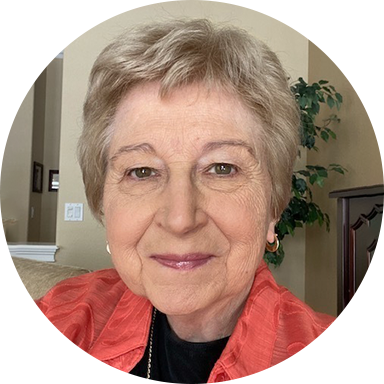
Mary Donnelly grew up in Reno, Nevada, and studied English and French at the University of Nevada, Reno. While still an undergraduate, she founded two children's choruses, an experience that redirected her career toward music education. She earned her Master's Degree in Education from Lesley College in Cambridge, Massachusetts, where she focused on integrating arts across the curriculum.
Donnelly spent thirty years teaching general music and choir in the Washoe County School District, retiring as an active member of ACDA, NEA, and ASCAP. In 1985, she met George Strid while co-teaching sixth grade music; their principal challenged them to write a musical for Reading Week, launching a prolific partnership. Together they have created more than two hundred songs and twenty-five musicals, blending accessibility with genuine musical craft.
Why we love this
Donnelly and Strid have engineered pure joy into this medley: the arrangement sits comfortably in young voices, the train-ride narrative keeps singers engaged, and the 2.5-minute length respects attention spans while delivering real musical substance. The recorded accompaniment option removes rehearsal barriers for busy directors, and the built-in theatrical spark (whistle, conductor hats) naturally elevates concert energy without requiring elaborate staging.
What to expect
A joyride across America. The medley bounces along with locomotive energy, evoking wide-open landscapes and frontier spirit while maintaining the playful innocence of childhood wonder. It feels less like a history lesson and more like an adventure sung from a moving train car.
Who it's for
Elementary and early middle school choirs looking for concert-ready material that engages singers and audiences alike. The 2-part voicing and accessible ranges make this ideal for programs mixing experienced singers with newcomers.
How to get the most out of it
- Establish a clear, steady pulse in rehearsal before adding the train-whistle prop; young singers often rush when excited, and a firm tempo foundation keeps the medley coherent.
- Layer the accompaniment gradually: start with voices alone to secure part independence, then add recorded accompaniment so singers hear themselves within the fuller texture.
- Shape each folk tune distinctly within the medley; brief phrase-level dynamics and tempo adjustments distinguish one song from the next and prevent the piece from blurring into a single block of sound.
How to use it
Pair this with other American-themed repertoire for a full-concert exploration of folk traditions, or use it as a standalone spring concert opener that immediately captures the audience. Its theatrical nature also works well in educational performances or family concert settings where minimal staging supports maximum impact.
Skills your students will build
- Singing in two-part harmony with secure part independence
- Tracking multiple folk melodies within a single continuous form
- Responding to dynamic and tempo changes that distinguish medley sections
- Coordinating with recorded accompaniment and maintaining ensemble cohesion