
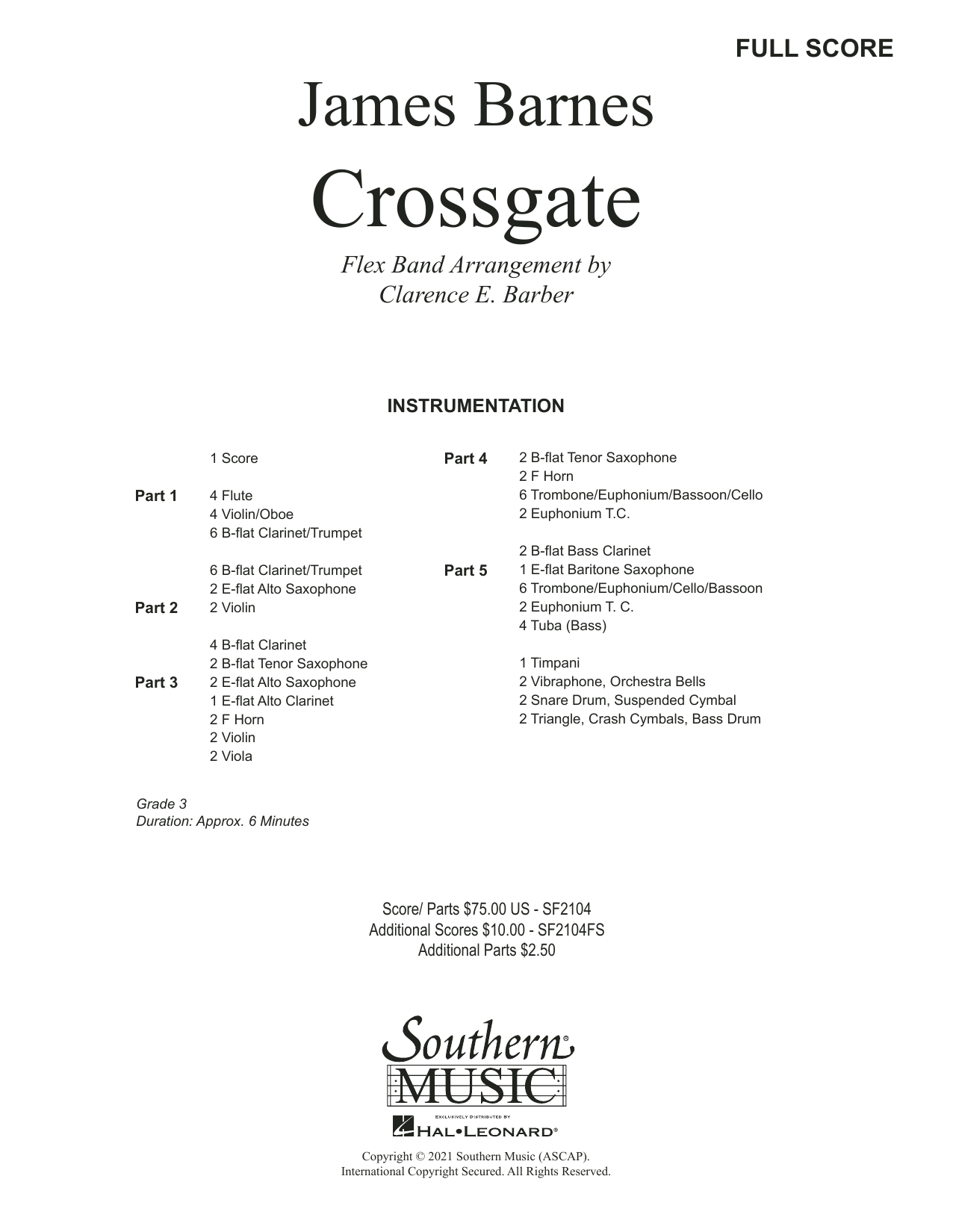

Crossgate Overture: Flex Ensemble Conductor Score & Parts
By James Barnes / Arranged by Clarence Barber
Grade: 2.5
Item: 35-PK00513176
$75.00
Pickup currently not available
Buy Extra Parts (Digital PDF Download)
Parts Added to Cart!
Description
New flexible ensemble scoring by Clarence Barber, playable on any SSATB combination of woodwind, brass, or string players with optional percussion. This lovely work includes an opening written in an overture style followed by a flowing slow section.


Crossgate Overture: Flex Ensemble Conductor Score & Parts isn't in MakeMusic Cloud just yet...but it could be. Let us know you'd like to see it, and you'll help shape what comes next. In the meantime, start a free trial and dive into thousands of interactive titles your students can play along with today.
Request This Title
Tell us you want it.
Start Your Free Trial
Explore everything that's ready to play right now.
Sample Audio
No sample audio found.
Sample Video
No sample videos found.
Additional Details
Publisher:
Hal Leonard
SKU:
35-PK00513176
More about this title
About the Composer: James Barnes
James Barnes is a prolific composer and conductor whose concert band and wind ensemble works have become staples in school music programs across the United States. His compositional approach balances accessibility with genuine musical substance, creating pieces that engage young musicians while maintaining artistic integrity. Barnes has composed over one hundred works for band, orchestra, and chamber ensembles, and his understanding of how student musicians develop shapes every note he writes.
Why we love this
Clarence Barber's flexible scoring removes the obstacle of instrumentation entirely, letting you use whoever shows up on a given day without sacrificing the integrity of the piece. The overture-to-slow-section architecture gives students a clear structural anchor while the SSATB flexibility means your personnel decisions never force compromise on the musical content.
What to expect
The opening unfolds with ceremonial warmth and gentle forward momentum, setting an accessible but refined tone. The slow section that follows invites introspection, offering players space to develop breath control and phrase awareness without technical barriers.
Who it's for
Directors managing inconsistent rehearsal attendance or building programs with limited instrumentation will find this arrangement liberating. It works equally well for schools serving small populations, charter programs with mixed ensembles, or camps where you inherit an unpredictable mix of players.
How to get the most out of it
- Shape the opening overture section with a clear sense of forward motion; the transitions between thematic material should feel inevitable rather than episodic.
- Balance the slow section carefully so that inner voices don't disappear. In a flex ensemble with fewer players per line, doublings matter tremendously for harmonic support.
- Let the optional percussion enhance rather than dominate. Even if you have timpani and bells available, consider starting rehearsals with percussion tacet to ensure the ensemble finds its own sonic foundation.
- Mark your articulation choices early in rehearsal and enforce them consistently. With flexible instrumentation, uniform style becomes your primary tool for cohesion.
How to use it
Open a fall concert with this piece to establish musicality and ensemble cohesion early in the season before tackling more demanding repertoire. Its moderate difficulty also makes it valuable as a bridge piece in spring concerts, giving you something substantial between lighter openers and heavier closing works.
Skills your students will build
- Conducting cues and ensemble entrance coordination across varied instrumental combinations
- Balance and blend in SSATB voicing with flexible instrumentation
- Phrase shaping across both fast and slow formal sections
- Part independence within an overture structure
- Listening for harmonic function across multiple instrumental families