
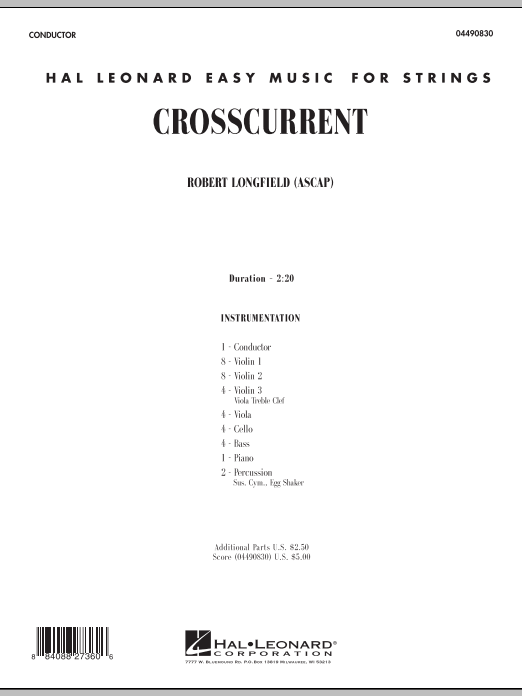

Crosscurrent: String Orchestra Conductor Score & Parts
By Robert Longfield
Grade: 2-3
Item: 35-PK00117119
$40.00
Pickup currently not available
Buy Extra Parts (Digital PDF Download)
| Product | Price | Quantity |
|---|---|---|
| Crosscurrent - Full Score | $7.50 | |
| Crosscurrent - Violin 1 | $7.00 | |
| Crosscurrent - Violin 2 | $7.00 | |
| Crosscurrent - Violin 3 (Viola Treble Clef) | $7.00 | |
| Crosscurrent - Viola | $7.00 | |
| Crosscurrent - Cello | $7.00 | |
| Crosscurrent - Bass | $7.00 | |
| Crosscurrent - Piano | $7.00 | |
| Crosscurrent - Percussion | $7.00 |
Parts Added to Cart!
Description
"Crosscurrent" has all the elements for success with younger players. Set in E minor with bold melody and lots of rhythmic drive, it's a style that students love to play. A cutting edge number to add fun and balance to your string ensemble repertoire. Dur: 2:20


Crosscurrent: String Orchestra Conductor Score & Parts isn't in MakeMusic Cloud just yet...but it could be. Let us know you'd like to see it, and you'll help shape what comes next. In the meantime, start a free trial and dive into thousands of interactive titles your students can play along with today.
Request This Title
Tell us you want it.
Start Your Free Trial
Explore everything that's ready to play right now.
Sample Audio
No sample audio found.
Sample Video
No sample videos found.
Additional Details
Publisher:
Hal Leonard
SKU:
35-PK00117119
More about this title
Why we love this
Longfield writes for young string players with genuine understanding of what energizes them in rehearsal. The rhythmic propulsion and accessible E minor tonality create immediate engagement without sacrificing musical substance. This is the kind of piece that builds confidence and ensemble pride.
What to expect
Sharp and forward-moving, with an edge that feels current rather than period. The E minor setting gives it natural minor-key brightness while the rhythmic momentum prevents any sense of heaviness. Players experience the satisfaction of driving a real arrangement that doesn't rely on emotional restraint.
Who it's for
String orchestras at the middle school and early high school level, or advanced elementary ensembles ready for Grade 2.5 material. The piece works equally well for groups balancing classical technique with contemporary appeal.
How to get the most out of it
- Establish a steady pulse from the opening; the rhythmic drive falls apart quickly if the conductor wavers on tempo.
- Balance the bold melody across your first violins and violas so neither overshadows the other.
- Mark the dynamic shifts clearly in parts before rehearsal. Young players often miss subtext if it's not visually obvious.
- Use the 2:20 duration as a rehearsal asset. Short enough to run multiple times in one session for refinement, long enough to build real musicianship.
How to use it
Slot this into a concert where you need a moment of contemporary energy between Baroque or Classical pieces. It also serves as an excellent finale option for a spring concert, ending on forward momentum rather than winding down. Early in the season, it's useful for building ensemble confidence before tackling larger works.
Skills your students will build
- Maintaining rhythmic precision in driving, modern contexts
- Balancing melody and accompaniment within string voices
- Responding to conductor direction in tempo and dynamic changes
- Ensemble cohesion across independent rhythmic figures