Critical Mass: E-flat Baritone Saxophone Sheet Music Preview

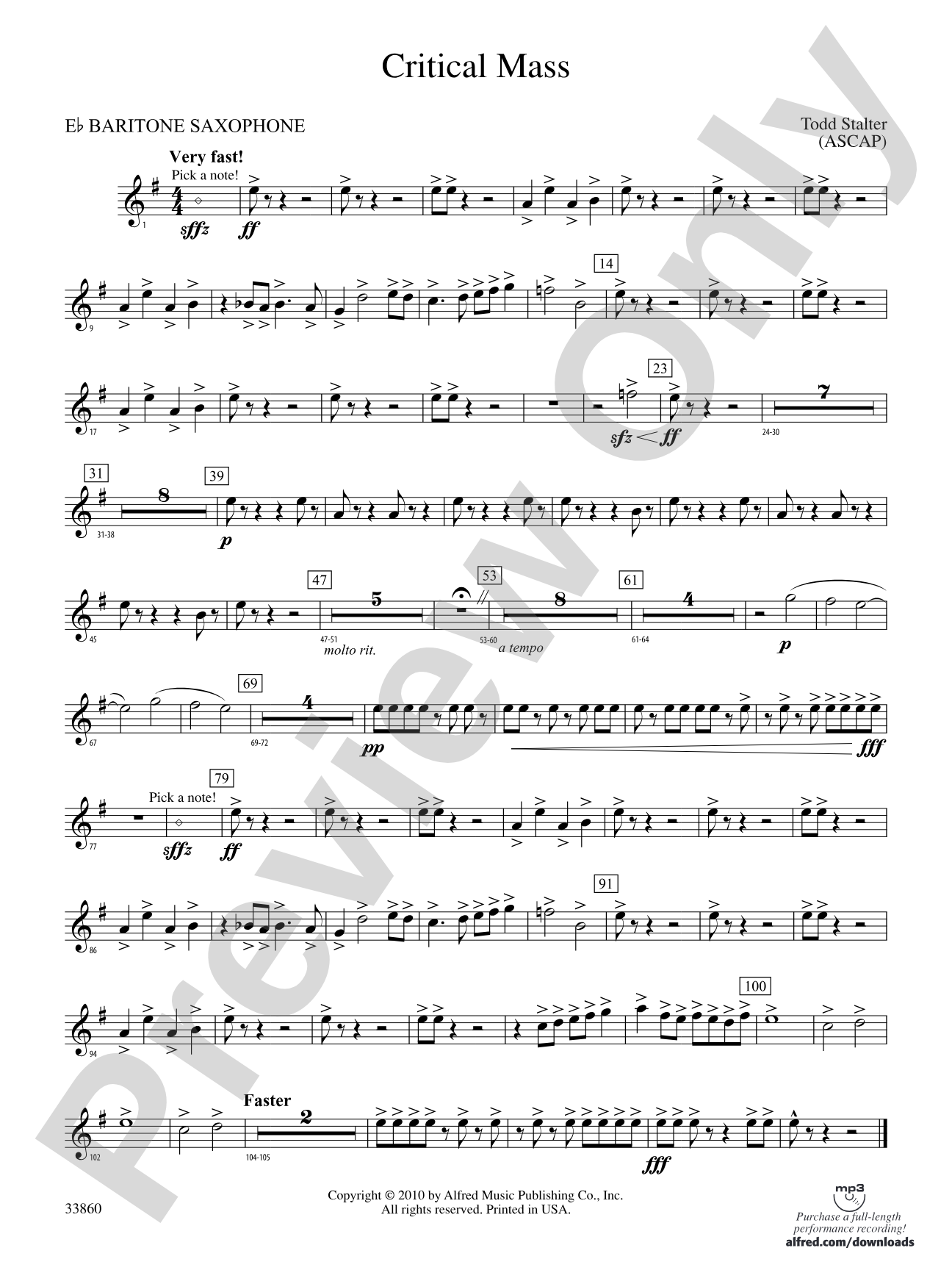
Critical Mass: E-flat Baritone Saxophone

By Todd Stalter

Grade: 3 (Medium)

Item: 00-PC-0014591_BTX

Digital Download
$3.00
Description
Critical mass is a scientific term that refers to the smallest amount of fissile material needed to sustain a nuclear chain reaction. This work begins with an explosion of sound, and then launches forward through small, ever-growing melodic fragments that expand outward and upward. (2:35) This title is available in MakeMusic Cloud.

Don't just read it, hear it, play along with it, and watch your students grow with it. In MakeMusic Cloud, Critical Mass: E-flat Baritone Saxophone comes alive with professional accompaniment, adjustable tempo, and built-in practice tools that turn solo practice into real progress.

Sample Audio
0:00
0:00
Sample Video
Additional Details
Series: Alfred Concert Band
Publisher: Alfred Music
Page Count: 210
SKU: 00-PC-0014591_BTX

More about this title

About the Composer: Todd Stalter

Todd Stalter

Todd Stalter built his reputation over 34 years as Director of Bands at Eureka High School in Illinois, where his ensembles earned consistent superior ratings at state contests and multiple festival championships. His marching band won 16 Class 1A state titles, and his groups performed at Orchestra Hall in Chicago and Walt Disney World. He was inducted into the Illinois State Marching Band Championships Hall of Fame.

Beyond his high school leadership, Stalter has conducted All-State Bands in Georgia and Delaware, adjudicated extensively for solo and large group competitions, and presented clinics on composition and music education at regional and state conferences. His compositions for band and string orchestra are performed nationwide and appear in state contest lists across the country. He holds degrees in music education and trumpet performance from Illinois State University, where he studied conducting with Dr. Stephen K. Steele.

Why we love this

The title's conceptual clarity makes it instantly engaging for students: an "explosion" that evolves into expanding melodic fragments mirrors the nuclear physics concept without sacrificing musicality. At Grade 3, Stalter balances accessibility with compositional substance, giving conductors material that teaches form and texture while remaining performable by developing ensembles. The programmatic framing transforms what could be a routine opener into a compelling centerpiece that students understand and remember.

What to expect

The piece opens with visceral impact before settling into a patient, methodical expansion. Small melodic cells accumulate and rise, creating a sense of unstoppable momentum building from restraint. The effect is intellectual and kinetic at once: listeners follow the construction in real time.

Who it's for

Concert bands at the Grade 3 level seeking programmatic repertoire with genuine dramatic arc and scoring substance. Directors preparing for festival or contest competition will appreciate music that demonstrates both technical facility and musical maturity without requiring advanced technique.

How to get the most out of it

  • Shape the opening outburst as a unified gesture across the full ensemble, then isolate the melodic fragments so their growth becomes audible to the audience as the piece unfolds.
  • Balance the expanding lines carefully; fragments should emerge from the texture rather than intrude on it, maintaining clarity even as density increases.
  • Use the 2:35 duration as a rehearsal checkpoint: if the ending feels rushed or the mid-section growth loses direction, the overall pacing likely needs adjustment.

How to use it

Program this as an opening number on a concert or contest performance to establish focus and energy immediately. Its programmatic nature and moderate length make it an ideal companion to a longer classical or romantic work, providing contemporary context and variety without overwhelming younger players.

Skills your students will build

  • tracking thematic fragments across instrumental sections while maintaining ensemble cohesion
  • executing rapid dynamic and textural shifts that require precise ensemble listening
  • sustaining focus through gradual accumulation and climax building
  • reading contemporary concert band scoring at Grade 3 difficulty

You May Also Like