
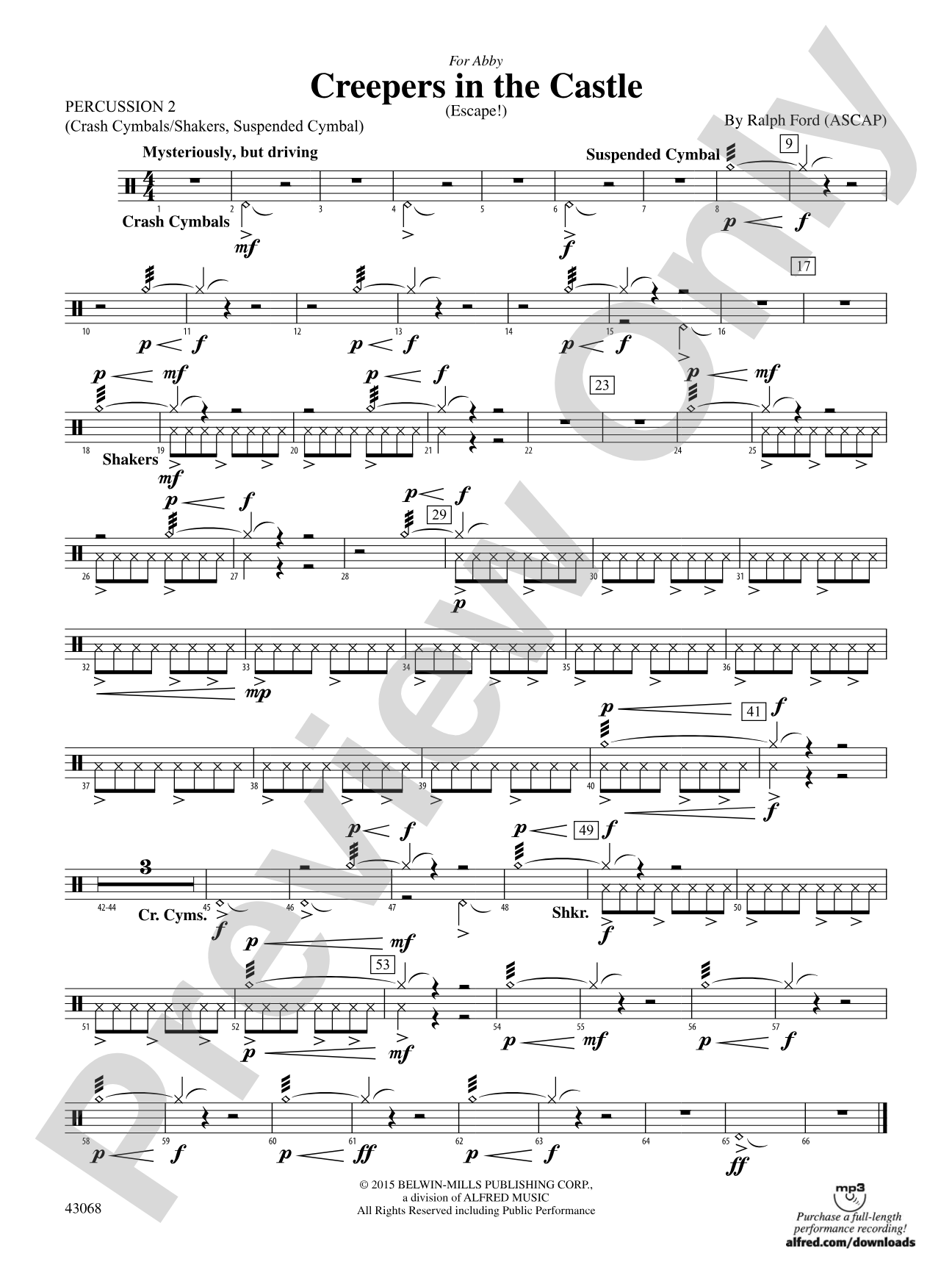

Creepers in the Castle: 2nd Percussion
(Escape!)
By Ralph Ford
Grade: 1.5 (Very Easy to Easy)
Item: 00-PC-0016725_PC2
$5.99
Pickup currently not available
Description
What would a creepy piece be if not in a minor key? Managed through the use of accidentals, this mysterious-sounding piece is actually in B-flat minor through a concert B-flat major key with the addition of accidentals. Great time to reinforce the concept that accidentals last a whole measure. With careful attention to dynamics and articulations, you're certain to have a spooktacular performance! (2:00)


Don't just read it, hear it, play along with it, and watch your students grow with it. In MakeMusic Cloud, Creepers in the Castle: 2nd Percussion comes alive with professional accompaniment, adjustable tempo, and built-in practice tools that turn solo practice into real progress.
Open in the Player
Jump straight in and assign it today.
Start Your Free Trial
Open this title and explore the full library in minutes.
Sample Audio
1
Audio File
--:--
0:00
0:00
Sample Video
Additional Details
Series:
Belwin Beginning Band
Publisher:
Alfred Music
Page Count:
210
SKU:
00-PC-0016725_PC2
More about this title
About the Composer: Ralph Ford

Ralph Ford brings three decades of professional experience across composition, arranging, conducting, and music education. After earning his Master of Science degree while teaching at Troy State University, he transitioned to full-time composing and arranging work, eventually becoming an exclusive composer and arranger for the Belwin division of Alfred Music in Los Angeles. His catalog spans over 250 published titles for orchestra, concert band, jazz ensemble, and marching band, with performances by university, military, professional, and school ensembles worldwide.
Beyond concert music, Ford has worked extensively in media production, broadcast, and commercial scoring, earning international recognition for his advertising and animation work. His career trajectory from student arranger at fifteen through faculty appointments teaching orchestration, arranging, theory, and applied brass demonstrates a commitment to both the craft of composition and the mentorship of emerging musicians.
Why we love this
Ford crafted a piece that manages to sound genuinely spooky while keeping the harmonic foundation straightforward for beginning players. The deliberate use of accidentals to create mystery within a simple B-flat framework gives you a concrete teaching moment about how chromatic inflection changes color without requiring advanced key reading skills.
What to expect
A creeping sense of unease unfolds through B-flat minor tonality, with unexpected chromatic turns adding genuine color to what might otherwise be a straightforward minor melody. The piece hovers somewhere between ominous and playful, creating atmosphere without demanding virtuosity from the ensemble.
Who it's for
Beginning concert bands preparing for fall festivals or Halloween-themed concerts will find a piece that's playable at Grade 1.5 but musically satisfying. The educational value lies equally in the performance itself and the harmonic concept it reinforces; even novice ensemble directors can build meaningful theory lessons around how accidentals function within a measure.
How to get the most out of it
- Isolate the accidentals in sectional rehearsals and have students mark them clearly in their parts before the first full run-through; this reinforces Ford's pedagogical intention and prevents mid-measure surprises.
- Lean into the dynamic contrast specified in the score to amplify the creepy effect; even a Grade 1.5 ensemble can convey character through controlled volume shifts.
- Balance clarity of articulation with the mysterious atmosphere; crisply tongued passages will cut through the minor-key haze rather than disappear into it.
- Use the two-minute duration strategically in rehearsal by recording a run-through and having students listen critically to their own dynamics and phrasing choices.
How to use it
Open a fall concert with this two-minute piece to establish a spooky tone, or pair it strategically before Halloween-week performances to capitalize on seasonal interest. At Grade 1.5, it serves equally well as a festival selection or a confidence builder on a mixed-level concert program.
Skills your students will build
- Reading and performing accidentals that affect an entire measure
- Executing expressive dynamics in a minor key context
- Precise articulation to distinguish chromatic passing tones
- Understanding how key signature and accidental interaction creates harmonic color