
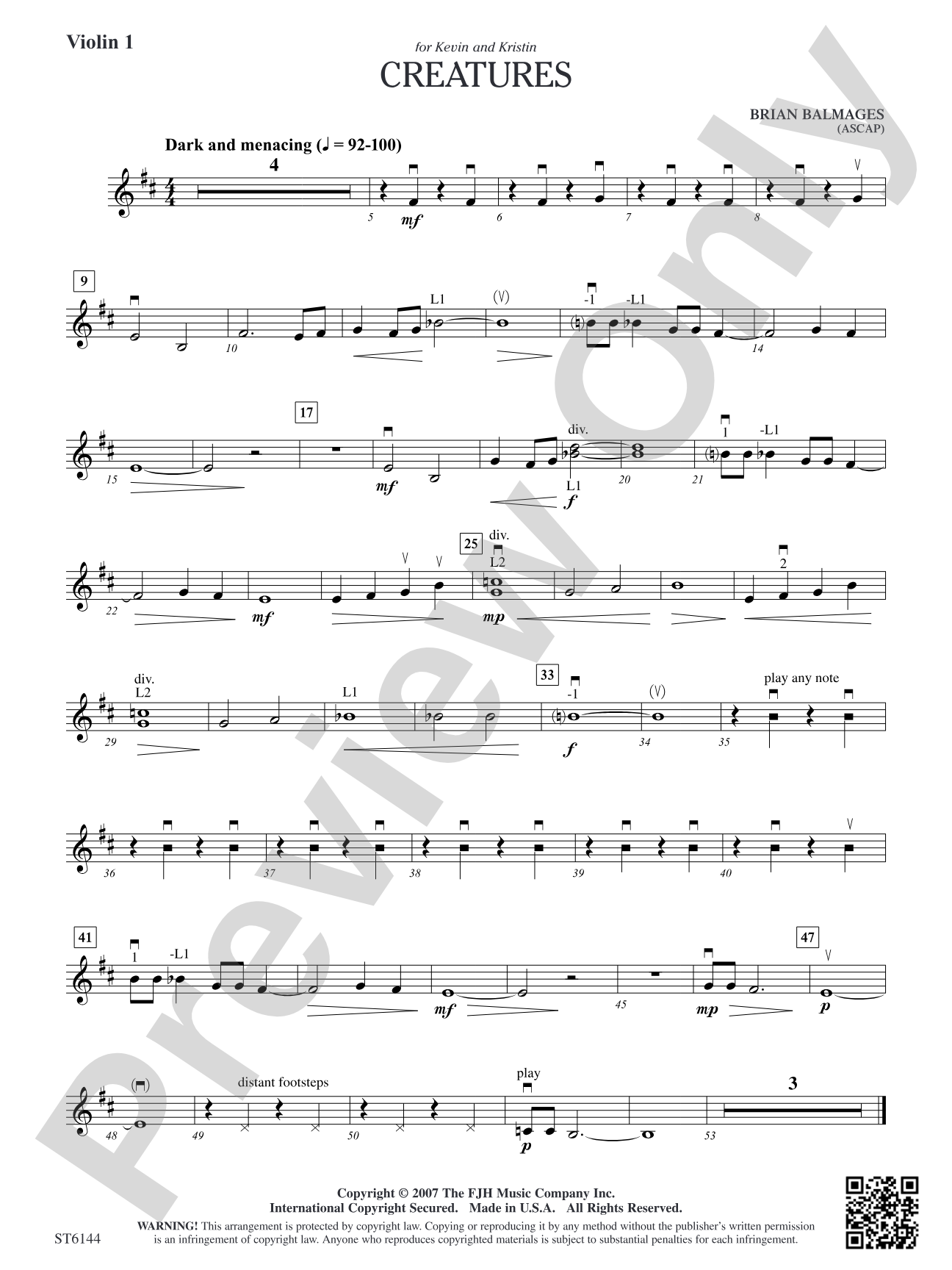

Creatures: Violin 1
By Brian Balmages
Grade: 2
Item: 98-PC-DST6144_VN1
$7.00
Pickup currently not available
Description
A dark and sinister night full of strange happenings and ghoulish encounters.... So describes this haunting work by Brian Balmages, perfect for any concert, especially in the fall. Opening with a menacing march as creatures emerge from the darkness, the mischief unfolds. Dissonances in upper strings add to the chaos before the audience hears footsteps in retreat of the coming dawn. A wonderful vehicle for introducing aleatoric music to students in a fun and creative way!


Don't just read it, hear it, play along with it, and watch your students grow with it. In MakeMusic Cloud, Creatures: Violin 1 comes alive with professional accompaniment, adjustable tempo, and built-in practice tools that turn solo practice into real progress.
Open in the Player
Jump straight in and assign it today.
Start Your Free Trial
Open this title and explore the full library in minutes.
Sample Audio
1
Audio File
--:--
0:00
0:00
Sample Video
No sample videos found.
Additional Details
Series:
FJH Developing Strings
Publisher:
The FJH Music Company, Inc.
SKU:
98-PC-DST6144_VN1
More about this title
About the Composer: Brian Balmages

Brian Balmages has established himself as a composer and conductor working fluently across orchestral, band, and chamber repertoire. His works have reached audiences at Carnegie Hall, the Kennedy Center, the Sydney Opera House, and countless school and university venues worldwide. He received the A. Austin Harding Award from the American School Band Directors Association and won the 2020 NBA William D. Revelli Composition Contest. As a guest conductor, he has led all-state ensembles, university orchestras, and professional groups at major conferences including the Midwest Clinic and College Band Directors Conference.
Balmages holds degrees from James Madison University and the University of Miami, receiving the inaugural Distinguished Alumni Award from JMU's School of Visual and Performing Arts. His music was performed at the 2013 Presidential Inaugural Prayer Service, and he has served as a commissioned composer for university inaugurations and major cultural events. Currently, he directs MakeMusic Publications and Digital Education for Alfred and MakeMusic.
Why we love this
Balmages crafts a genuinely theatrical experience here that Grade 2 orchestras can pull off without stumbling. The menacing march entrance and retreat footsteps give students memorable musical storytelling moments, while the aleatoric writing introduces controlled experimental texture in a way that feels spooky rather than academic. This is the kind of piece that makes young players feel they're doing something sophisticated while also having real fun.
What to expect
The piece unfolds like a film score for a creature feature. Opening with a steady, ominous march, it builds unease through dissonant high string writing and sudden harmonic shifts before resolving into the fading footsteps of a retreating threat. The journey from darkness through chaos to relief creates a clear dramatic arc that audiences recognize even without a program note.
Who it's for
String orchestra ensembles at the Grade 2 level who want a concert showpiece with genuine theatrical impact and programming flexibility. Conductors looking to introduce aleatoric techniques, unconventional textures, and Halloween or fall programming will find this piece immediately engaging for students.
How to get the most out of it
- Emphasize the march rhythm in the opening section with clarity and confidence. The forward momentum sets the creature entrance; if the rhythm wavers, the moment loses its menace.
- Shape the dissonant upper string passages as a gradual crescendo of chaos. Students should hear the increasing density rather than play all the notes at once at full volume.
- Balance the retreating footsteps carefully so they sound like movement away from the listener, not a simple decrescendo. Slight rubato and spacing between pizzicato notes help sell the effect.
- Assign the aleatoric sections to different stand groups and rehearse independently first. Once each section owns its material, the composite effect becomes genuinely unsettling rather than murky.
How to use it
This works beautifully as a fall or Halloween concert opener, setting a bold and memorable tone while showcasing your orchestra's range beyond standard classical repertoire. It also pairs well on programs where you want to demonstrate student growth in contemporary techniques and ensemble control; the piece gives young musicians real responsibility for creating atmosphere.
Skills your students will build
- Reading and performing aleatoric music notation
- Balancing dissonant chord clusters and upper register ensemble sonority
- Maintaining rhythmic precision in a march-based foundation while executing non-traditional textures
- Creating dramatic contrast through dynamic shaping and articulation shifts
- Ensemble cohesion when executing pizzicato passages and rhythmic retreats