
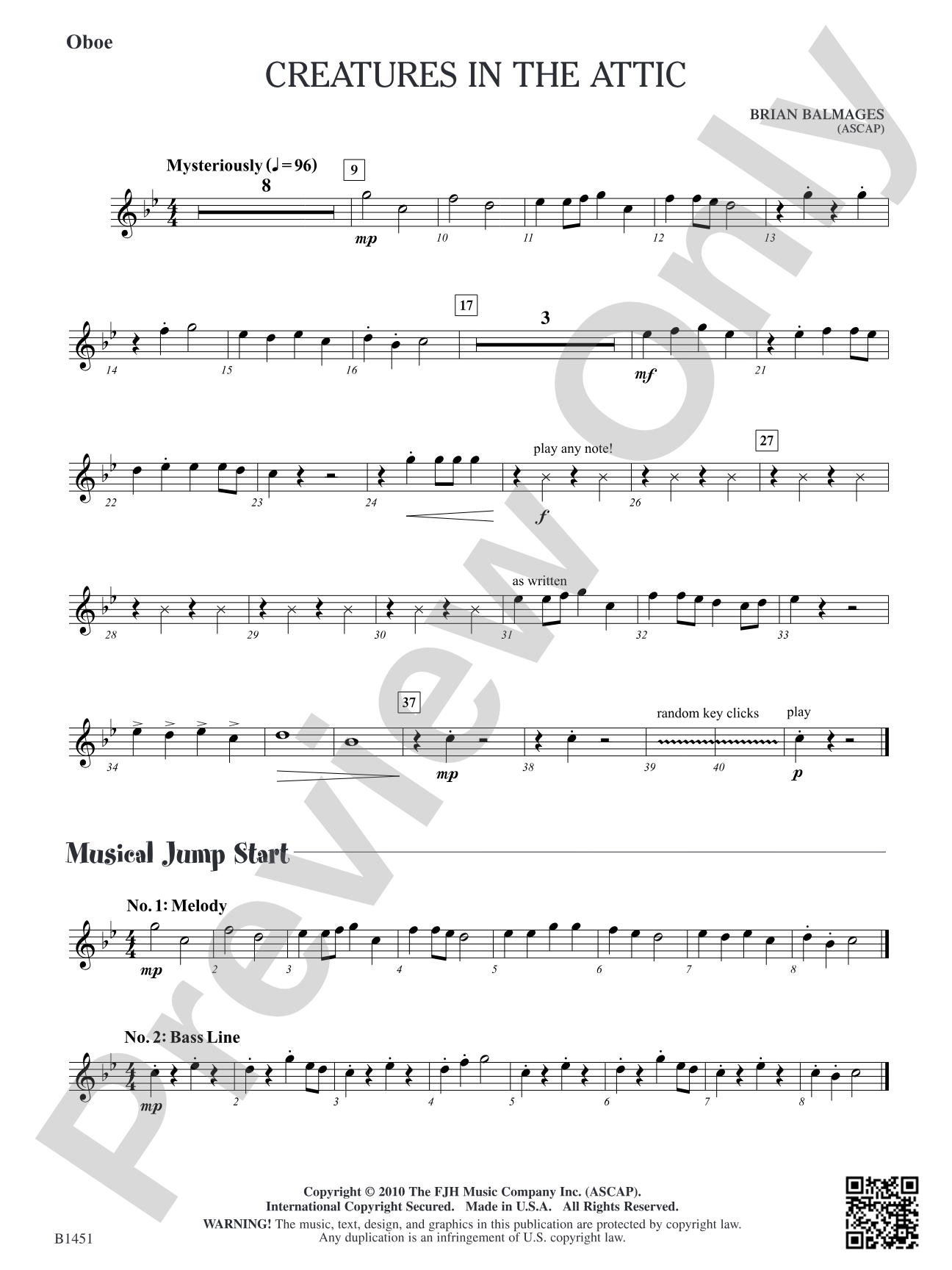

Creatures in the Attic: Oboe
By Brian Balmages
Level:.5
Item: 98-PC-DB1451_O1
$7.00
Pickup currently not available
Description
I have a little secret that I’ll no longer keep. Explaining lots of little sounds when everyone’s asleep... So begins the poem that can be read by a student or faculty member before the performance. Mysterious effects and easy aleatoric passages combine to create a sinister background from which the creatures emerge. Imaginative and fun writing for the youngest of bands!


Don't just read it, hear it, play along with it, and watch your students grow with it. In MakeMusic Cloud, Creatures in the Attic: Oboe comes alive with professional accompaniment, adjustable tempo, and built-in practice tools that turn solo practice into real progress.
Open in the Player
Jump straight in and assign it today.
Start Your Free Trial
Open this title and explore the full library in minutes.
Sample Audio
1
Audio File
--:--
0:00
0:00
Sample Video
No sample videos found.
Additional Details
Series:
FJH Starter Series
Publisher:
The FJH Music Company, Inc.
SKU:
98-PC-DB1451_O1
More about this title
About the Composer: Brian Balmages

Brian Balmages has established himself as a composer and conductor whose work spans orchestral, band, and chamber music with equal fluency. His compositions have been performed by ensembles from professional symphonies to elementary school bands in prestigious venues including Carnegie Hall, the Kennedy Center, and the Sydney Opera House. He received the A. Austin Harding Award from the American School Band Directors Association and won the 2020 NBA William D. Revelli Composition Contest for Love and Light. He is an elected member of the American Bandmasters Association and has received distinguished alumni recognition from both James Madison University and the University of Miami, where he was commissioned to compose music for the institution's presidential inauguration.
As a conductor, Balmages maintains an active schedule guest conducting all-state ensembles, university groups, and professional orchestras worldwide. His conducting appearances have included major conferences such as the Midwest Clinic, Western International Band Clinic, and the College Band Directors Conference. He currently serves as Director of MakeMusic Publications and Digital Education for Alfred and MakeMusic, bringing both composition and publishing expertise to music education.
Why we love this
Balmages writes for young bands with genuine theatrical flair rather than talking down to inexperienced players. The mysterious poem framing and creature-inspired aleatoric effects give students a genuine narrative to inhabit, making the early-level writing feel purposeful and imaginative rather than merely foundational. This is the kind of opening piece that reminds students why they wanted to join band in the first place.
What to expect
Delightfully spooky and inventive, with the feeling of discovering something hidden and alive in the shadows. The mysterious aleatoric textures create an unsettling backdrop against which playful creatures emerge, balancing sinister intent with genuine musical fun that invites imagination and risk-taking from young players.
Who it's for
Youngest concert bands and beginner ensembles ready to move beyond basic technique books into genuine repertoire. This is ideal for students in their first or second year who need accessible writing that respects their emerging musicianship and doesn't talk down to them through storylelling and theatrical concepts.
How to get the most out of it
- Read the opening poem aloud before the performance begins, either as a conducted introduction or recorded narration, to establish the sinister atmosphere and give the audience context for the sound effects that follow.
- Balance the mysterious background effects (achieved through the aleatoric writing) so they remain eerie rather than chaotic; mark exact dynamic levels in rehearsal to maintain control over the ethereal quality.
- Shape the creature entrances as distinct musical moments rather than arbitrary insertions; each emergence should feel inevitable within the piece's architecture.
- Invest rehearsal time in the ensemble's comfort with the aleatoric passages so students feel confident playing independently within the controlled structure, rather than nervous about when to enter.
How to use it
Program this as an opening concert piece or standalone short work on a fall concert when thematic programming works well, or use it to kick off a concert featuring theatrical or narrative-driven works. Its brief length and imaginative concept make it an excellent opener that energizes audiences and sets a playful tone before moving into longer works.
Skills your students will build
- Reading and executing aleatoric (chance-based) notation within a controlled ensemble context
- Balancing individual musical lines within mysterious, textural backgrounds
- Responding to visual conducting gestures during flexible rhythmic passages
- Creating dynamic contrast and color through effects that support a narrative arc
- Ensemble precision in short-note coordination and rhythmic articulation