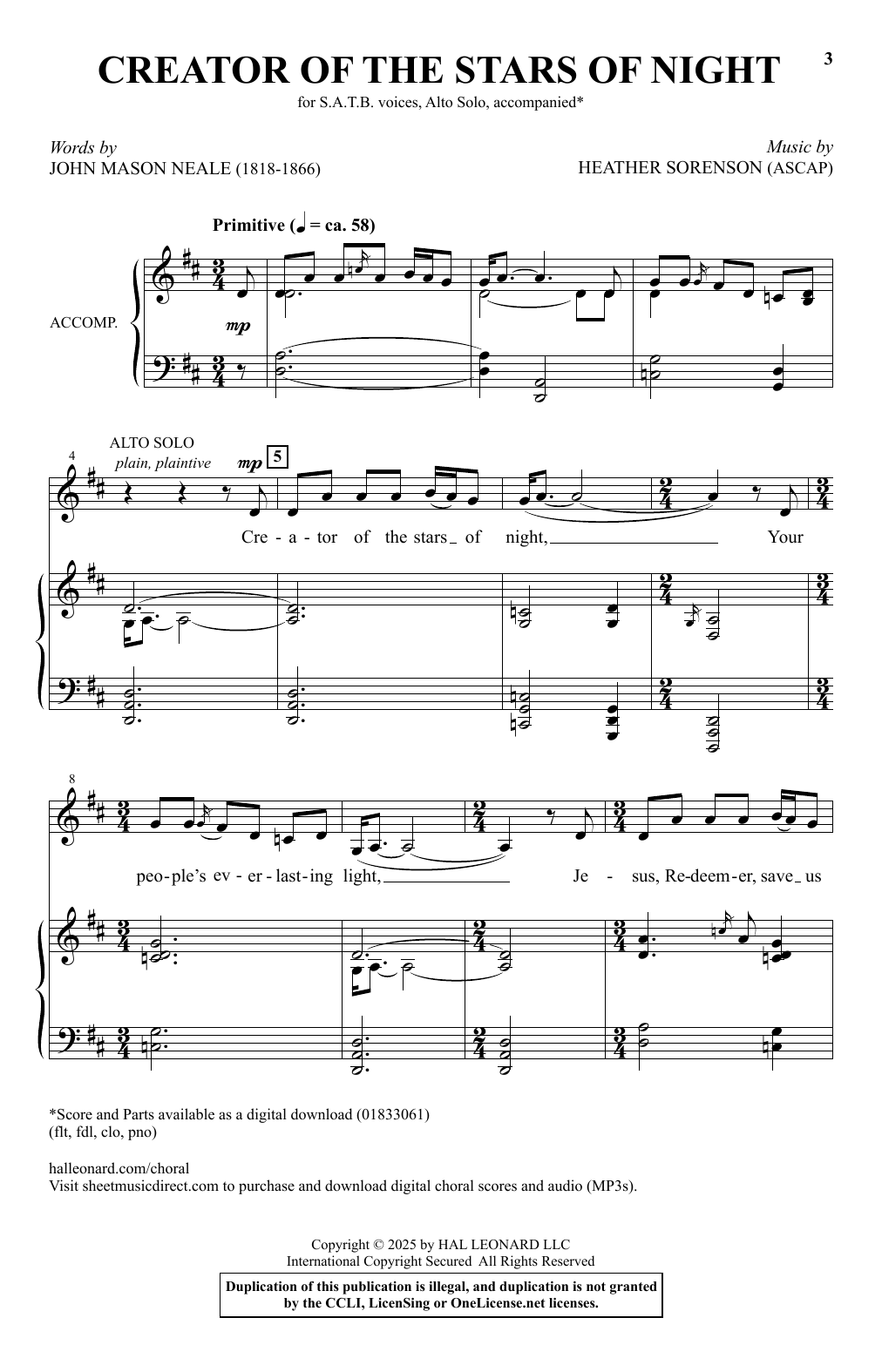
Creator Of The Stars Of Night Sheet Music Preview

Creator Of The Stars Of Night: SATB Choral Octavo

By Heather Sorenson

Item: 35-DS01646702

Digital Download
$2.75
Description

Creator Of The Stars Of Night: SATB Choral Octavo isn't in MakeMusic Cloud just yet...but it could be. Let us know you'd like to see it, and you'll help shape what comes next. In the meantime, start a free trial and dive into thousands of interactive titles your students can play along with today.

Sample Audio
No sample audio found.
Sample Video
Additional Details
Publisher: Hal Leonard
Page Count: 13
SKU: 35-DS01646702

More about this title

About the Composer: Heather Sorenson

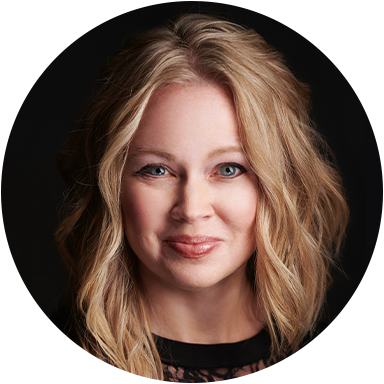
Heather Sorenson

Heather Sorenson has established herself as a composer and arranger whose works span sacred and secular contexts, performed regularly in churches, academic settings, and concert halls worldwide. Based in Dallas, Texas, she built her reputation first as a pianist before becoming recognized for her distinctive choral, orchestral, and piano compositions. Her commissions have included projects for Texas A&M University, the Kennedy Memorial Foundation, and a Carnegie Hall premiere of her oratorio EXODUS, alongside numerous works created for individual churches and performers.

Sorenson's teaching background shapes her compositional approach. She spent four years teaching elementary music at Grace Academy of Dallas, served as adjunct faculty at Baylor University, and regularly conducts master classes in piano and songwriting. Her work blends traditional and contemporary Christian music idioms into a signature style that feels both rooted and fresh. She remains active as a guest conductor and lecturer at worship conferences, universities, and churches throughout the United States, while also directing her energy toward fundraising benefit concerts for nonprofit organizations.

Why we love this

Sorenson writes sacred choral music that honors hymnody without feeling antiquated. Her arrangement captures the contemplative beauty of this Advent text while remaining accessible to singers at a manageable difficulty level. The piece gives your choir a substantive sacred selection that works equally well in a liturgical setting or a concert program.

What to expect

The music unfolds with quiet contemplation, drawing from the ancient hymn tune while layering harmonies that feel both timeless and personal. There is an unhurried quality to the setting, one that invites singers and listeners into reflection rather than spectacle. The overall effect is intimate and purposeful, befitting a text about light and creation.

Who it's for

This octavo works well for church choirs seeking seasonal sacred repertoire with musical substance, community choirs comfortable with mixed voicing and four-part harmony, and high school or early college singers building their sacred music literacy. It fits comfortably in rehearsal schedules since it is manageable in length and difficulty without sacrificing musical integrity.

How to get the most out of it

  • Shape the harmonic progressions with gentle dynamic swells rather than sudden changes; this allows the traditional melody to breathe naturally across phrases.
  • Pay attention to how the inner voices support the soprano line. Balance them distinctly enough to hear the counterpoint without letting them overshadow the main tune.
  • Approach any modal or unexpected harmonic moments with slight deliberation in rehearsal so singers understand their voice leading function and can sing with confidence.
  • Consider the acoustic properties of your performance space; Sorenson's writing rewards warm, resonant tone production in sacred venues.

How to use it

Program this during Advent services or December concerts where you need a choral selection that honors the season's spiritual themes. It pairs naturally with organ, piano, or a modest instrumental ensemble. Consider pairing it with other Advent or Christmas octavos in a set, or opening a secular holiday concert with this piece to establish a more reflective tone before lighter selections.

Skills your students will build

  • Reading SATB voicing with independent inner voice lines
  • Interpreting harmonic analysis in sacred music contexts
  • Blending four-part texture while maintaining melodic clarity
  • Singing with appropriate tone color and dynamic control in sacred repertoire
  • Understanding hymn tune traditions and their modern arrangements

You May Also Like