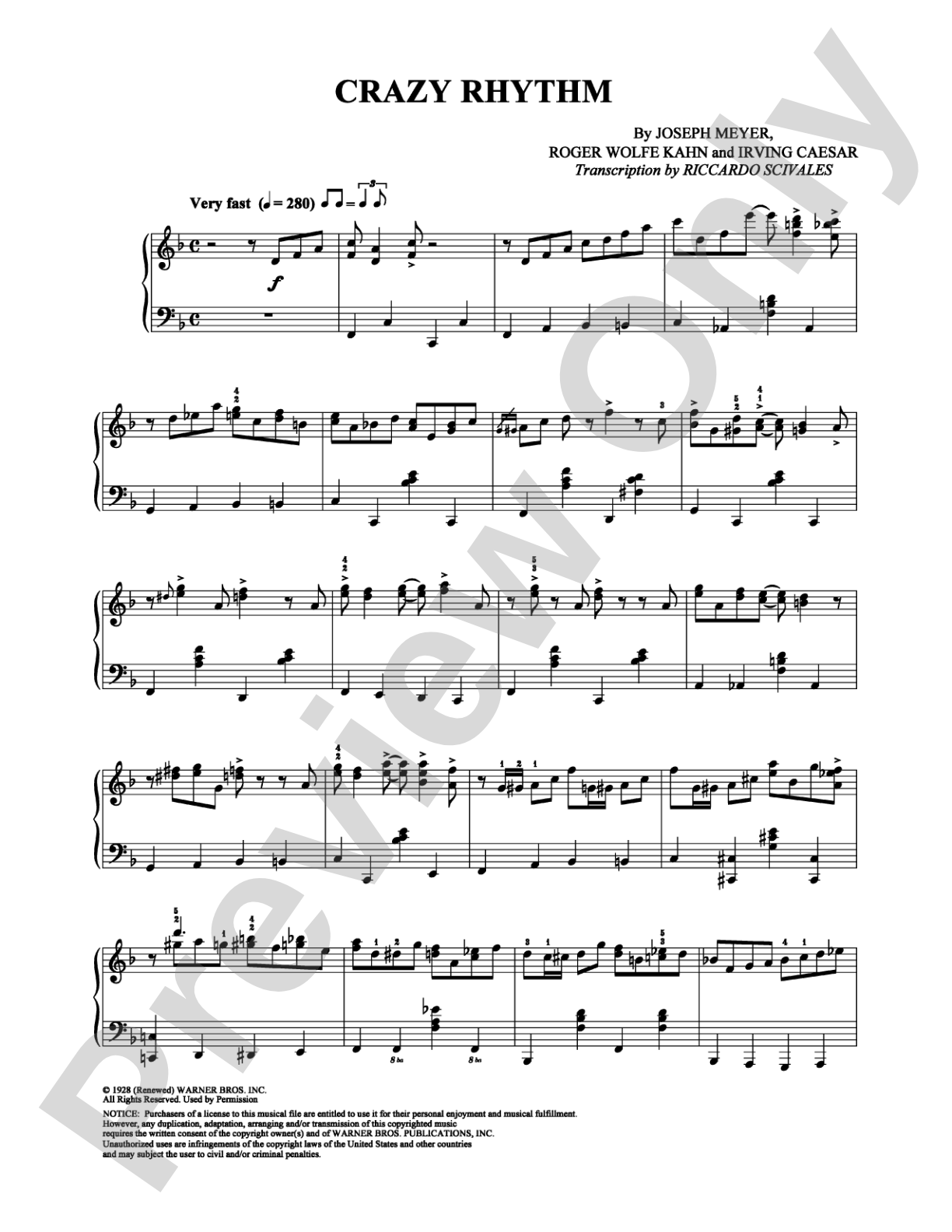
Crazy Rhythm: Piano Digital Sheet Music

Crazy Rhythm: Piano Digital Sheet Music

Irving Caesar, Joseph Meyer, Roger Wolfe Kahn, Cliff Jackson

Item: 00-PS-0008404

Digital Download
$3.99
Description

Crazy Rhythm: Piano Digital Sheet Music isn't in MakeMusic Cloud just yet...but it could be. Let us know you'd like to see it, and you'll help shape what comes next. In the meantime, start a free trial and dive into thousands of interactive titles your students can play along with today.

Sample Audio
No sample audio found.
Sample Video
Additional Details
SKU: 00-PS-0008404

More about this title

About the Artist: Cliff Jackson

Cliff Jackson was a stride pianist and bandleader active in the jazz scene from the 1920s through the 1950s. A specialist in the robust, left-hand-driven stride piano style that defined early jazz piano, Jackson recorded prolifically and performed in New York jazz clubs during the swing era.

Jackson's approach to standards like "Crazy Rhythm" showcases the technical command and rhythmic vitality that stride pianists brought to popular tunes. His interpretations demonstrate how jazz musicians of his generation transformed written compositions into vehicles for improvisation and rhythmic innovation.

Why we love this

This is a genuine jazz standard recorded by one of stride piano's defining voices. Students get to study how a master improviser approached a classic tune, with all the harmonic sophistication and rhythmic drive that made early jazz piano so influential.

What to expect

Energetic and propulsive, with a rhythm section supplied entirely by the left hand. The piece has the confident swagger of the swing era, driven by the relentless pump of the stride bass and punctuated by Jackson's melodic ideas in the right hand.

Who it's for

Jazz piano students ready to tackle stride technique and improvisation within a recognizable standard. Advanced pianists studying jazz history and interpretation will find Jackson's approach valuable for understanding how early jazz pianists transformed composed melodies into personal performances.

How to get the most out of it

  • Study the stride pattern carefully: the left hand establishes both the harmonic foundation and the rhythmic pulse, so lock in the bass notes before layering right-hand melody and counterline.
  • Listen through the entire performance to identify where Jackson departs from the standard melody and where he returns to it; this reveals the architecture of his improvisation.
  • Pay attention to how syncopation in the right hand plays against the steady left-hand pattern; the tension between these layers is essential to the swing feel.
  • Don't rush the tempo; stride piano requires space and clarity in the left hand, so maintain a relaxed pace that lets both hands breathe.

How to use it

Feature this in a jazz recital or standards showcase alongside other stride piano recordings to give students historical context for the idiom. It works well as a solo piece in a concert celebrating early jazz pianists or as a model for a student's own stride arrangement project.

Skills your students will build

  • Stride piano left-hand technique (alternating bass and chord pattern)
  • Improvisation over a jazz standard form
  • Syncopation and swing rhythms
  • Listening to recorded performances for transcription and analysis
  • Understanding how early jazz pianists approached composition and interpretation

You May Also Like