Crazy Rhythm: Piano Digital Sheet Music

Crazy Rhythm: Piano Digital Sheet Music

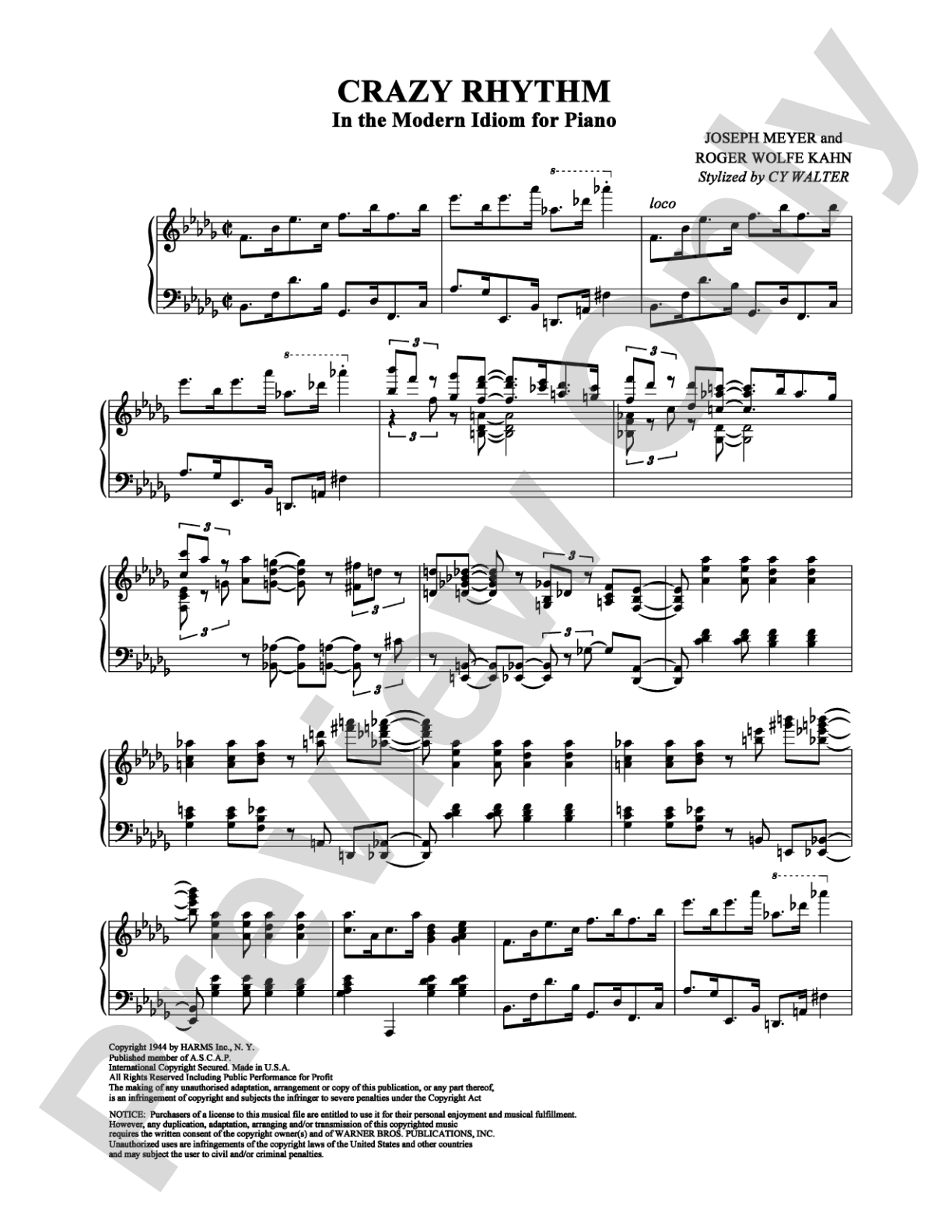
Joseph Meyer, Roger Wolfe Kahn, Cy Walter

Item: 00-PS-0001905

Digital Download
$3.99
Description

Crazy Rhythm: Piano Digital Sheet Music isn't in MakeMusic Cloud just yet...but it could be. Let us know you'd like to see it, and you'll help shape what comes next. In the meantime, start a free trial and dive into thousands of interactive titles your students can play along with today.

Sample Audio
No sample audio found.
Sample Video
Additional Details
SKU: 00-PS-0001905

More about this title

About the Artist: Cy Walter

Cy Walter was a pianist and composer who became known for his sophisticated interpretations of jazz standards and popular songs of the 1920s through 1950s. His playing combined classical technique with jazz sensibility, and he performed regularly on radio and in clubs, leaving behind recordings that capture the elegant, swinging style of mid-century American jazz piano.

Why we love this

This standard offers piano students a genuine slice of American songwriting history with melody and changes that have earned their place in countless performances across decades. The tune sits well under the hands and rewards clean voicing and rhythmic precision, making it an excellent bridge between classical repertoire and jazz-informed playing.

What to expect

Buoyant and clever, with the urbane sophistication of a well-dressed room and a cocktail in hand. The rhythm has inherent swing, the melody dances with rhythmic wit, and there's real joy in the harmonic movement.

Who it's for

Pianists with intermediate jazz language and comfortable sight-reading who want to expand their standard repertoire. This works equally well for classical pianists exploring interpretive freedom and for jazz students building fluency with chord changes and melodic phrasing.

How to get the most out of it

  • Anchor the left hand comping with steady quarter-note motion to establish the swing feel; let the right hand melody breathe over it rather than rushing to fill every space.
  • Listen closely to where the phrase naturally peaks and shape dynamics accordingly; avoid playing through to the end of a line without considering the song's arc.
  • Experiment with different voicing densities during repeats to keep the tune fresh; sparse statements of the melody can be just as effective as fuller harmonizations.

How to use it

Feature this in a jazz or American songbook recital as a solo piece, or pair it with other standards of similar era to build a thematic program around mid-century popular piano styles. It also works as an encores piece or as a teaching tool in a mixed-level repertoire lesson.

Skills your students will build

  • Reading and interpreting jazz chord symbols
  • Swung eighth-note rhythms and shuffle grooves
  • Building variation through reharmonization
  • Left-hand comping independence from right-hand melody
  • Phrasing standards with forward momentum and shape

You May Also Like