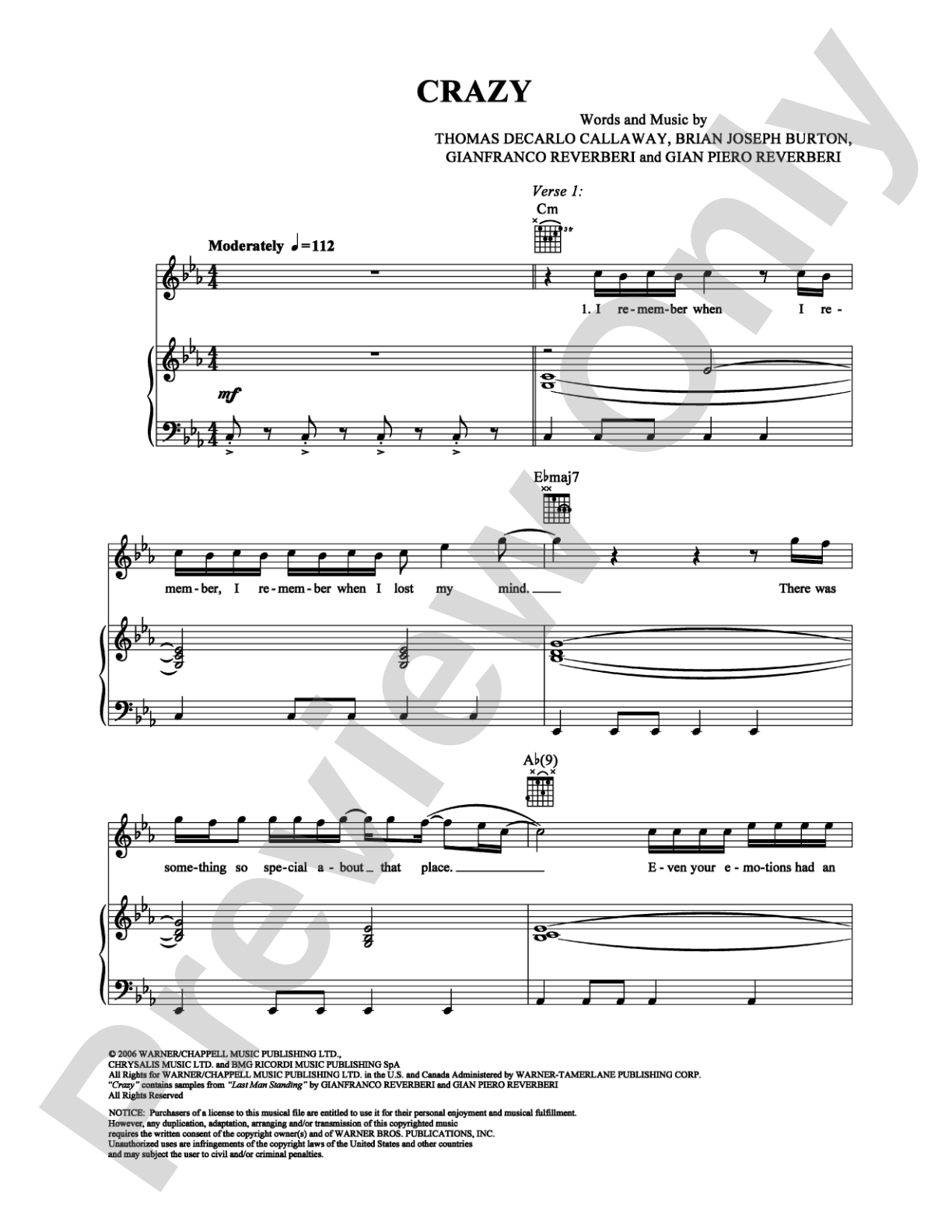
Crazy: Piano/Vocal/Chords Digital Sheet Music

Crazy: Piano/Vocal/Chords Digital Sheet Music

Gnarls Barkley, Thomas DeCarlo Callaway, Brian Joseph Burton, Gianfranco Reverberi, Gian Piero Reverberi

Item: 00-PS-0004090

Digital Download
$3.99
Description

Crazy: Piano/Vocal/Chords Digital Sheet Music isn't in MakeMusic Cloud just yet...but it could be. Let us know you'd like to see it, and you'll help shape what comes next. In the meantime, start a free trial and dive into thousands of interactive titles your students can play along with today.

Sample Audio
No sample audio found.
Sample Video
Additional Details
SKU: 00-PS-0004090

More about this title

About the Artist: Gnarls Barkley

Gnarls Barkley is the musical collaboration between producer Brian Burton (Danger Mouse) and singer CeeLo Green, formed in 2003. The duo emerged from hip-hop and electronic music circles but crafted a sound that blends soul, funk, and alternative pop, creating some of the most inventive and genre-defying work of the 2000s. Their debut album The Odd Couple established them as artists unafraid to experiment with unconventional arrangements and production techniques.

Their breakthrough hit "Crazy" became a global phenomenon and remains a staple of contemporary pop culture. The track's success demonstrated how unconventional songwriting and production can achieve mainstream appeal without sacrificing artistic integrity. For music educators, Gnarls Barkley's work offers students a window into how contemporary artists use unexpected harmonic choices, layered production textures, and emotional directness to create memorable songs.

Why we love this

This arrangement captures the quirky harmonic and melodic character that made "Crazy" resonate across so many listeners. The piano/vocal/chords format lets singers access a contemporary hit while pianists tackle the distinctive production signatures that make the song instantly recognizable, from its moody harmonic movement to its infectious groove.

What to expect

"Crazy" captures a moment of emotional turbulence with dark humor and sonic experimentation. The arrangement preserves that off-kilter, slightly haunted quality while leaning into the song's vocal vulnerability and harmonic sophistication. Playing or singing this requires comfort with unconventional harmonic language and a willingness to sit in the song's moody, introspective space.

Who it's for

Student vocalists and pianists exploring contemporary pop and alternative music in recitals, studio recordings, or contemporary music ensembles. This arrangement works for singers developing interpretive maturity and pianists interested in learning how contemporary production translates to acoustic instruments.

How to get the most out of it

  • Pay attention to the harmonic movement in the verses; the song relies on unexpected chord progressions rather than standard changes, so lock in the harmony early and keep it stable to let the vocal melody breathe over top.
  • The groove matters as much as the notes. Work with your pianist to establish a sense of forward motion and rhythmic precision, even in the quieter sections.
  • Shape the vocal line with restraint. The song's power comes from emotional delivery rather than volume; focus on dynamics and phrasing to convey the song's slightly off-kilter mood.
  • Balance the relationship between voice and piano. This isn't a piano solo with vocal accompaniment; it's a conversation between two voices, so adjust levels and respond to each other in real time.

How to use it

Program this in a recital exploring contemporary songwriting alongside art songs or musical theater selections. It works especially well when paired with other songs that prioritize emotional authenticity and harmonic innovation over conventional pop formulas, helping audiences hear how modern songcraft can be as sophisticated as any classical or traditional art song.

Skills your students will build

  • Reading and performing non-traditional harmonic progressions
  • Balancing vocal phrasing with piano accompaniment in contemporary idioms
  • Interpreting emotional subtext through restraint rather than volume
  • Recognizing how production elements in recorded music translate to acoustic performance
  • Developing rhythmic independence between voice and piano parts

You May Also Like