
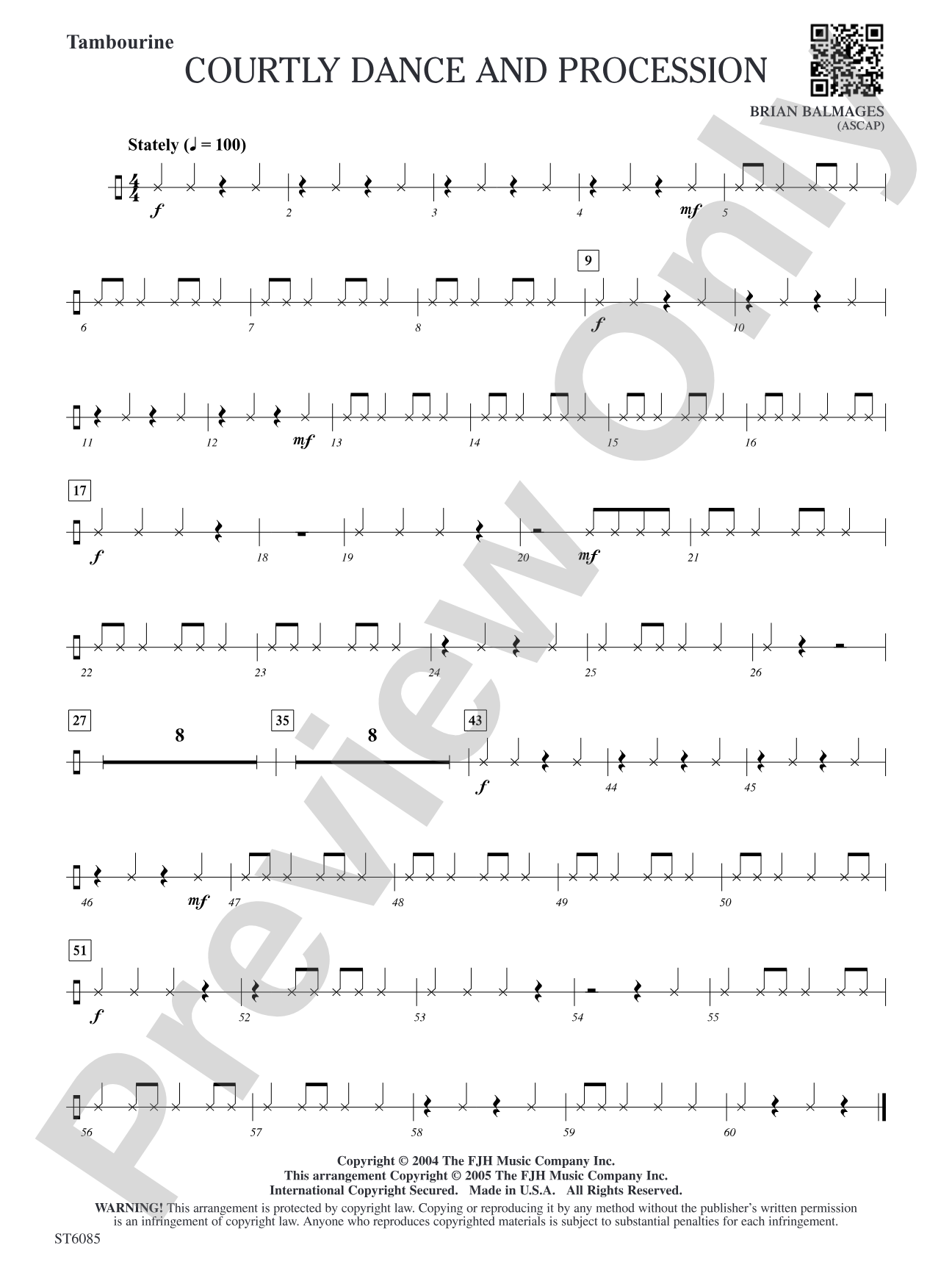

Courtly Dance and Procession: Opt. Tambourine
By Brian Balmages
Grade: 1
Item: 98-PC-DST6085_OTAM
$7.00
Pickup currently not available
Description
You'll be surprised to know that this great sounding work uses only six notes in all instruments (D-B). The piece has a Renaissance quality to it and includes a lyrical processional theme (at the same tempo) to work on legato playing. An optional tambourine part is included. Brian Balmages' music has been performed by professional orchestras around the country - now you can bring his music into your own concert hall!


Don't just read it, hear it, play along with it, and watch your students grow with it. In MakeMusic Cloud, Courtly Dance and Procession: Opt. Tambourine comes alive with professional accompaniment, adjustable tempo, and built-in practice tools that turn solo practice into real progress.
Open in the Player
Jump straight in and assign it today.
Start Your Free Trial
Open this title and explore the full library in minutes.
Sample Audio
1
Audio File
--:--
0:00
0:00
Sample Video
No sample videos found.
Additional Details
Series:
FJH Beginning Strings
Publisher:
The FJH Music Company, Inc.
SKU:
98-PC-DST6085_OTAM
More about this title
About the Composer: Brian Balmages

Brian Balmages brings equal fluency to orchestral, band, and chamber music, with performances spanning professional symphony orchestras, elementary school ensembles, and venues including Carnegie Hall, the Kennedy Center, and Sydney Opera House. His honors include the A. Austin Harding Award from the American School Band Directors Association, the 2020 NBA William D. Revelli Composition Contest, and membership in the American Bandmasters Association. He was awarded the inaugural James Madison University Distinguished Alumni Award and later commissioned by the University of Miami to compose for the inauguration of its sixth president.
As a conductor, Balmages maintains regular engagements with all-state, regional, university, and professional ensembles worldwide, with notable guest appearances at the Midwest Clinic, Western International Band Clinic, and state ASTA conferences. His work has reached national prominence, including a performance as part of the 2013 Presidential Inaugural Prayer Service. Currently, he serves as Director of MakeMusic Publications and Digital Education for Alfred and MakeMusic.
Why we love this
The constraint of using only six notes (D through B) across all instruments proves that sophistication lies in orchestration, not complexity. Balmages balances a courtly opening with a legato processional section, giving young string players distinct musical moods to explore within an accessible Grade 1 framework. This piece works brilliantly for early-season concerts and festivals because it sounds polished without demanding technical facility.
What to expect
The opening carries the formal dignity of a Renaissance court scene, with deliberate pacing and elegant restraint. The processional theme that follows invites a contrasting warmth, shaped by the challenge of sustaining tone and shaping long phrases with limited harmonic vocabulary. Together, the two sections create a complete musical narrative.
Who it's for
Beginning string orchestras (Grade 1) ready to move beyond simple unison exercises. This piece serves ensembles in their first or second year of playing, offering a confidence-building work that sounds mature without overwhelming young musicians.
How to get the most out of it
- Pay close attention to the processional section's legato marking. Young players often rush through connected passages; insist on sustained tone and smooth bow transitions rather than speed.
- The tambourine part, though optional, adds textural interest and can engage a percussionist who might otherwise sit idle at this level. Use it to reinforce the courtly character.
- Maintain the Renaissance flavor by shaping phrases with gentle dynamics rather than exaggerated swells. The limited pitch palette rewards clarity and control.
How to use it
Open a concert with this piece to establish an elegant tone, or pair it with other Grade 1 works to showcase your ensemble's range in a single program. Its accessible difficulty and polished sound make it ideal for festival play, where judges appreciate mature musicmaking from young orchestras.
Skills your students will build
- Sustaining tone across longer phrases and managing bow distribution
- Listening for blend when all instruments share a limited pitch set
- Interpreting articulation differences between staccato and legato passages
- Maintaining rhythmic precision without relying on harmonic context for guidance