
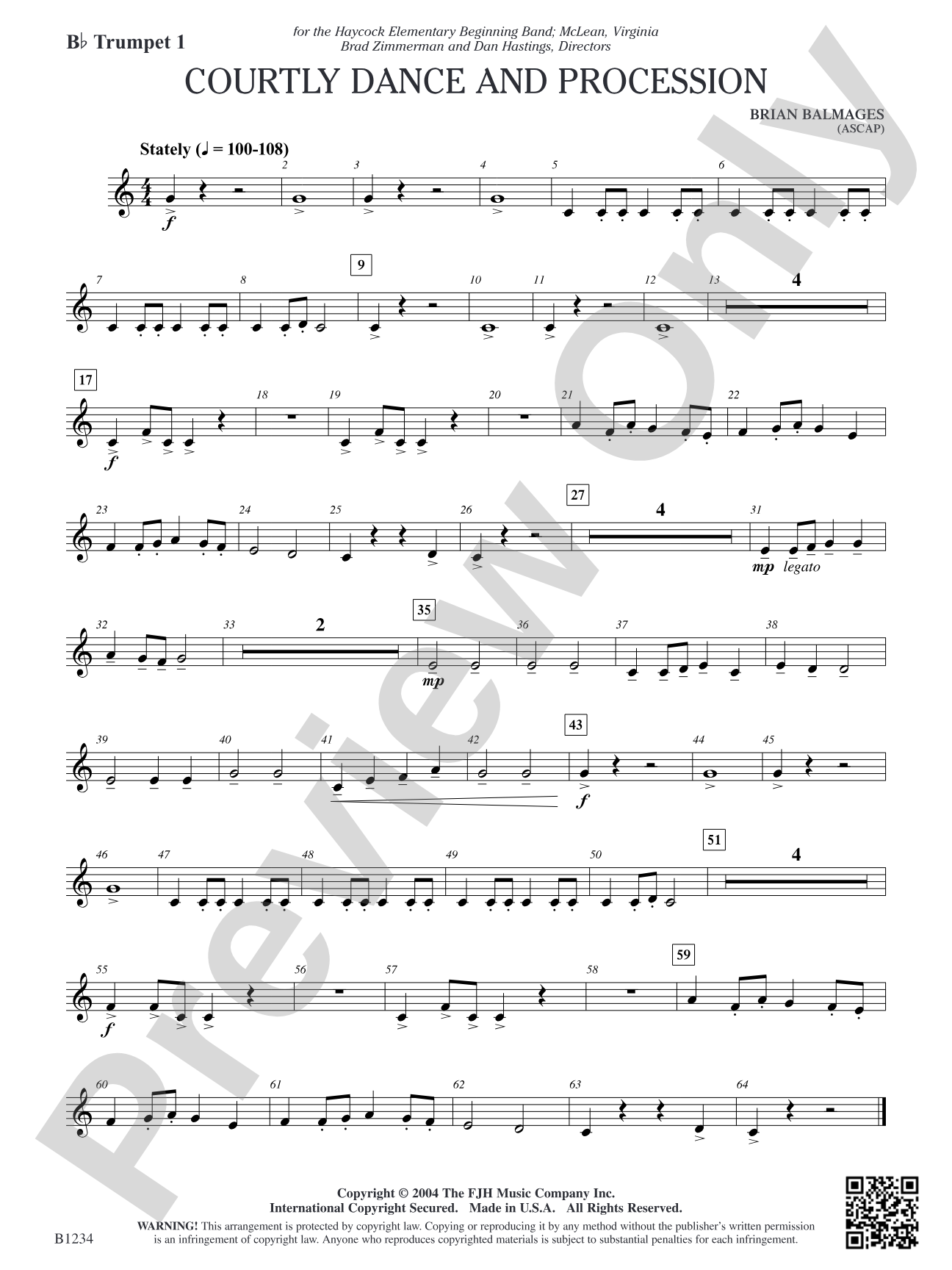

Courtly Dance and Procession: B-flat Trumpet 1
By Brian Balmages
Grade: 1
Item: 98-PC-DB1234_T1
$7.00
Pickup currently not available
Description
You'll be surprised to know that this great sounding work uses only six notes in all instruments, with the exception of the clarinets, which also use a low written B to involve the right hand. The piece has a Renaissance quality to it and includes a middle processional theme (at the same tempo) to work on legato playing. Optional parts are included for clarinet 2 and trumpet 2. There is something for everyone in this dynamic addition to the repertoire!


Courtly Dance and Procession: B-flat Trumpet 1 isn't in MakeMusic Cloud just yet...but it could be. Let us know you'd like to see it, and you'll help shape what comes next. In the meantime, start a free trial and dive into thousands of interactive titles your students can play along with today.
Request This Title
Tell us you want it.
Start Your Free Trial
Explore everything that's ready to play right now.
Sample Audio
1
Audio File
--:--
0:00
0:00
Sample Video
No sample videos found.
Additional Details
Series:
FJH Beginning Band
Publisher:
The FJH Music Company, Inc.
SKU:
98-PC-DB1234_T1
More about this title
About the Composer: Brian Balmages

Brian Balmages has established himself as a composer and conductor with an expansive reach across orchestral, band, and chamber music. His works have been heard in prestigious venues including Carnegie Hall, the Kennedy Center, and the Sydney Opera House, performed by ensembles ranging from professional orchestras to elementary school bands. He is a recipient of the A. Austin Harding Award from the American School Band Directors Association and won the 2020 NBA William D. Revelli Composition Contest for Love and Light. He was also commissioned by the University of Miami to compose music for the inauguration of the institution's 6th president, and his work was performed at the 2013 Presidential Inaugural Prayer Service.
As a conductor, Balmages maintains regular engagements with all-state and regional ensembles as well as university and professional groups worldwide. His guest conducting appearances have included the Midwest Clinic, Western International Band Clinic, and numerous national and international conferences. An elected member of the American Bandmasters Association and recipient of the James Madison University Distinguished Alumni Award, Balmages currently serves as Director of MakeMusic Publications and Digital Education for Alfred and MakeMusic.
Why we love this
Balmages has crafted a Grade 1 work that doesn't sound like Grade 1, using clever orchestration and a limited pitch set to create something genuinely musical rather than merely accessible. The Renaissance flavor paired with a processional middle section gives your ensemble a chance to explore character and legato phrasing at the earliest levels. This is the kind of piece that sounds impressive in concert without asking your students to do the impossible.
What to expect
The opening courtly dance has a stately, almost ceremonial quality, with clean articulation and a sense of pageantry. The middle processional theme shifts into sustained legato lines that feel contemplative and grand, giving every student a moment of genuine musical expression before returning to the dance's rhythmic energy.
Who it's for
This piece is ideal for beginning concert bands navigating the transition from method book work to independent repertoire. It works equally well for groups just starting instrumental study or for established ensembles looking for accessible festival and contest material that still demands musical maturity.
How to get the most out of it
- Focus on maintaining a steady, processional pulse in the middle section; the legato writing requires ensemble security in pulse and clarity of phrase shape rather than technical facility.
- Work the limited pitch palette to your advantage by drilling articulation clarity and ensemble balance; with only six notes available, every player's voice matters in the texture.
- Use the optional clarinet 2 and trumpet 2 parts strategically; introducing them partway through rehearsals or adding them for a final concert performance version builds momentum and gives developing players a graceful entry point.
- Shape the Renaissance character through dynamic contrast and deliberate voicing rather than tempo changes; let the instrumentation itself suggest the courtly atmosphere.
How to use it
Program this early in the concert to establish a strong opening with something that sounds polished and intentional; the festive character sets an engaging tone without overextending a young ensemble. It also makes an excellent choice for festivals or contests at the Grade 1 level, offering a piece that judges will recognize as well-crafted composition rather than filler.
Skills your students will build
- Articulation clarity and precision across the ensemble
- Sustained legato playing and phrase shaping
- Dynamic control and balance within a limited harmonic palette
- Listening and blending across different instrumental families
- Ensemble pulse security in a processional tempo