
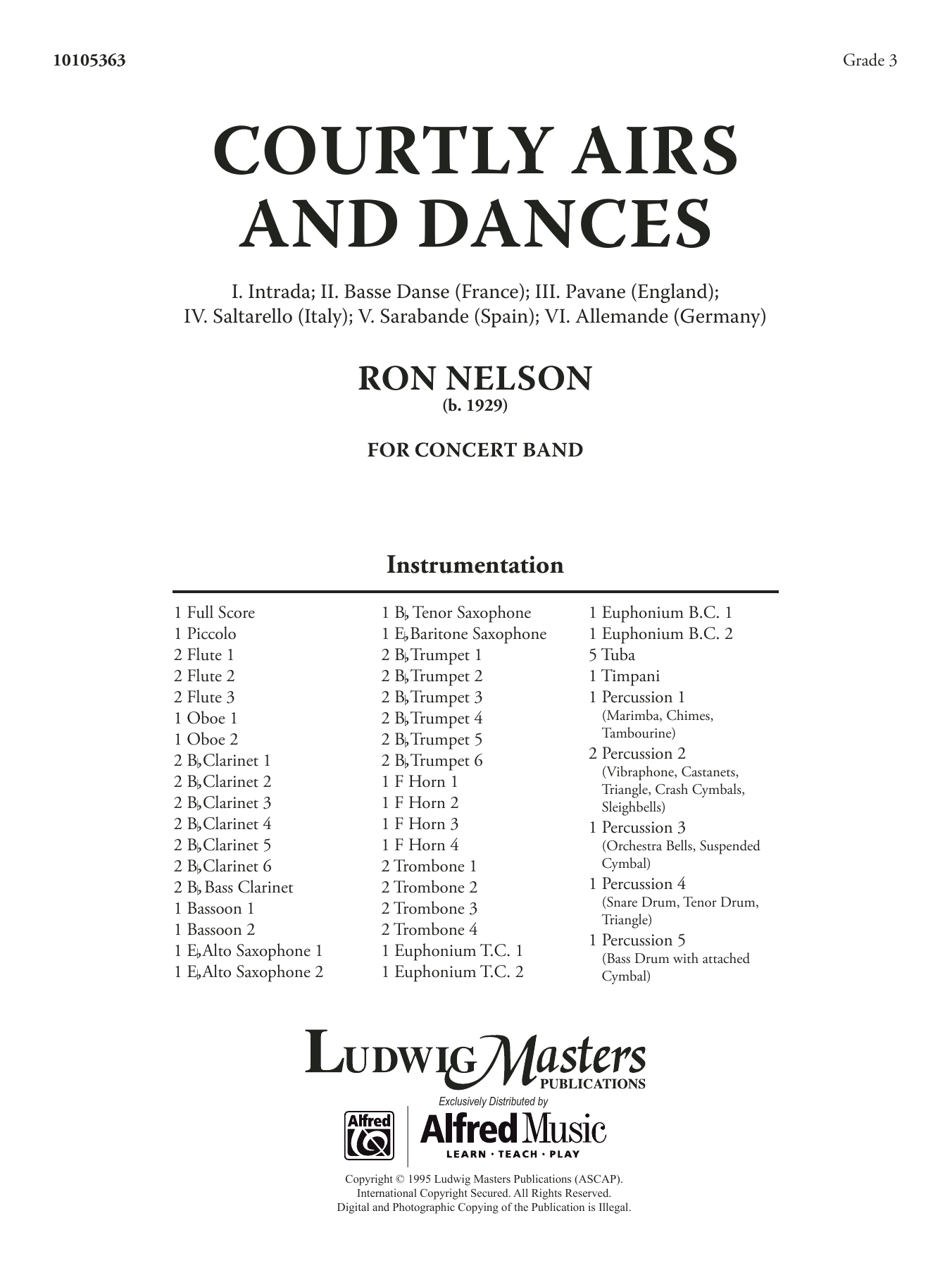

Courtly Airs and Dances: Concert Band Conductor Score & Parts
By Ron Nelson
Grade: 3
Item: 35-PK01470554
$90.00
Pickup currently not available
Buy Extra Parts (Digital PDF Download)
Parts Added to Cart!
Description
This is a suite of Renaissance dances which were characteristic to five different European countries. The festival opens with a fanfare-like Intrada followed by Basse Dance (France), Pavane (England), Saltarello (Italy), Sarabande (Spain) and Allemande (Germany). This is one of the composer's more accessible works for bands at this level.


Discover MakeMusic Cloud: thousands of interactive titles your students can play along with today.
Sample Audio
No sample audio found.
Sample Video
No sample videos found.
Additional Details
Publisher:
Hal Leonard
SKU:
35-PK01470554
More about this title
About the Composer: Ron Nelson
Ron Nelson is a prolific composer whose catalog spans orchestral, band, and choral works with a particular gift for writing idiomatically for winds. His pieces balance accessibility with genuine musical substance, making them staples in rehearsal rooms from middle schools through university programs. Nelson's arrangements and original compositions frequently draw on historical and folk sources, which he transforms into vehicles for ensemble development without sacrificing artistic integrity.
Why we love this
Nelson crafts each dance with distinct character and instrumentation, so your band moves through five contrasting musical worlds rather than grinding through variations on a theme. The writing sits comfortably for Grade 3 ensembles while maintaining enough textural detail and harmonic interest to keep rehearsals engaging, and the historical progression gives your concert a narrative arc that audiences genuinely appreciate.
What to expect
A guided tour through Renaissance Europe, where courtly pageantry unfolds in miniature. Each dance carries the flavor of its origin, from the stately formality of Spanish court to the buoyant energy of Italian celebration, creating a vivid musical travelogue that feels both intimate and ceremonial.
Who it's for
This suite works beautifully for Grade 3 concert bands looking for repertoire with historical substance and clear contrasts between movements. Directors seeking a springboard for cultural discussion or a programmatic work that educates audiences while developing ensemble musicianship will find it especially useful.
How to get the most out of it
- Bring out the ceremonial character of the opening Intrada by balancing trumpet and trombone solos against the ensemble, treating it as a gateway rather than background fanfare.
- Shape each dance's phrasing to reflect its cultural origin. The Basse Dance sits close to the earth with gentle rubato; the Saltarello bounces with articulation and lift.
- Let the saxophone and woodwind soloists breathe between phrases rather than pushing through mechanically. These dances thrive on conversation between sections.
- Mark conductor cues carefully where ensemble texture shifts or meter implications change. Your clarity keeps the band grounded in the style without overcomplicating.
How to use it
Open a concert with this suite to establish an accessible, engaging tone while signaling that the band takes repertoire seriously. Its historical theme pairs naturally with humanities curricula or cultural heritage programs. It also sits well mid-concert as a palate cleanser between heavier contemporary or classical works.
Skills your students will build
- Stylistic differentiation between baroque and renaissance dance forms
- Phrasing and articulation in period-appropriate contexts
- Solo passage execution with accompaniment awareness
- Ensemble balance across changing instrumental textures
- Reading and interpreting historically informed conducting gestures