

Couperin: The Graded Couperin (Ed. Marthe Motchane): Piano Book
By François Couperin / ed. Marthe Morhange Motchane
Item: 00-PK-0002815

$12.99
Pickup currently not available
Buy Extra Parts (Digital PDF Download)
Parts Added to Cart!
Description
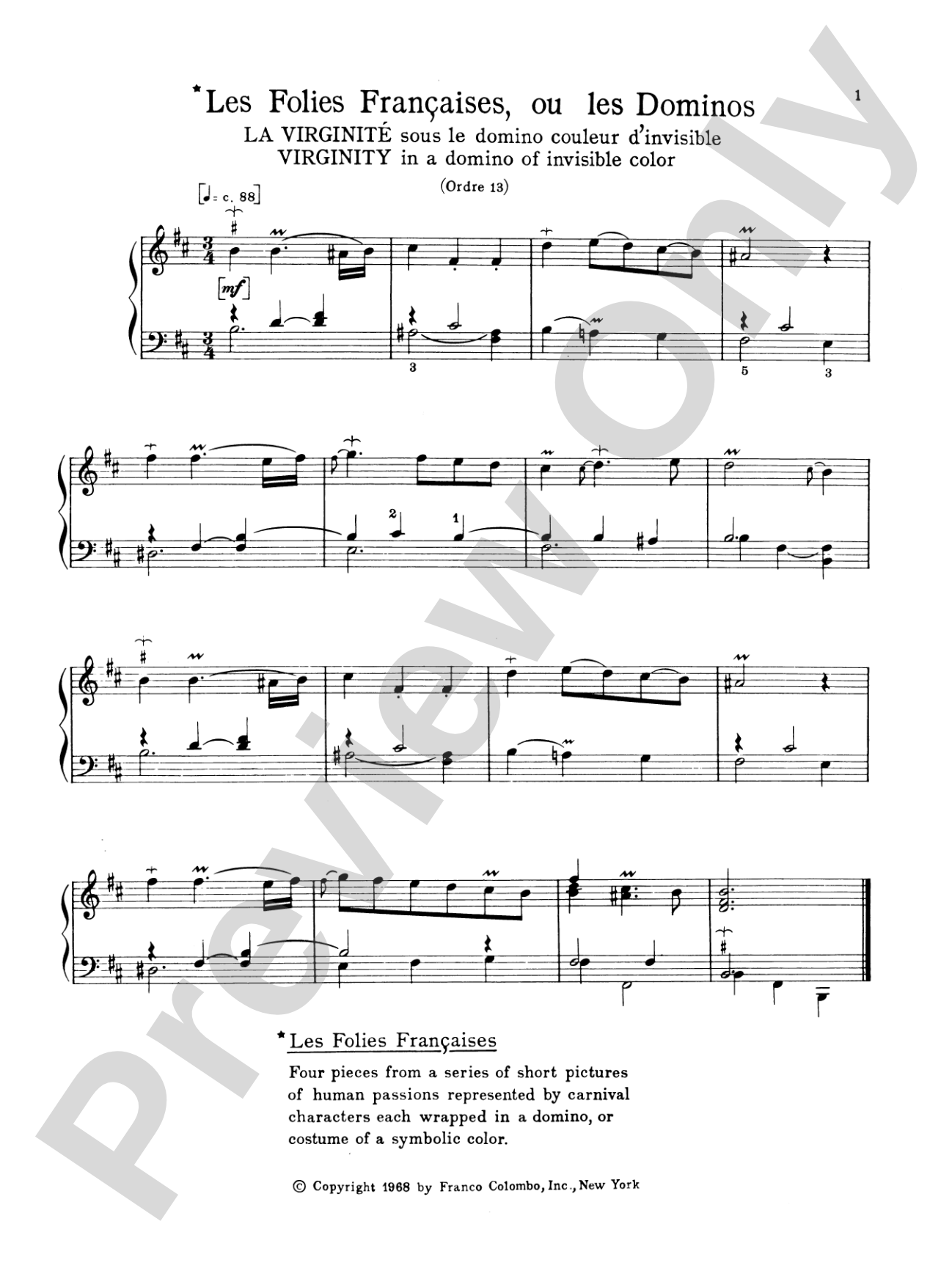
This collection presents pieces which are among the most beautiful of this great musician's works. This is also a graded Couperin, intended to make this an ideal edition for teaching. The text scrupulously follows the original, with editorial details indicated in brackets.


Don't just read it, hear it, play along with it, and watch your students grow with it. In MakeMusic Cloud, Couperin: The Graded Couperin (Ed. Marthe Motchane): Piano Book comes alive with professional accompaniment, adjustable tempo, and built-in practice tools that turn solo practice into real progress.
Open in the Player
Jump straight in and assign it today.
Start Your Free Trial
Open this title and explore the full library in minutes.
Sample Audio
No sample audio found.
Sample Video
No sample videos found.
Additional Details
Series:
Kalmus Edition
Publisher:
Alfred Music
Page Count:
80
SKU:
00-PK-0002815
More about this title
About the Composer: François Couperin
François Couperin (1668, 1733) was the most celebrated member of the Couperin family and one of the defining voices of French Baroque keyboard music. His harpsichord works, organized into ordres (suites), blend dance forms with character pieces and demonstrate remarkable harmonic sophistication alongside accessible melodic writing. Couperin's influence on keyboard pedagogy remains substantial; his pieces appear in curricula worldwide because they reward both technical precision and interpretive nuance.
As a court musician and composer for Louis XIV, Couperin distilled the elegance of French style into works that span from intimate salon pieces to larger formal structures. His writing privileges clarity and ornamentation over virtuosic display, making his music particularly valuable for students learning to balance technical demands with musical storytelling.
Why we love this
Motchane's grading system makes these treasures genuinely teachable, allowing students to encounter authentic Baroque keyboard writing at their level rather than settling for simplified stand-ins. The editorial restraint, with original details preserved and modern clarifications in brackets, gives young pianists the experience of reading historical sources while building confidence in ornamentation and phrasing.
What to expect
These pieces balance precision with intimacy. The ornamental language creates a sense of courtly elegance and gentle refinement, while the harmonic language speaks with sophistication and occasional melancholy. Playing Couperin feels like learning to speak a language where every gesture carries cultural meaning.
Who it's for
Intermediate to advanced students who have developed secure technique and are ready to engage with Baroque ornamentation and refined phrasing. Teachers seeking graded Baroque repertoire that spans from early-intermediate through advancing students will find this collection invaluable for building musical literacy alongside technical growth.
How to get the most out of it
- Approach the ornaments as integral to the melodic line, not decoration. Each trill, turn, and mordent carries expressive weight; play them with the same legato sensitivity you'd use for unadorned notes.
- Shape phrases according to the harmonic rhythm rather than surface note length. Many pieces contain brief, pointed gestures that need clear articulation to maintain forward motion across the page.
- Let the hand position remain relaxed through hand-crossing passages and rapid figurations. Couperin's writing rewards wrist flexibility and a settled hand rather than finger-driven tension.
- Practice the continuo-like left-hand figures separately, establishing their rhythmic independence. These bass patterns anchor the texture and deserve the same rhythmic clarity as any solo voice.
How to use it
Couperin works beautifully in a Baroque recital or as part of a keyboard literature series spanning harpsichord traditions. Individual pieces can anchor a student recital or appear alongside Bach and Scarlatti to show the breadth of keyboard writing in the late Baroque. The graded approach means you can program a single piece at a community concert without requiring a full Couperin program.
Skills your students will build
- Baroque ornamentation (trills, turns, mordents, and their historical variants)
- Phrasing and structural awareness in suite movements
- Hand independence and voice leading in two and three-part writing
- Rhythmic precision in continuo-based accompaniment patterns
- Interpretive choices within historically informed stylistic boundaries