
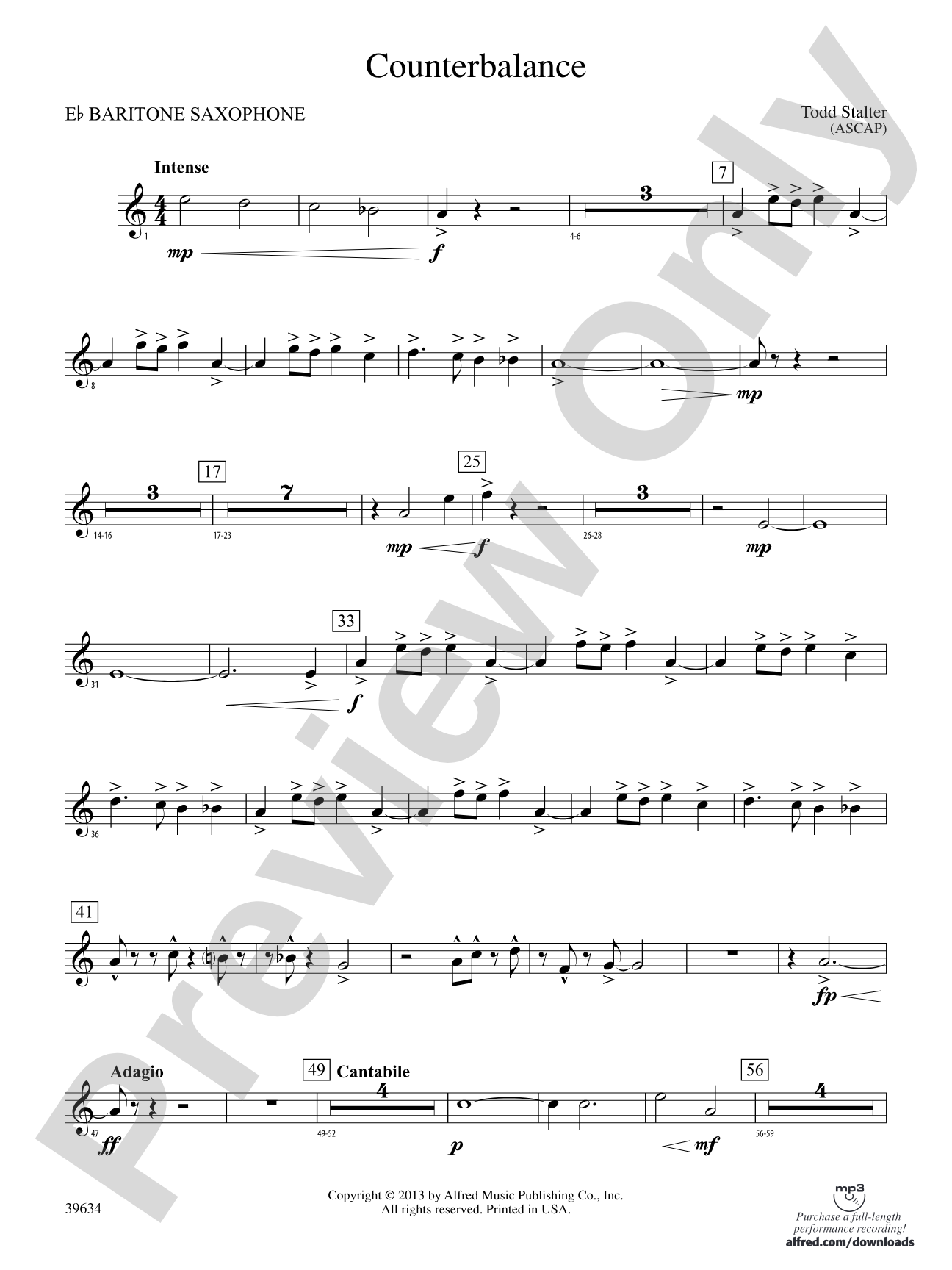

Counterbalance: E-flat Baritone Saxophone
By Todd Stalter
Grade: 2.5 (Medium Easy)
Item: 00-PC-0015908_BTX
$3.00
Pickup currently not available
Description
This exciting work explores musical opposites---long vs. short, soft vs. loud, high vs. low, and smooth vs. angular. It will be sure to energize your ensemble on your next concert! (4:00)
This title is available in MakeMusic Cloud.


This title is available in MakeMusic Cloud.
Don't just read it, hear it, play along with it, and watch your students grow with it. In MakeMusic Cloud, Counterbalance: E-flat Baritone Saxophone comes alive with professional accompaniment, adjustable tempo, and built-in practice tools that turn solo practice into real progress.
Open in the Player
Jump straight in and assign it today.
Start Your Free Trial
Open this title and explore the full library in minutes.
Sample Audio
1
Audio File
--:--
0:00
0:00
Sample Video
Additional Details
Series:
Young Symphonic
Publisher:
Alfred Music
Page Count:
264
SKU:
00-PC-0015908_BTX
More about this title
About the Composer: Todd Stalter

Todd Stalter built a legendary 34-year tenure as Director of Bands at Eureka High School in Illinois, where his programs earned statewide recognition: the marching band won 16 Class 1A state championships, the concert band consistently achieved Superior ratings at IHSA contests, and ensembles performed at Orchestra Hall in Chicago and Walt Disney World. Beyond the high school podium, he has guest-conducted All-State Bands in Georgia and Delaware, led numerous district and honor bands, and served actively as an adjudicator and clinician throughout the Midwest.
As a composer, Stalter's works for band and string orchestra have gained national reach, appearing on state contest lists across the country and earning inclusion in the GIA publication Teaching Music Through Performance in Band. He holds degrees from Illinois State University: a Bachelor of Music Education (cum laude) and a Master of Music in Trumpet Performance, where he studied with distinguished faculty including Richard Lehman of the United States Marine Band and conducted under Dr. Stephen K. Steele.
Why we love this
Counterbalance takes a conceptual approach that engages student musicians intellectually while keeping the writing accessible. The exploration of contrasting musical opposites creates natural teaching moments about how composers build structure and interest, and the 4-minute duration fits perfectly into concert programming without overshadowing lighter works or dominating a set.
What to expect
Counterbalance pulses with intelligent energy as it weaves together opposing forces. Long, sustained sonorities crash against sharp, brittle passages; whisper-soft dynamics explode into bold declarations; high, soaring lines anchor themselves in lower registers. The piece feels like watching a musical argument unfold, where each opposite reinforces the other.
Who it's for
Grade 2.5 bands that are ready for music with conceptual depth and confident technical execution. This work suits ensembles that thrive on programming contemporary repertoire and benefit from pieces that encourage thoughtful, engaged musicmaking rather than relying solely on lyrical or virtuosic display.
How to get the most out of it
- Rehearse the opposing sections separately before combining them; isolate the soft/smooth material and the loud/angular material to establish clarity in each character before blending them.
- Mark dynamic shifts prominently in all parts, since the piece hinges on the ensemble's ability to switch between extremes with precision and unity.
- Use the recorded accompaniment available in MakeMusic Cloud to help sections lock their parts independently before full ensemble rehearsals.
- Conduct the angular sections with sharper, more defined gestures and the smooth sections with legato motion to reinforce the textural contrast for your ensemble.
How to use it
Open a concert with this to establish an energetic tone and showcase your ensemble's range of expression. It pairs well alongside more traditional repertoire, demonstrating your students' ability to engage with contemporary compositional thinking while maintaining musical maturity.
Skills your students will build
- Executing sharp dynamic contrasts (pp to ff)
- Reading and sustaining contrasting articulation styles (legato vs. staccato/angular)
- Balancing melody and countermelody across multiple registers
- Understanding how composers use opposition as a structural organizing principle
- Responding to subtle conducting gestures that signal textural change