Counter Mission: 2nd Violin Sheet Music Preview

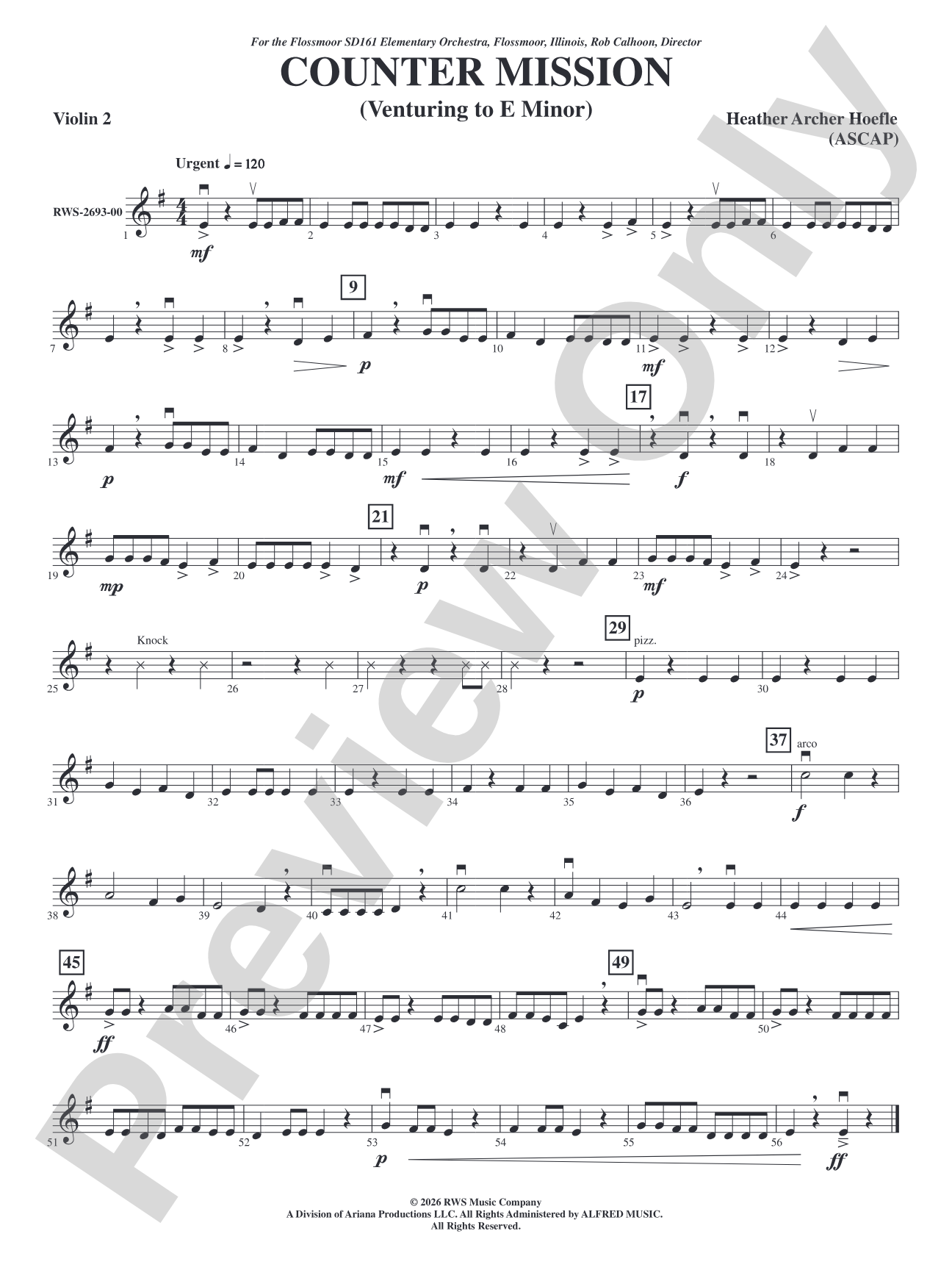
Counter Mission: 2nd Violin

By Heather Archer Hoefle

Grade: 1.5

Item: 98-PC-0000067_VN2

Digital Download
$3.00
Description
Take your string players on a thrilling mission into E Minor! Counter Mission: Venturing Into E Minor bursts with rhythmic accents and inventive instrument knocks, while cello and bass players get to shine with bold, memorable melodic lines that drive the music forward. Perfect for engaging both ensembles and audiences alike!

Counter Mission: 2nd Violin isn't in MakeMusic Cloud just yet...but it could be. Let us know you'd like to see it, and you'll help shape what comes next. In the meantime, start a free trial and dive into thousands of interactive titles your students can play along with today.

Sample Audio
0:00
0:00
Sample Video
Additional Details
Series: RWS - Beginning Strings
Publisher: RWS Music Company
SKU: 98-PC-0000067_VN2

More about this title

About the Composer: Heather Archer Hoefle

Heather Archer Hoefle has built a reputation for crafting accessible yet musically substantial works that capture the energy and engagement young musicians crave. Her compositions for beginning ensembles balance technical clarity with genuine artistic ambition, proving that Grade 1.5 literature doesn't have to be simplistic.

Why we love this

Counter Mission nails the sweet spot between challenge and playability. The rhythmic drive and instrumental knocks create immediate engagement from players and audiences, while the meaty cello and bass lines ensure your lower strings feel like they're carrying real musical weight rather than padding out harmony.

What to expect

Counter Mission pulses with restless energy and forward momentum. The instrumental knocks and rhythmic accents create texture and color that feels modern and engaging, while the E Minor tonality gives it a focused, almost dramatic edge that lifts it beyond generic beginner fare.

Who it's for

String orchestras at the Grade 1.5 level who are ready to tackle something with genuine character and rhythmic sophistication. This works equally well for groups preparing festival repertoire or those seeking concert material that holds audience attention without overwhelming young musicians.

How to get the most out of it

  • Shape those rhythmic accents with clear articulation in the upper strings; they're the heartbeat that makes the piece snap, so resist the urge to soften them.
  • Highlight the cello and bass melodies by allowing them slightly more voice in the mix during their featured passages. These players deserve to feel the impact of their lines.
  • The instrument knocks should land with intentional precision. Brief sectional work isolating the rhythmic figures prevents them from becoming sloppy or tentative.
  • Lock the ensemble into the E Minor tonality by anchoring on the tonic at key moments. Young players settle into pitch center faster when conductors emphasize harmonic landmarks.

How to use it

Pair this with contrasting lyrical material to showcase your ensemble's range, or lead a concert set with it to grab attention right away. Its festival credentials make it a natural choice for spring competitions, and the compact length means it slots easily between larger works.

Skills your students will build

  • Ensemble rhythmic precision and stylistic accent control
  • Reading accidentals and tonality within E Minor framework
  • Sustaining lyrical lines with proper tone projection (cello and bass)
  • Coordinating pitched and non-pitched articulation (instrument knocks)
  • Balancing section independence with unified ensemble sound

You May Also Like