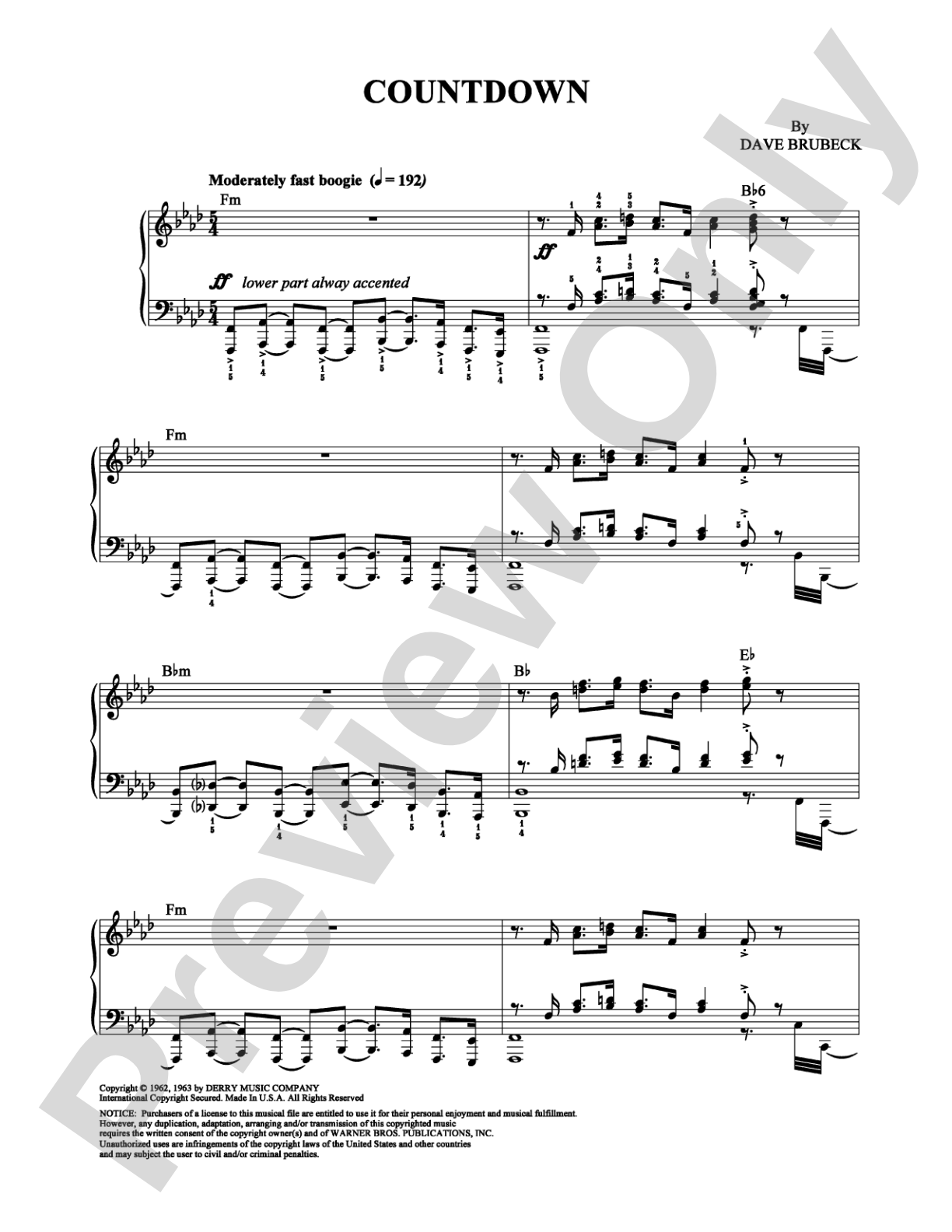
Countdown: Piano Digital Sheet Music

Countdown: Piano Digital Sheet Music

Dave Brubeck

Item: 00-PS-0000918

Digital Download
$3.99
Description

Countdown: Piano Digital Sheet Music isn't in MakeMusic Cloud just yet...but it could be. Let us know you'd like to see it, and you'll help shape what comes next. In the meantime, start a free trial and dive into thousands of interactive titles your students can play along with today.

Sample Audio
No sample audio found.
Sample Video
Additional Details
SKU: 00-PS-0000918

More about this title

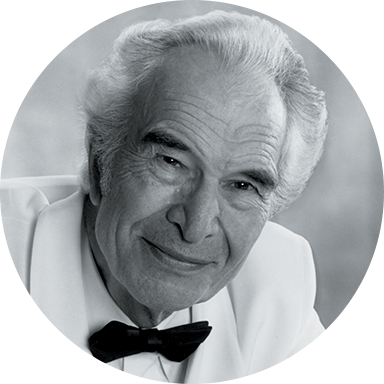
About the Artist: Dave Brubeck

Dave Brubeck

Dave Brubeck's career spanned decades as both a virtuoso pianist and prolific composer who seamlessly merged jazz vernacular with classical forms. His studies with Darius Milhaud at Mills College shaped a compositional voice that drew equally from bebop language and European traditions, resulting in works ranging from solo piano pieces to large-scale orchestral compositions, choral pieces, and ballets. Beyond his musical innovations, Brubeck was a trailblazer in breaking racial barriers during the mid-20th century, using his platform to advance social change.

His landmark 1959 album "Time Out" became the first jazz record to achieve platinum sales, anchored by the enduring standard "Take Five." Throughout his career, Brubeck's compositions were championed by major ensembles including the London Symphony Orchestra and performed internationally, from concert halls in Vienna to the National Cathedral in Washington, DC. His legacy extends across multiple generations of musicians, honored with a Grammy Lifetime Achievement Award, induction into the American Classical Music Hall of Fame in 2003, and the Presidential Medal of the Arts.

Why we love this

Brubeck's "Countdown" captures the sophisticated harmonic language and rhythmic precision that define his piano writing, offering pianists a chance to explore jazz composition through a master's lens. The piece balances improvisation-friendly structures with clear notational guidance, making it accessible to intermediate pianists while revealing layers of complexity that advanced players will mine for years. Programming this work alongside classical or contemporary repertoire signals to audiences that jazz composition operates at the same artistic level as any concert tradition.

What to expect

"Countdown" unfolds with the forward momentum of a jam session that has been carefully mapped, blending tight ensemble logic with the open air of exploration. Harmonically rich and rhythmically inventive, the piece invites you into Brubeck's creative world where precision and freedom coexist.

Who it's for

Pianists with solid intermediate technique who are ready to engage seriously with jazz composition and improvisation. This piece rewards musicians who can read fluently, listen critically to their own sound, and bring interpretive maturity to both composed and freely improvised sections.

How to get the most out of it

  • Study the harmonic progressions carefully before focusing on tempo; understanding Brubeck's chord movements will inform your phrasing and voicing choices more effectively than rushing through at performance speed.
  • Listen to Brubeck's own recordings to internalize the swing feel and rhythmic placement he favored, then trust your ear when notated articulation marks align with that sensibility.
  • Balance precision in the written passages with genuine spontaneity during marked improvisation sections; the score functions as a framework, not a cage.

How to use it

Feature "Countdown" as a centerpiece in a jazz-focused recital or as the anchor for a concert exploring American compositional voices across traditions. This piece also works powerfully in educational settings where students encounter Brubeck's work, providing a window into how a serious jazz composer thinks about form and harmony.

Skills your students will build

  • Reading and executing jazz chord symbols and voicings
  • Interpreting swing rhythm and jazz articulation in notated passages
  • Building harmonic awareness through Brubeck's sophisticated progressions
  • Balancing notated and improvised material within a composed framework

You May Also Like