
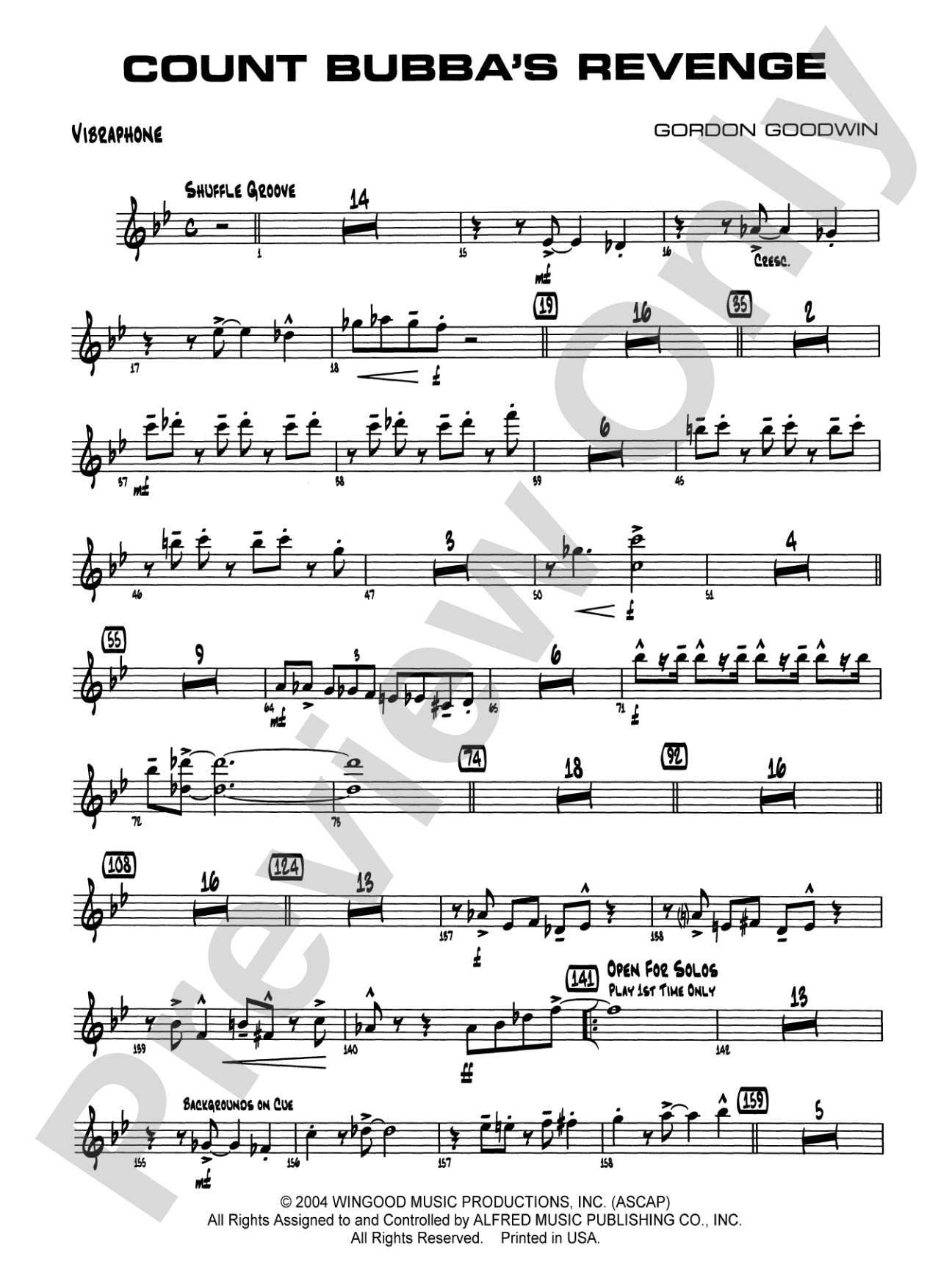

Count Bubba's Revenge: Vibraphone
By Gordon Goodwin
Grade: 5.5 (Advanced / Difficult)
Item: 00-PC-0017545_V
$3.00
Pickup currently not available
Description
Revenge is very sweet! Gordon Goodwin is the hot writer of today's big band charts and this arrangement proves it. Count Bubba's Revenge features a shuffle swing that builds and builds. On top of that, it showcases all the sections by trading back and forth, playing a cappella, and so on. Solo space is provided for tenor, bari, trumpet, trombone, and piano or guitar. Gordon is masterful at creating a chart that exudes energy and excitement, and this one delivers. Standard instrumentation---no doubles. (6:24) This title is available in MakeMusic Cloud.


Don't just read it, hear it, play along with it, and watch your students grow with it. In MakeMusic Cloud, Count Bubba's Revenge: Vibraphone comes alive with professional accompaniment, adjustable tempo, and built-in practice tools that turn solo practice into real progress.
Open in the Player
Jump straight in and assign it today.
Start Your Free Trial
Open this title and explore the full library in minutes.
Sample Audio
1
Audio File
--:--
0:00
0:00
Sample Video
Additional Details
Series:
Gordon Goodwin Series
Publisher:
Alfred Music
Page Count:
74
SKU:
00-PC-0017545_V
More about this title
About the Composer: Gordon Goodwin

Gordon Goodwin heard complete compositions in his head from childhood and began notating them before he could read or write music fluently. By thirteen, he had already written his first big band chart, Hang Loose, signaling a gift that would define his career. His work has earned three Emmy Awards and multiple Grammy nominations across television, film, and concert music; his orchestrations appear in scores ranging from Bad Boys II and Con Air to Remember the Titans and Star Trek: Nemesis. He has written for and performed alongside Christina Aguilera, Quincy Jones, Ray Charles, and many of the most celebrated voices in popular music.
In 2000, Goodwin founded Gordon Goodwin's Big Phat Band, establishing himself as a bandleader and orchestrator of contemporary big band jazz. The ensemble's debut album, Swingin' for the Fences, made history as the first commercially released DVD audio title and earned two Grammy nominations. His subsequent records, including the triple-nominated XXL, cement his status as one of the most prolific and honored big band writers of the twenty-first century.
Why we love this
Goodwin's mastery lies in his ability to build unstoppable momentum; Count Bubba's Revenge opens with a shuffle swing and escalates systematically, keeping ensembles and audiences engaged throughout. The chart's architecture distributes solos across every section (tenor, bari, trumpet, trombone, and keyboard), ensuring that every player has a moment to shine while maintaining cohesive ensemble energy. At Grade 5.5, it sits perfectly for advanced high school and college groups seeking sophisticated, contemporary big band literature that sounds both impressive and genuinely fun to perform.
What to expect
A propulsive, groove-driven journey that never stops gaining speed. The shuffle swing pocket invites the band to settle into deep pocket and build from there, with sections peeling off for a cappella moments before surging back together. Six and a half minutes of controlled intensity that feels crafted for both the stage and the rehearsal room.
Who it's for
Advanced high school and college jazz ensembles seeking contemporary big band literature with substance and star power. Directors preparing for festival competitions or concert showcases need a chart that demonstrates ensemble maturity, sectional independence, and soloist capability all at once.
How to get the most out of it
- Establish the shuffle swing subdivision early in rehearsal; this rhythm underpins the entire chart and needs to be locked before layering complexity.
- Use sectional trading passages to build confidence in smaller groups, then integrate them into the full ensemble so the back-and-forth dialogue lands cleanly.
- Feature your strongest soloists in their designated chairs (tenor, bari, trumpet, trombone, piano or guitar), but also use sectional rehearsals to prepare secondary options.
- Control the dynamic arc carefully; the chart builds by design, so resist the urge to play loud early. Let restraint in the opening sections make the climax genuinely impactful.
How to use it
Program this as a centerpiece for a big band concert or a festival set where you want to showcase both ensemble and individual artistry. Pair it alongside a ballad or swing standard to show range, or position it as a closer if you want to leave the audience energized.
Skills your students will build
- Sustaining shuffle swing groove over changing section dynamics
- Trading solos across sections (trumpet, trombone, saxophone, keyboard) with rhythmic precision
- Reading and executing a cappella passages with secure intonation
- Managing dynamic buildup and release across a multi-section arrangement
- Responding to sectional trading cues and maintaining ensemble cohesion through call-and-response writing