
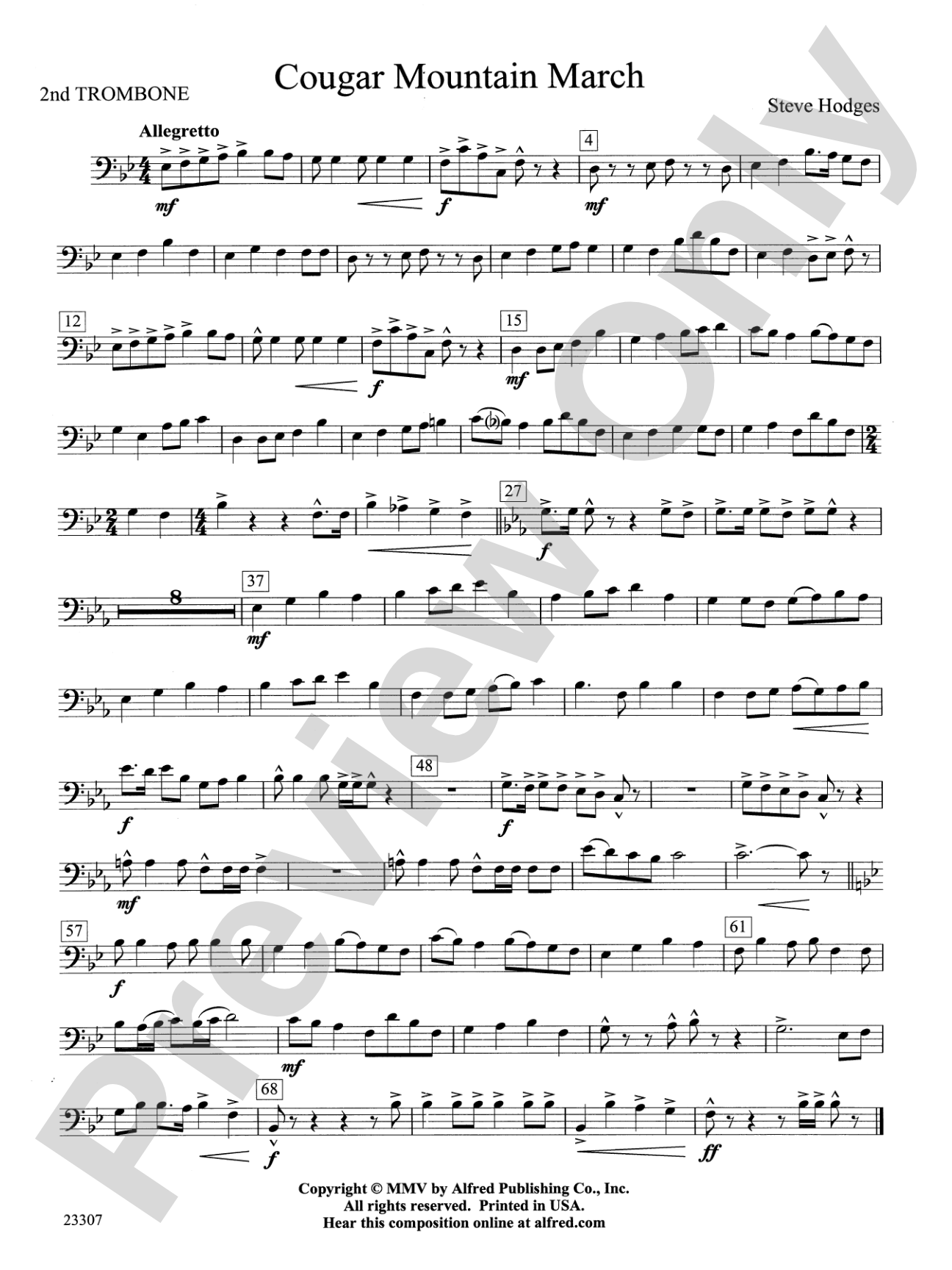

Cougar Mountain March: 2nd Trombone
By Steve Hodges
Grade: 2.5 (Medium Easy)
Item: 00-PC-0000657_TN2
$3.00
Pickup currently not available
Description
The entire band will enjoy working on this exciting new march by Steve Hodges. With bold introductions, spirited melodies and buoyant countermelodies the energy level will remain high during each performance of the piece. A perfect opener or closer to any concert! This title is available in MakeMusic Cloud.


Don't just read it, hear it, play along with it, and watch your students grow with it. In MakeMusic Cloud, Cougar Mountain March: 2nd Trombone comes alive with professional accompaniment, adjustable tempo, and built-in practice tools that turn solo practice into real progress.
Open in the Player
Jump straight in and assign it today.
Start Your Free Trial
Open this title and explore the full library in minutes.
Sample Audio
1
Audio File
--:--
0:00
0:00
Sample Video
No sample videos found.
Additional Details
Series:
Young Symphonic
Publisher:
Alfred Music
Page Count:
138
SKU:
00-PC-0000657_TN2
More about this title
About the Composer: Steve Hodges

Steve Hodges studied music education at Western Oregon University and Central Washington University, earning both his bachelor's and master's degrees. He spent four decades in public school music education, directing bands, choirs, and small ensembles at every level before retiring from full-time teaching.
Since 1986, Hodges has composed over 120 concert band works published by Alfred Music, along with choral arrangements released by Staff Music and Shawnee Press. His music has appeared at state conventions and festivals across North America and internationally, and his commissioned works have been performed by honor bands and schools from Virginia to British Columbia. His compositions have also been featured on TBS and ESPN programming. A member of ASCAP, Hodges remains active in community music in The Dalles, Oregon, where he continues to be delighted when his grandchildren share news of performing his pieces in their school bands.
Why we love this
Hodges writes with the confidence of someone who has spent decades in the rehearsal room. Cougar Mountain March balances accessibility with genuine musicality, offering strong countermelodies and structural interest that keep musicians engaged without demanding virtuosity. It's the kind of opener that builds confidence and energy from the first downbeat.
What to expect
Cougar Mountain March radiates optimism and forward motion. The bold opening announces itself with confidence while the spirited melodies dance above countermelodies that lock together like gears. From first note to last, the piece maintains an infectious energy that feels celebratory without becoming exhausting.
Who it's for
This march works well for bands in their second or third year of playing together, or for more experienced ensembles seeking accessible, energetic repertoire that doesn't require advanced technical facility. Directors will appreciate the straightforward arranging and robust scoring that allows parts to be doubled or adapted for smaller groups.
How to get the most out of it
- Shape the melodic lines with clear phrasing rather than treating them as note-reading exercises. The buoyant character depends on singers treating each phrase as a gesture, not a series of pitches.
- Balance the bold introductions with space for the spirited melodies to breathe. Let the momentum carry naturally rather than pushing artificially.
- Lock in rhythmic precision in the countermelodies early in rehearsal. Once the ensemble understands how each voice locks together, the arrangement's architecture becomes audible and satisfying.
- Use the recorded accompaniment (available separately) to build sectional confidence before full ensemble rehearsals, especially with younger or less experienced players.
How to use it
This is a natural choice for opening a concert. The piece establishes momentum and audience engagement immediately, setting a positive tone for everything that follows. It also works as an effective closer, leaving audiences with a sense of accomplishment and buoyancy.
Skills your students will build
- Maintaining consistent tempo and pulse through a march form
- Balancing melodic and countermelodic voices to create texture
- Executing clear articulation in fast-moving passages
- Reading and performing in multiple sections simultaneously
- Responding to dynamic contrast and sectional cueing