
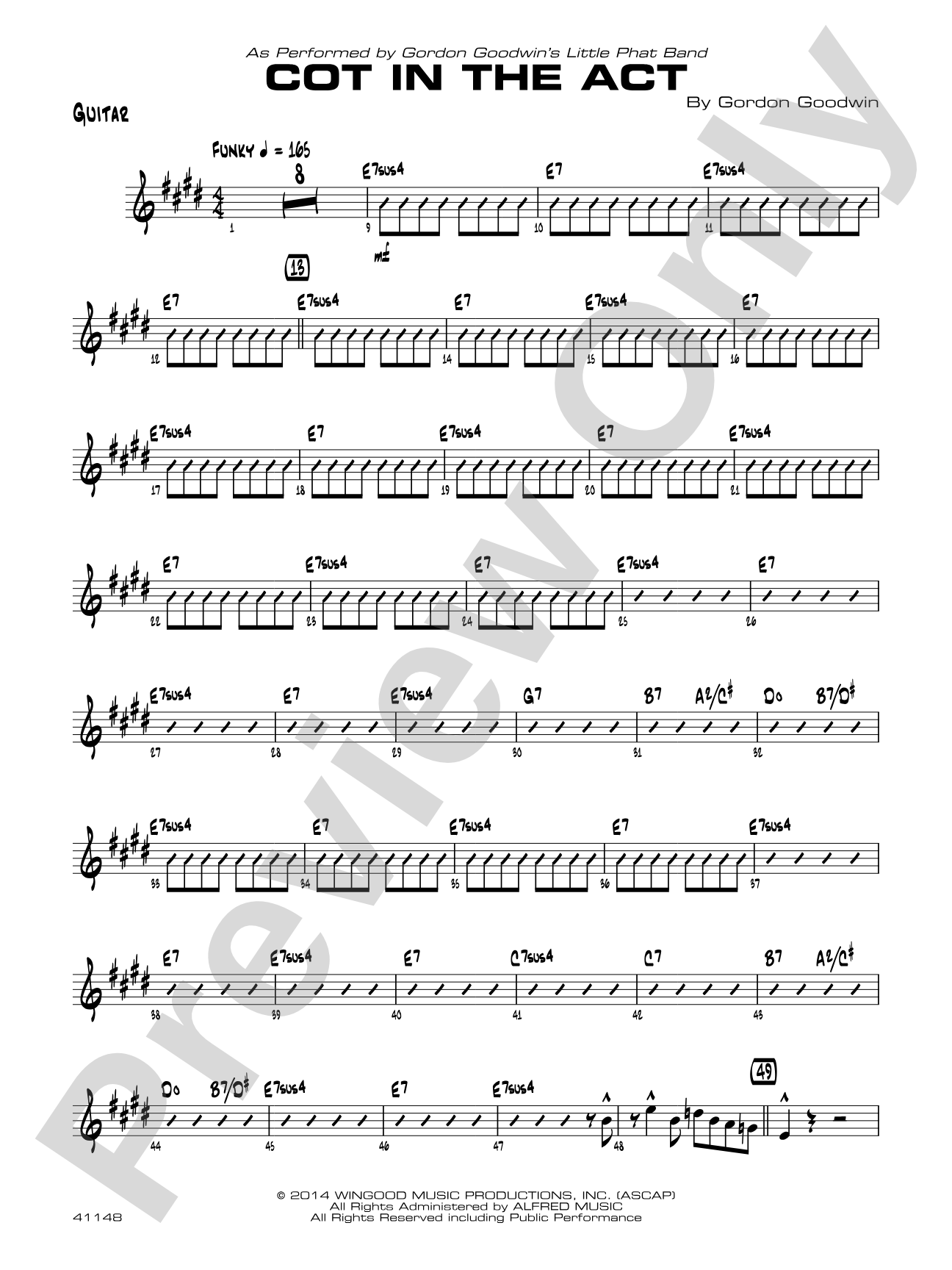

Cot in the Act: Guitar
As Performed by Gordon Goodwin's Little Phat Band
By Gordon Goodwin
Grade: 5 (Advanced / Difficult)
Item: 00-PC-0016284_G
$3.00
Pickup currently not available
Description
Funky with a very hip piano intro! Little band instrumentation is for tenor, trumpet, trombone, piano, bass, guitar, and drums. This chart includes solo space for all. (2:16) This title is available in MakeMusic Cloud.


Don't just read it, hear it, play along with it, and watch your students grow with it. In MakeMusic Cloud, Cot in the Act: Guitar comes alive with professional accompaniment, adjustable tempo, and built-in practice tools that turn solo practice into real progress.
Open in the Player
Jump straight in and assign it today.
Start Your Free Trial
Open this title and explore the full library in minutes.
Sample Audio
1
Audio File
--:--
0:00
0:00
Sample Video
No sample videos found.
Additional Details
Series:
Gordon Goodwin Little Phat Band Series
Publisher:
Alfred Music
Page Count:
34
SKU:
00-PC-0016284_G
More about this title
About the Composer: Gordon Goodwin

Gordon Goodwin has been composing music since age five, writing complete pieces rather than fragments from the beginning. His first big band chart, Hang Loose, arrived when he was just thirteen, establishing a trajectory that would lead to three Emmy Awards and multiple Grammy nominations across television, film, and concert music. His film and television work spans scores for Bad Boys II, Con Air, Gone in 60 Seconds, Remember the Titans, Star Trek: Nemesis, and Armageddon, among others.
Goodwin has written for and performed alongside major artists including Christina Aguilera, Quincy Jones, Ray Charles, and David Foster. He has conducted leading symphony orchestras in Atlanta, Dallas, Utah, Seattle, Toronto, and London. Since 2000, he has led Gordon Goodwin's Big Phat Band, a Los Angeles-based ensemble that redefined contemporary big band jazz. His recordings have earned Grammy recognition and pioneered new formats in the jazz recording industry.
Why we love this
Goodwin writes jazz charts that balance immediate accessibility with genuine sophistication. The funky hip piano intro hooks listeners instantly while the solo space for every player ensures every section gets to contribute something meaningful. Grade 5 doesn't mean inaccessible; it means the chart respects your ensemble's abilities and asks them to play at their best.
What to expect
Fresh and funky right out of the gate with that distinctive piano intro, then settles into a groove that feels modern and hip without losing the swing underneath. Every solo space invites personality; the piece crackles with the energy of musicians who know they can play.
Who it's for
Advanced high school or community jazz ensembles ready to tackle material with real depth and contemporary edge. Each player needs solid fundamentals and comfort improvising or interpreting solo space, and the ensemble must have a drummer and bassist who can lock in tight.
How to get the most out of it
- Lock the piano intro with the rhythm section first. The pocket depends on the drummer locking with the bass and the pianist setting the harmonic and rhythmic anchor that everything else hangs from.
- Give soloists clear section boundaries and let each one establish their own voice. Goodwin writes for distinct personalities, so soloists should shape their sections with full ownership rather than playing it safe.
- Balance the hip factor against clarity. The funky elements draw the ear, but make sure all the inner voices cut through in the ensemble sections. Adjust dynamic balance in rehearsal rather than relying on the written dynamics alone.
- Use the recorded accompaniment or reference recording to lock the groove reference, then rehearse without it. Your band needs to feel confident owning the pocket themselves.
How to use it
This works beautifully as a centerpiece for a jazz concert or as a late-set opener that lifts the energy and shows off your band's modern sensibilities. It pairs well alongside more traditional big band charts to demonstrate the breadth of the jazz canon your ensemble commands.
Skills your students will build
- Reading and performing contemporary jazz vocabulary and phrasing
- Building and sustaining a groove with the rhythm section
- Solo improvisation or interpretation over defined chord changes and section boundaries
- Ensemble balance in a small-group jazz setting with active comping and counter-lines
- Listening and responding to other soloists' phrasing and energy in real time