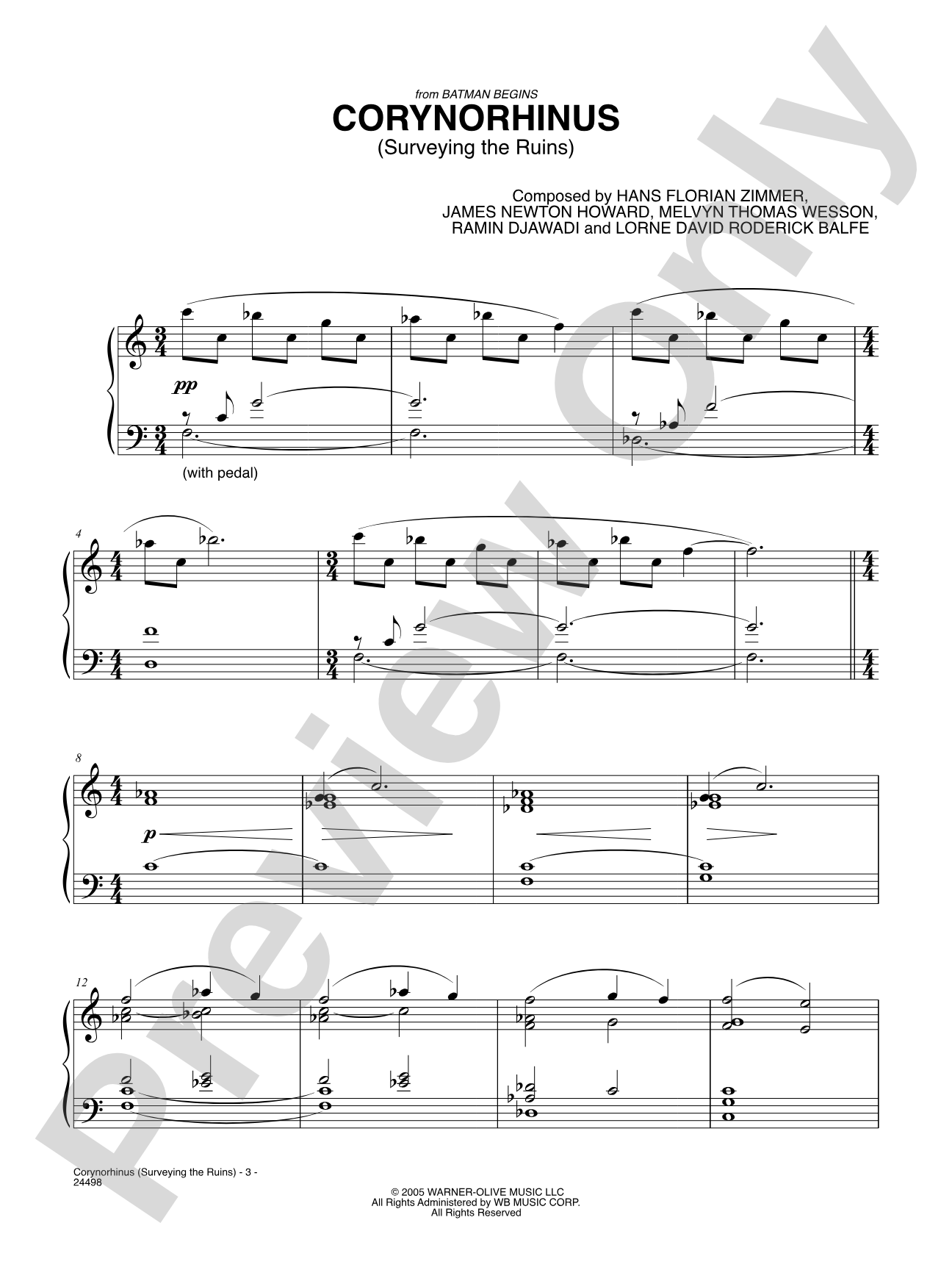
Corynorhinus (Surveying the Ruins) (from Batman Begins): Piano
Music by Hans Zimmer, James Newton Howard, Melvyn Thomas Wesson, Ramin Djawadi, and Lorne David Roderick Balfe
Item: 00-XIP-000196
Digital Download
$3.99
Pickup currently not available
Description
Alfred is pleased to present the sheet music for "Corynorhinus (Surveying the Ruins)," from the "Batman Begins" soundtrack. This sheet music provides the song's piano and chord arrangements.
Discover MakeMusic Cloud: thousands of interactive titles your students can play along with today.
Hans Zimmer stands among contemporary cinema's most influential composers, with a career spanning over four decades and scores for more than 150 films. His work across genres from science fiction to crime thrillers to historical epics demonstrates a rare ability to create memorable, emotionally resonant music that serves the narrative while standing on its own as composition. Zimmer's approach to orchestration and his integration of electronic and acoustic elements have shaped modern film scoring and influenced a generation of composers working in media.
Why we love this
This piece captures the psychological tension of Batman Begins with restrained, architecturally precise writing that rewards careful listening. The chord progression and sparse textures translate beautifully to solo piano, making it accessible for intermediate players while maintaining the cinematic weight of the original. Programming this in a recital or concert gives pianists and vocalists the chance to explore how film composers build atmosphere through harmonic economy rather than orchestral excess.
What to expect
Corynorhinus evokes a kind of atmospheric unease that is more cerebral than dramatic. The music hovers in shadows, suggesting observation and calculation rather than action. There is a contemplative quality to the harmonic movement, a sense of something vast and damaged being examined piece by piece. The piano writing mirrors this introspection, with enough space between musical ideas to let the listener's imagination fill the gaps.
Who it's for
This arrangement suits pianists and vocalist-pianists at the intermediate level who are interested in film music and enjoy working with contemporary harmonic language. It offers a refreshing alternative to standard art song or popular song repertoire while remaining approachable without simplification. Solo pianists will find it rewarding for recital programming; vocalists will appreciate the psychological depth it brings to a concert set.
How to get the most out of it
Treat silence and space as actively as you treat the notes; the drama lives in what you don't play as much as what you do.
Shape the vocal line with restraint, avoiding oversinging. Let the minor tonality and harmonic movement carry the emotional work.
Balance the chord voicings so the melody emerges clearly; resist the urge to fill every moment with accompaniment density.
Pay close attention to the piece's pacing. Zimmer's style often relies on subtle shifts in texture and dynamics rather than tempo changes, so your control of rubato becomes essential.
How to use it
This works exceptionally well in a concert exploring contemporary film composition alongside classical or art song repertoire, creating an interesting dialogue about how different eras approach understatement and harmonic color. It also serves well as an opening or interlude piece, offering audiences a moment of psychological depth before or after more extroverted works. Consider pairing it with other character theme arrangements from major film scores to build a thematic concert around the craft of cinematic music.
Skills your students will build
Reading and performing sparse, minimalist textures with dramatic effect
Voicing jazz-influenced seventh and ninth chords with clarity and purpose
Controlling phrasing and dynamics to sustain interest across long harmonic spaces
Collaborating between vocalist and pianist to balance melody against atmospheric accompaniment
You May Also Like
Scan to Complete Your Purchase
Use your phone's camera to scan the code below
You'll log in on your phone and the order will be added to your account