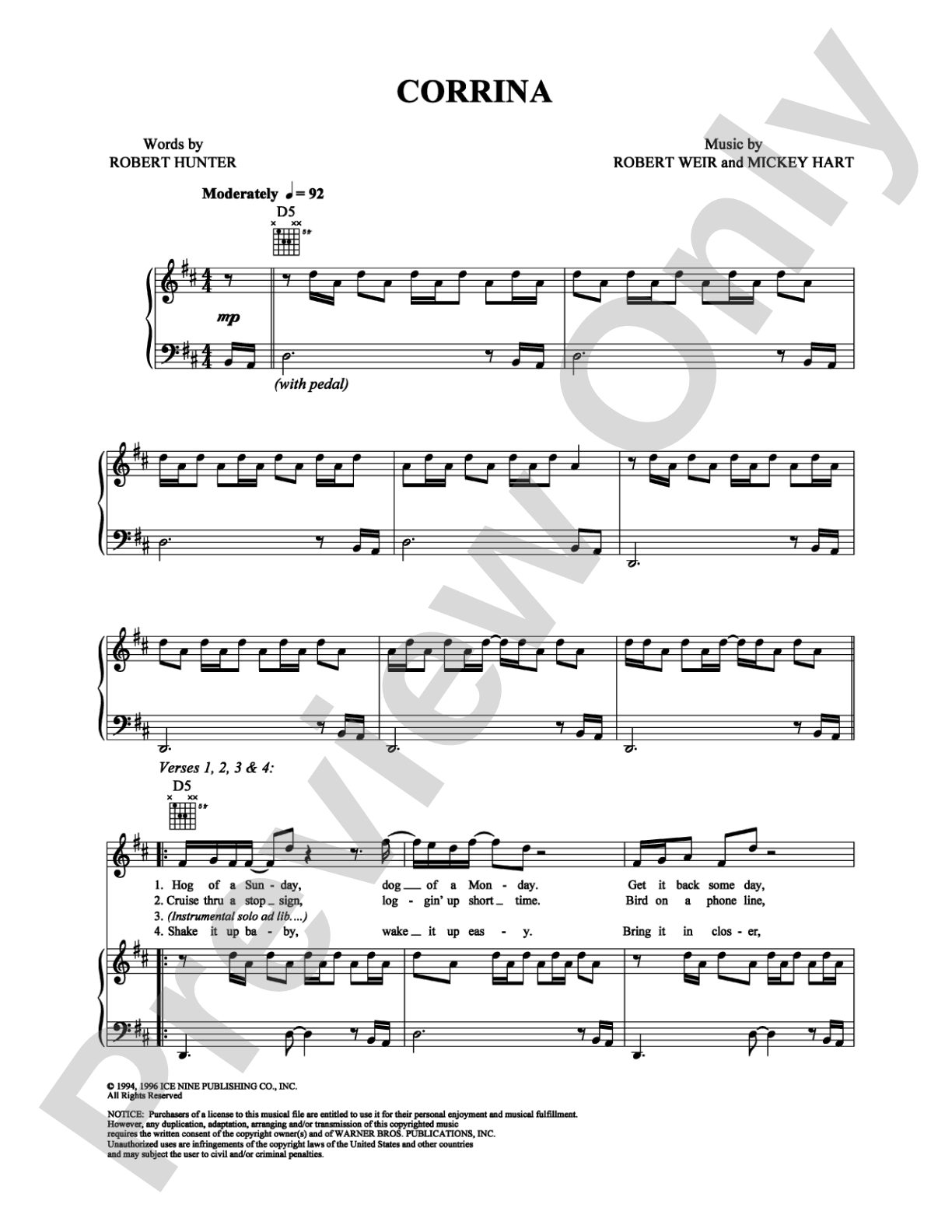
Corrina: Piano/Vocal/Chords Digital Sheet Music

Corrina: Piano/Vocal/Chords Digital Sheet Music

Grateful Dead, Bob Weir, Mickey Hart

Item: 00-PS-0004621

Digital Download
$2.95
Description

Corrina: Piano/Vocal/Chords Digital Sheet Music isn't in MakeMusic Cloud just yet...but it could be. Let us know you'd like to see it, and you'll help shape what comes next. In the meantime, start a free trial and dive into thousands of interactive titles your students can play along with today.

Sample Audio
No sample audio found.
Sample Video
Additional Details
SKU: 00-PS-0004621

More about this title

About the Artist: Grateful Dead

The Grateful Dead emerged from the San Francisco Bay Area in the mid-1960s as pioneers of psychedelic rock and improvisational live performance. Led by Jerry Garcia, the band built a legendary career spanning three decades through relentless touring and a deep commitment to musical exploration. Their influence on American rock music, jam band culture, and fan community engagement remains unmatched; their catalog spans blues, folk, country, and rock traditions woven together with intricate musicianship and adventurous arrangement.

For music educators and performers, the Grateful Dead represent an essential touchstone in contemporary American music. Their songs reward close listening and serious study, offering rich harmonic possibilities, interesting lyrical narratives, and performance approaches that emphasize both precision and spontaneity. Teaching and performing their work opens conversations about song interpretation, ensemble listening, and the cultural significance of rock music in education.

Why we love this

Corrina sits at the intersection of folk tradition and rock energy, giving performers a song that sounds deceptively straightforward but reveals harmonic depth on repeated playing. The melody and chord progression create natural opportunities to explore phrasing, dynamics, and the relationship between accompaniment and vocal line. For mixed-ability ensembles and solo vocalists alike, this arrangement respects the song's character while remaining accessible.

What to expect

Corrina carries a wistful, narrative quality; the melody feels both intimate and driving, pulled between reflection and momentum. The arrangement grounds the performance in clear harmonic support while leaving room for the vocalist's interpretation and feeling to shape each phrase.

Who it's for

Vocalists preparing rock and pop repertoire for recitals, auditions, or casual performance will find a song that bridges traditional and contemporary styles. Pianists accompanying singers gain experience with the specific voicings and rhythmic flexibility that rock-based arrangements require. Students exploring American song traditions benefit from studying how folk melodies and structures translate into contemporary popular music.

How to get the most out of it

  • Listen closely to how the chord changes support the vocal melody in the second verse; letting the accompaniment breathe slightly before each lyric will clarify the song's harmonic movement.
  • Build the energy across verses rather than holding the same intensity throughout; dynamics here serve the storytelling more than technical display.
  • The guitar-influenced chord voicings in this arrangement suggest letting some notes ring slightly longer than you might in classical playing; this approach honors the original's sonic character.

How to use it

Include this in a recital that mixes classical and contemporary repertoire, pairing it with other American song traditions to show how rock music connects to folk and blues roots. It works equally well as a solo feature or as part of a larger set exploring Grateful Dead compositions and their influence on American musicianship.

Skills your students will build

  • Reading piano/vocal/chord notation and translating chord symbols into voicings
  • Phrasing and lyrical interpretation in a rock or pop context
  • Coordinating vocal line with rhythmic accompaniment patterns
  • Understanding harmonic progressions built on seventh chords and extensions
  • Balancing accompaniment dynamics to support rather than overshadow the vocal melody

You May Also Like