
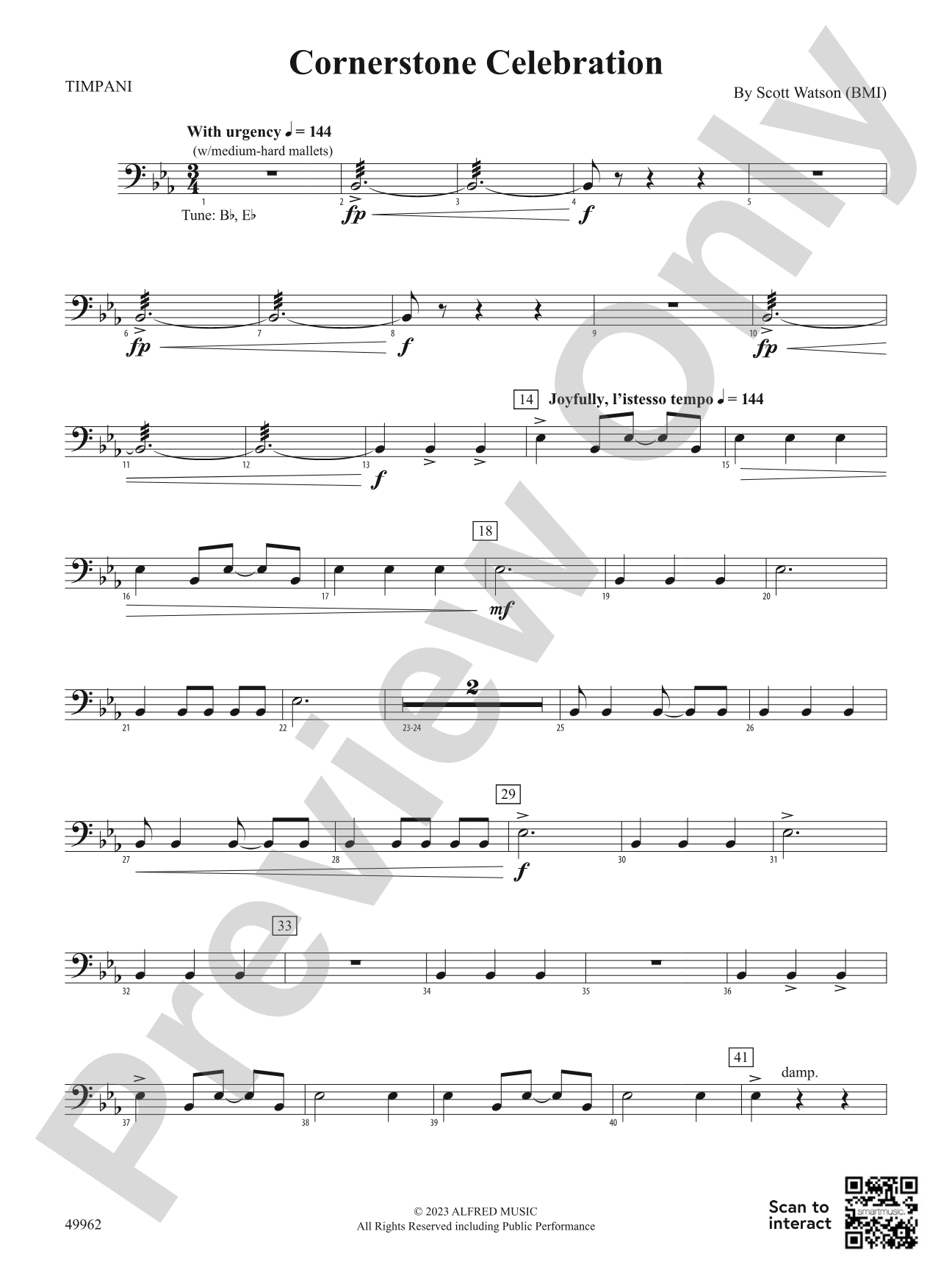

Cornerstone Celebration: Timpani
By Scott Watson
Grade: 1
Item: 00-PC-0019028_TMP
$3.00
Pickup currently not available
Description
Cornerstone Celebration, by Scott Watson, is a musical outpouring of joy and gladness aimed at portraying what's best about the communities in which we live. Written in 3/4 meter, exploiting the Mixolydian mode, and employing a compelling, syncopated rhythm throughout, this piece will surely bring exciting and rewarding new sounds to your band. (2:20) (Correlates to Sound Innovations, Book 1, Level 6.)


Don't just read it, hear it, play along with it, and watch your students grow with it. In MakeMusic Cloud, Cornerstone Celebration: Timpani comes alive with professional accompaniment, adjustable tempo, and built-in practice tools that turn solo practice into real progress.
Open in the Player
Jump straight in and assign it today.
Start Your Free Trial
Open this title and explore the full library in minutes.
Sample Audio
1
Audio File
--:--
0:00
0:00
Sample Video
Additional Details
Series:
Sound Innovations for Concert Band
Publisher:
Alfred Music
SKU:
00-PC-0019028_TMP
More about this title
About the Composer: Scott Watson

Scott Watson has shaped music education across multiple roles and decades. As Director of Bands at Allentown's Parkland High School and later as coordinator of the district's elementary band and strings program, he taught instrumental music for 35 years while establishing himself as a prolific composer. His body of work spans more than 120 published pieces for concert band, string orchestra, and chamber ensembles at every level, drawing equally from his knowledge of contemporary classical music and the practical realities of the rehearsal room.
Now Associate Professor of Music at Cairn University, Watson continues to compose, guest conduct, and lead clinics for music educators nationwide. His work has reached international audiences and been performed at venues including the Academy of Music in Philadelphia, the Midwest Clinic in Chicago, and the White House. He serves as exclusive composer and clinician for Alfred Publications and authored the music education text "Using Technology to Unlock Musical Creativity" (Oxford University Press, 2011).
Why we love this
Watson writes for the actual band in your room, not the one in his head. The Mixolydian mode and syncopated rhythmic drive give this piece distinctive color without requiring virtuosity, and the 3/4 meter in a Grade 1 context feels fresh compared to the typical march-time fare. At just over two minutes, it's proportional enough to program meaningfully yet short enough to absorb quickly into rehearsal time.
What to expect
The piece radiates optimism grounded in community rather than bombast. Syncopated rhythms propel the music forward with a modern sensibility, while the Mixolydian mode creates an unexpected harmonic flavor that catches the ear. The overall effect is celebratory but never saccharine: this is music about real people and real places.
Who it's for
Grade 1 bands with solid fundamentals in basic meter and rhythm reading will find this piece immediately rewarding. Directors seeking contest or festival material that sounds confident and contemporary without excessive technical demands will appreciate how Watson delivers genuine musicality at an accessible level.
How to get the most out of it
- Lean into the syncopated rhythms as a unified section; this piece thrives when the band commits to the groove rather than playing it cautiously. Mark the syncopated figures in your parts so every player knows where their line sits relative to the beat.
- Exploit the Mixolydian mode's characteristic flatted seventh degree by letting woodwind colors shine in passages where that note appears. It's a teaching moment about modal color built right into the piece.
- Balance the 3/4 meter with a tempo that feels natural and conversational, not mechanically counted. The piece should breathe like a celebration, not march through one.
How to use it
This works as a centerpiece for a spring concert program, standing easily among more conventional Grade 1 pieces yet offering something stylistically distinct. Its festival-ready quality also makes it valuable for invitational contests where you want a piece that represents your band's musicianship and character in just over two minutes.
Skills your students will build
- Reading and performing in 3/4 meter with consistent accuracy
- Executing syncopated rhythmic figures as an ensemble
- Understanding and hearing modal harmonic color (Mixolydian mode)
- Balancing individual part independence with section blend
- Maintaining groove and forward momentum in an unfamiliar meter