Corelli: Twelve Sonatas, Op. 5 (Volume II) Sheet Music Preview

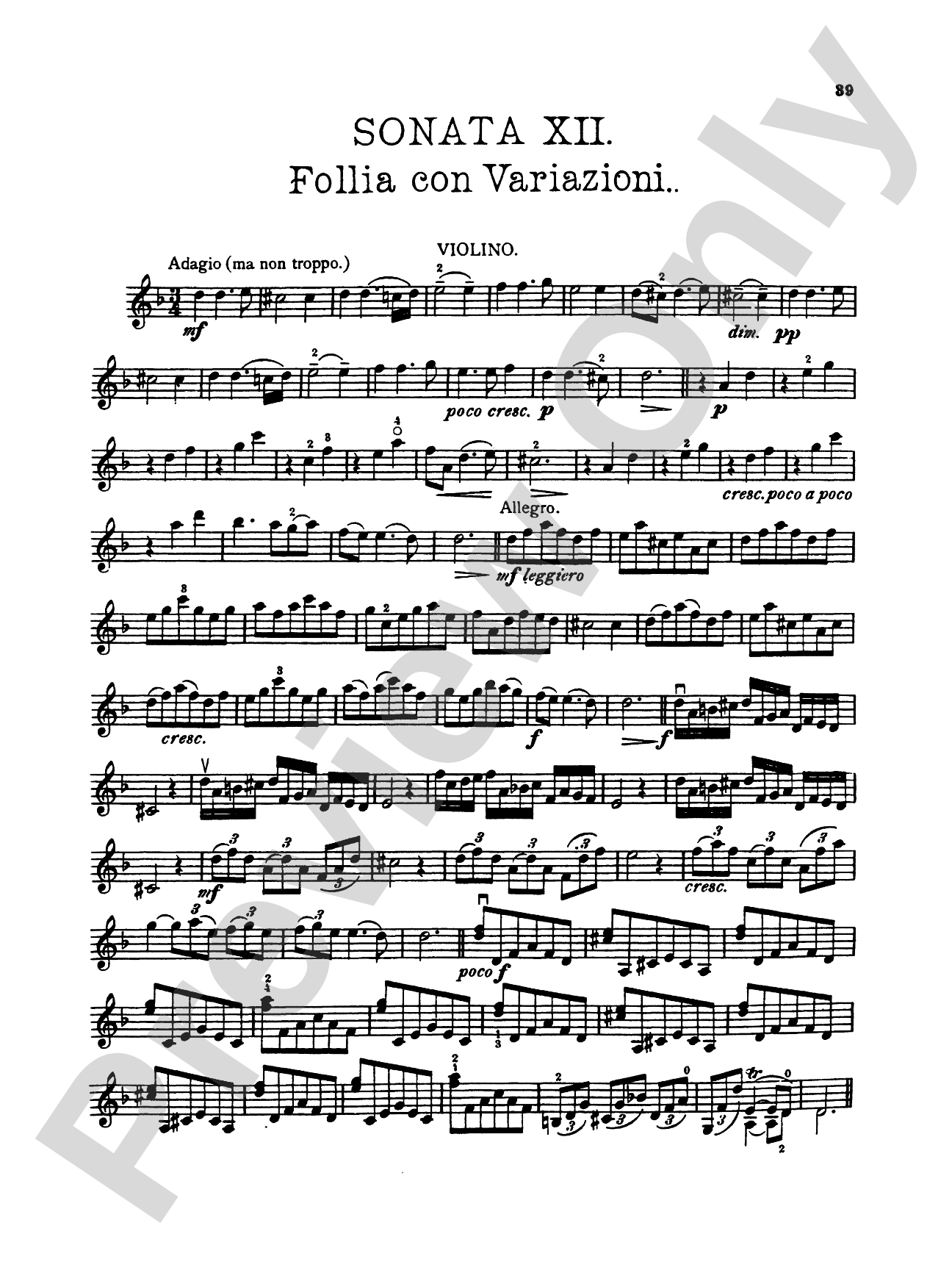
Corelli: Twelve Sonatas, Op. 5 (Volume II)

By Arcangelo Corelli

Item: 00-PC-0010381

Digital Download
$0.99
Description
Nos. 7-12

Don't just read it, hear it, play along with it, and watch your students grow with it. In MakeMusic Cloud, Corelli: Twelve Sonatas, Op. 5 (Volume II) comes alive with professional accompaniment, adjustable tempo, and built-in practice tools that turn solo practice into real progress.

Sample Audio
No sample audio found.
Sample Video
Additional Details
Series: Kalmus Edition
Publisher: Alfred Music
Page Count: 72
SKU: 00-PC-0010381

More about this title

About the Composer: Arcangelo Corelli

Arcangelo Corelli (1653-1713) was an Italian violinist and composer whose sonatas established the violin as a solo instrument of genuine virtuosity and expressive depth. Working in Rome during the late Baroque, he codified the sonata da chiesa form and created a body of work that became the foundation for all subsequent violin pedagogy. His twelve opus numbers were studied by nearly every violinist who followed, and they remain essential repertoire for understanding how the instrument evolved from accompanying role to musical protagonist.

Why we love this

These six sonatas represent Corelli at his most mature, with writing that balances technical brilliance against profound lyricism. The Kalmus edition provides clean, accessible notation that honors the original while remaining practical for today's violinists, making these masterworks genuinely playable rather than antiquarian exercises. Programming Volume II signals serious artistic ambition and rewards both accomplished students and professional musicians with music that sounds as moving in performance as it is instructive to learn.

What to expect

Corelli's writing unfolds with clarity and emotional directness, balancing passages of genuine virtuosity with moments of profound stillness. The fast movements shimmer with repeating figures and confident arc; the slow movements invite the violinist to sing with an intimacy that feels less like display and more like candid conversation. Throughout, there is a sense of architectural proportion, where each movement knows exactly where it is going and how long it will take to arrive.

Who it's for

This volume is aimed at accomplished violinists pursuing serious repertoire study, whether advanced high school students, college music majors, or teachers building a sustainable recital practice. Pianists accompanying these sonatas need secure sight-reading skills and familiarity with Baroque harmonic conventions. Both performers should approach these works with the understanding that Corelli's syntax is grammatically rigorous and rewards careful score study before rushing into performance.

How to get the most out of it

  • Approach the slow movements as opportunities for long-line singing rather than mere ornamentation; Corelli's harmonic foundation supports sustained phrasing without excessive vibrato or rhythmic fussiness.
  • Use the fast passages to cultivate even, articulate bow control; rapid note sequences demand clarity without sacrificing the legato flow that defines the Baroque style.
  • Balance the weight between violin and piano carefully, especially in sections where the keyboard provides essential harmonic grounding; neither instrument should dominate unprompted by the musical texture.
  • Study the figured bass or continuo part with your pianist; understanding the harmonic language underneath the melodic line deepens interpretation and ensures secure harmonic support throughout.

How to use it

These six sonatas work exceptionally well as a full recital program or as substantial pairing with later Baroque works by Vivaldi, Bach, or Leclair. They also serve as historical anchors in survey concerts tracing the development of the violin sonata from Corelli through the Classical period. Consider programming individual sonatas among works of different eras to highlight how Corelli's formal clarity influenced everything that followed.

Skills your students will build

  • Baroque articulation and phrasing conventions
  • Extended range work across all four strings
  • Rapid passagework with rhythmic precision and legato integrity
  • Harmonic literacy and voice-leading awareness
  • Cantabile slow-movement technique without excess vibrato
  • Collaboration with continuo-based accompaniment
  • Structural analysis of multi-movement sonata design

You May Also Like