
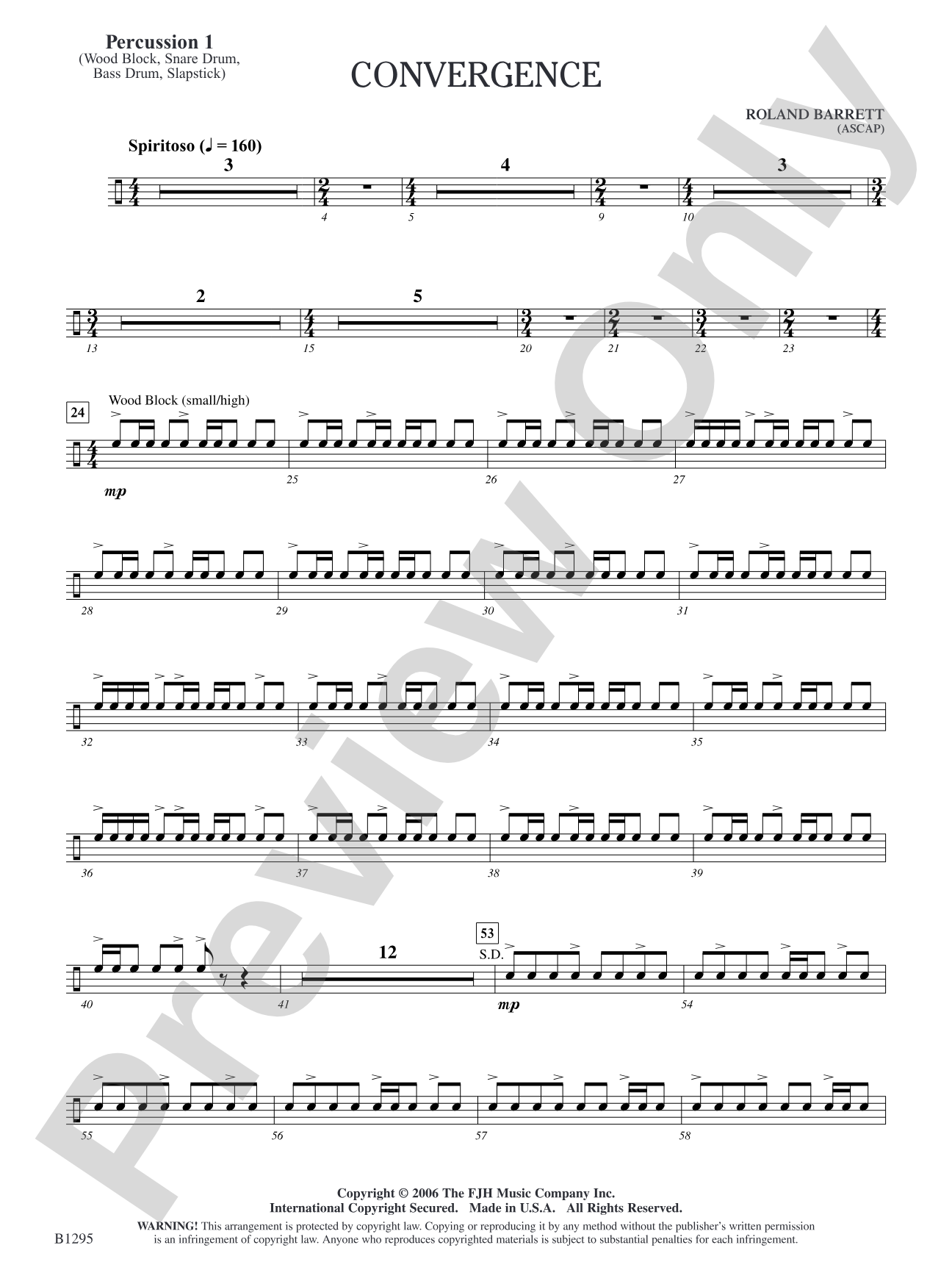

Convergence: Percussion 1
By Roland Barrett
Grade: 4
Item: 98-PC-DB1295_PC1
$7.00
Pickup currently not available
Description
Explosive fanfares and woodwind flourishes set the pace for this high-energy work that celebrates the boundless spirit created by the convergence of cultures, beliefs, and ideals. The main theme is first stated by piccolo before reiterated by full ensemble. Oboe or English horn is showcased in the lyrical section that features intimate chamber playing and sweeping melodic lines. As the final section builds, the opening fanfare returns under a fierce woodwind ostinato. Outstanding!


Discover MakeMusic Cloud: thousands of interactive titles your students can play along with today.
Sample Audio
1
Audio File
--:--
0:00
0:00
Sample Video
No sample videos found.
Additional Details
Series:
FJH Concert Band
Publisher:
The FJH Music Company, Inc.
SKU:
98-PC-DB1295_PC1
More about this title
About the Composer: Roland Barrett

Roland Barrett holds a faculty position at the University of Oklahoma, where he teaches music theory and composition with a specialization in 20th-century techniques. Before joining the university in 2001, he spent fifteen years as Assistant Director of Bands, giving him deep insight into what concert and marching ensembles need to succeed.
Barrett's catalog includes more than two hundred published works and arrangements across symphonic band, chamber music, and marching band contexts. His music has been commissioned by All-State and All-Region honor bands, aired on NPR, and performed by the Dallas Wind Symphony. He continues to arrange for the Pride of Oklahoma marching band and is a multiple recipient of the ASCAP Plus award.
Why we love this
Convergence delivers exactly what Grade 4 bands need: a structurally clear piece that builds genuine excitement without relying on sustained technical difficulty. The piccolo-led theme statement followed by full ensemble restatement gives young players immediate ownership of the main idea, while the chamber-style oboe or English horn section offers a refreshing contrast that keeps the ensemble engaged throughout. The return of the opening fanfare over a woodwind ostinato creates a satisfying climax that rewards rehearsal time and sounds impressive in performance.
What to expect
Convergence opens with brilliant fanfare energy, then shifts into an intimate, song-like moment that invites the band to breathe and listen to one another. The return to full force in the final section feels inevitable and earned, building from the opening material into something more complex and forceful. It's a piece that celebrates the ensemble's collective sound while honoring individual voices.
Who it's for
Grade 4 concert bands with solid fundamentals and the stamina to manage a multi-sectional work. The lyrical oboe passage demands a musician comfortable with sustained lyricism, though the role could be covered by English horn if needed. This piece works well for ensembles preparing for festival or contest performance.
How to get the most out of it
- Nail the entrance of that piccolo theme. It sets the entire piece's character. Work it in sectionals first so the winds lock in before full-ensemble readings.
- Balance the lyrical section carefully. The oboe (or English horn) solo shouldn't disappear into the harmonic texture. Have the supporting voices play at a dynamic level that lets the soloist breathe and phrase naturally.
- The final section's woodwind ostinato can easily obscure the returning fanfare. Rehearse the brass separately on the rebuilt opening statement, then layer in the woodwinds at reduced volume until the brass can cut through cleanly.
- Don't rush the tempo as energy builds. The piece's impact depends on controlled intensity, not speed. Mark a tempo and hold it steady through the final fanfare.
How to use it
Open a concert with Convergence to set an energetic tone, or use it as a closing number if you want to send audiences out on an uplifting note. It pairs well with lyrical or contrasting pieces, since its own internal arc (fanfare-lyrical-climax) gives it programming flexibility. Festival and contest settings are a natural fit given its structural clarity and satisfying musical payoff.
Skills your students will build
- Executing stylistic contrasts between energetic fanfare writing and sustained lyrical passages
- Tuning and balancing a woodwind section during fast, parallel passages
- Maintaining ensemble cohesion while individual sections carry melodic material
- Reading and executing rhythmic figures common in contemporary band composition
- Shaping a long-line phrase within a chamber ensemble context